Tuesday, December 6, 2022

WHAT DID I JUST SEE?!


The British Film Institute poll a group of 1,639 cineastes every decade to build a list of the 100 best films of all time.  Ten years ago, it was a big deal when Alfred Hitchcock's Vertigo knocked perennial favorite Citizen Kane off the top spot on the list.  But that's nothing compared to what happened to the top spot on this year's poll.    Oh boy, is there a big change: shooting up from #35 last decade, the number one film now is the Belgium film Jeanne Dielman, 23 Quai du Commerce, 1080 Bruxelles.  This marks the first time that the number one film was one that was  directed by a woman.

As a person who curates a blog like this and who passionately loves to watch films from all eras, I felt a little humbled to realize that I had never even heard of writer director Chantal Akerman's film.  And then I found it available on HBO Max.  I set aside three and a half hours of time and watched it alone with intense interest.  And my reaction?  Well, let me first say that I like to think that I'm open to experimental films, and movies that play with conventional filmmaking styles.  I generally like directors like Jean Luc Goddard and Luis Bunuel. In other words, I expected something unusual and tried to open myself to the experience.

But this movie to me was almost completely unwatchable.  First, let's talk about the style, or really, its almost complete lack of any.  All of the shots in this film are at medium length without camera movement.  The takes are mostly very long with simple editing.  There's no soundtrack, and not much dialogue to speak of, and the sets are just normal, uninteresting looking locations.  Even the color of the film looks drab and lifeless, and there are some technical flaws, like a when a boom mike momentarily dips into a shot.  All of this might be alright if the story and acting were redeemable, but they aren't.  In fact, there hardly is a story.

Oh sure, one does slowly emerge, in dribs and drabs. Delphine Seyrig plays the titular character, a middle aged widow who lives with her son in a small apartment.  She sometimes turns tricks to get by.  Honestly, that description probably sounds a lot more interesting than what's on screen.  Most of this film consists of Jeanne working around her house in real time.  So we have an entire scene of a woman doing the dishes in a single take with her back to the camera.  Realize, there is no other sound on the soundtrack, no dialogue, no music, just the sound of her doing the dishes.  This goes on for five minutes.  In another scene we see her shine a pair of shoes in much the same way.  Again, this goes on for some very long minutes.  And what could be even more boring than that?  Later in the film she does both things again in the exact same way!  We also see her prepare two different meals, also in real time.

Things get even crazier in a later scene in the film in which Jeanne just sits completely still and silent in a chair.  Save for some traffic noises in the background, there is nothing in this scene to let us know that we're actually watching a film instead of staring at a photo.  Director Ackerman really seems to be daring the audience to keep watching, giving them nothing to hang on to.  It's the cinematic equivalent of wallpaper.  It beats Andy Warhol's Empire for movement, but only slightly.  The next scene seems to push Ackerman's dare to the audience even further when Jeanne picks up a neighbor's baby, which cries incessantly for a long period of time, again challenging the audience to remain seated and keep watching.

So what was Ackerman up to here?  Was she trying to make a point about the mundane nature of the average woman's life at that time?  By showcasing the small housekeeping tasks that Jeanne must engage in, is it glorifying her work, or shoving its difficulties in our faces so that we appreciate women like her more?  This has been called a feminist film, and I suppose it is (it even had an all female crew), but points about the hardships of "women's work" can be made without boring the audience. (I suppose the film's defenders would say that the boredom is the point, allowing the audience to experience the same challenges that Jeanne does).  And even if the point of the film is the difficult and repetitive nature of Jeanne's life, how does that explain the scene I mentioned before in which she sits motionless in a chair for a long period of time.  That she's finally resting, and the audience is supposed to rest with her?  I suppose, but that point could be made in far less time.

I should mention that there is some dialogue, and that the relationship between Jeanne and her son Sylvain (Jan Decorte) has some interesting moments, although even that is hurt by the fact that Sylvain talks and acts like a teenage boy but is played by the then 25 year old Decorte.  I haven't even mentioned much about Jeanne's life as a prostitute, but that's because, through out most of the film, it's incidental.  Most of the time we see her greet her client (with just a few words) walk him to her bedroom, and then cut to her later showing him out.  We never know how she feels about her clients, or how she wound up as a a prostitute in the first place.  (Does her son know?).  The film's ending (spoiler) finally shows her engaging in lifeless sex with one of her clients.  Afterwards she silently picks up a pair of scissors and stabs him in the throat.  The shock of the violence is jolting in a film that has been so lifeless up to this moment.  But there's no build up to her action, we see no real anger or rage in what she does.  Why does she stab this client?  Because she's so sick of her life that she wants to take it out on someone?  Or did he do something particularly horrible that we didn't see? Afterwards she sits in a chair, her hand covered in blood, unmoving for what seems like an eternity.  Her face is a blank mask, although she eventually drops her head, but even that gesture seems mild given what she's done.  Is she remorseful?  Excited?  Happy that she has forced a change into her life in the most dramatic way possible? We never really know.

Now that I have spent several paragraphs breaking down this film, I suppose that means that it is worthy of discussion, and I would encourage people to see it for themselves (although I imagine very few people will actually finish it!).  But I must strongly say that I think that the emperor has no clothes and that the BFI's choice of this as the best film ever seems like an absurd joke on the viewing public.  Oh sure, I understand that there is a big difference between critical tastes and popular ones, but I can't see how anyone could find this static film superior to Citizen Kane or Vertigo.  Or nearly every other film on the list for that matter.

Monday, April 4, 2022

CODA (2021)


CODA (DIR: SIAN HEDER) (SCR: HEDER, BASED ON LA FAMILLE BELIER, WRITTEN BY VICTORIA BEDOS, STANILAS CARRE DE MALBERG AND ERIC LARTIGAU)

While the most recent Oscar broadcast will go down in history as "that time when Will Smith slapped Chris Rock", there were a number of other interesting things that happened.  Ariana Debose became the first openly gay woman of color to win an award (Best Supporting Actress for WESTSIDE STORY), Troy Kotsur became the first deaf man to win an award (Best Supporting Actor for CODA), and, perhaps most interestingly for the future not only of the Oscars but for movies in general, CODA became the first Best Picture winner ever to  play on a streaming site (Apple+) before opening in only a few theaters.  Will streaming services soon be the only way to view certain Oscar winning films?  Obviously the theater owners of America aren't too thrilled about that prospect, but with moviegoers heading back into theaters more and more as the pandemic seems to wind down,  it has been  mostly the big blockbusters that have drawn a crowd.  It's clear that a low budget film like CODA is going to  be seen on small screens by most people, as foreign and independent films go the streaming route.  Personally, I think that that is a shame, given that I prefer those kinds of movies and enjoy seeing them on the big screen. Really, the pandemic just seemed to accelerate a growing trend of audiences only going to see big spectacle movies in the theaters and staying home for everything else.

In any event, CODA was a bit a of surprise winner, given that it was nominated for only 3 awards (Best Picture, Supporting Actor and Adapted Screenplay), while Jane Campion's Western THE POWER OF THE DOG was up for a whopping 12.  Add to that the fact that CODA is the rare Best Picture winner to not even get a Best Director nomination, and its victory seemed unlikely. But then Campion's more complicated film is a tougher sell than CODA, which tells a simple, moving story with likable characters.  So maybe a sweet film like CODA winning in a world coming out of a pandemic and looking for something uplifting isn't all that surprising after all.  In any event, CODA is such a good natured film, so openly trying to coax tears from its audience, that I found it hard to resist, even if I also think it was far from perfect. 

It tales the story of teenager Ruby (Emilia Jones) who lives with her father Frank (Kotsur), mother Jackie (Marlee Matlin) and older brother Leo (Daniel Durant).  Ruby is the only member of her family that isn't deaf.  They make a living fishing, with each family member helping out.  When Ruby joins the choir at school, her teacher, Bernardo (Eugenio Derbez) thinks she has potential and personally trains her while encouraging her to try out for a scholarship to a musical academy.  But her parents want her to stay with them and continue to help out with their struggling business.


Emilia Jones


CODA began as a French film (LA FAMILLE BELIER) released in 2014.  While the film was a hit in France, it sparked some controversy because deaf characters were sometimes portrayed by actors who weren't actually deaf.  When Sian Heder was brought it to adapt and direct an American version of the film, she made sure not to make the same mistake.  It didn't hurt that the first person she cast for the film was Marlee Matlin, the deaf actress who herself had won an Oscar back in 1986, and who is probably the  most famous deaf actor in Hollywood.  And for the crucial lead role of Ruby, Heder cast English born actress Jones, who spent months learning both sign language and how to fish.  The film was shot  on location in Gloucester, Massachusetts.  After it was debuted at the Sundance Film Festival in Utah, it was purchased by Apple for a festival record 25 million dollars.

In a way it's not surprising to me that Heder was not nominated for Best Director, given that, apart from some lovely shots of fishing boats, the direction here is far from striking.  Really, one get the impression that she knew that this film was fated to be seen mostly on smaller screens, so visuals are not a high priority here.  Still, the film does have a nice sense of place, with what seems to be a realistic depiction of the highs and lows of living life as a fishing boat worker.  Heder's script (for which she won a Best Adapted Screenplay award) tells the story well, but is often predictable; yes, there's a scene in which Ruby's brother is called a "freak" for being deaf, yes, the family eventually supports her singing dreams, and yes, it even ends with a group family hug.  All quite formulaic.    It also never explains just how the family overcomes their financial difficulties. 

So, to the extent that the film works, it works on the strength of its performances: Jones is very good here, capably carrying the film and playing a teen girl who's likable without being perfect (she does yell "I hate you!" at her parents at one point).  Plus she has a nice chemistry with Ferdia Walsh-Peelo as her boyfriend Miles.  And most of the rest of the cast is also very good, with Kotsur's earthy but soulful  performance as Ruby's dad being a standout (he pretty much won his Best Supporting Actor award for his enthusiastic signing about birth control in one scene.)  The one performance I didn't care for is Derbez as Ruby's music instructor; perhaps because the inspiring teacher character is such a cliche, Derbez's performance and the script seem to play up his more eccentric behavior, making him too over the top for my taste. 

SO DID THE ACADEMY GET IT RIGHT?

I think that it's clear that I admire this film but don't actually love it.  I think Stephen Spielberg's lovely new version of WEST SIDE STORY is a better film.  I also preferred NIGHTMARE ALLEY, LICORICE PIZZA and the underrated TICK, TICK, BOOM...Still, CODA isn't a bad choice.  

Tuesday, February 8, 2022

THE 2021 OSCAR NOMINATIONS: FIRST IMPRESSIONS


 Given that the state of movies playing in theaters seems to be precarious these days (although the latest Spiderman movie is packing them in), the announcement of the Oscar nominations this morning was a less lighthearted affair than it usually is.  Still, even during a pandemic, the Oscar nominations are always big news to film fans like me.  Right away, it was interesting to see the Academy have ten nominations for Best Picture (last year there were only 8).  Perhaps the Academy is trying to drum up interest in theater going by spreading the love?  Hard to say.

In any event, there were some surprises: to me the biggest was the complete shut out of Wes Anderson's terrific THE FRENCH DISPATCH (poor Anderson has been nominated 7 times without winning!).  I was also disappointed that Lynn Manuel Miranda's first rate musical TICK,TICK...BOOM was not given a Best Picture nomination (although Andrew Garfield's performance in the film is up for Best Actor ).  Speaking of Best Picture, I was really surprised to see Adam McKay's DON'T LOOK UP up for that award, considering that the film's critical reception was mostly lukewarm (it got three other nominations too).  Still, it was very popular on Netflix, and it's certainly a timely satire (and the all star cast doesn't hurt either).

With twelve nominations, the most of any film, Jane Campion's western THE POWER OF THE DOG seems to be the front runner for Best Picture.  While I personally didn't love the film, its Oscar success makes for a nice comeback for Campion, who, after her 1993 film THE PIANO was a surprise hit that won 3 Oscars, hasn't had much of an impact in this country since.  Another favorite contender for the top award is Kenneth Branagh's bittersweet, autobiographical film BELFAST, which tells the kind of simple, uplifting story about tolerance that the Academy often embraces.  And then there's Steven Spielberg's new version of WEST SIDE STORY, which may have an outside chance because the Academy often favors musicals.  It also wouldn't hurt to help the well reviewed film out, considering that it's box office has been underwhelming.  Perhaps the Academy will want to help give a boost to the popular Spielberg.  And it would be the first time that a remake of a film that won Best Picture also wins Best Picture, which would be an interesting turn of events.  (And I for one thought that it was a great movie).

This year will see the return of a large crowd for the show at the Dolby Theater in Hollywood, a nice change after last year's subdued, scaled down  show.  Whether or not this return to normalcy will result in better ratings for the show (which have been slumping for years) remains to be seen.  Either way, I'll be watching, partly just to get the sense that the world is finally returning to normal. 

Friday, June 4, 2021

A QUIET PLACE PART II, AND THE PROBLEM WITH ALIEN INVASIONS

Deus ex machina:

Latin,  English: "god out of the machine".  A plot device whereby a seemingly unsolvable problem in a story is suddenly and abruptly resolved by an unexpected and unlikely occurrence.

 (There are spoilers for A Quiet Place II and other movies in this post).


It's hard to know exactly when stories about alien invaders attacking earth began; clearly there are ancient carvings and painting showing humans being attacked from above by some sort of creatures, but whether they count as aliens or just mythical beings muddies the waters a bit.  The first real proper alien invasion story is generally considered to be HG Wells's classic eighteen ninety eight novel, THE WAR OF THE WORLDS.  All of the usual elements are there: ghastly martians in spaceships, laser beams, terrified humans and so on.  The impact of the novel over the years has been huge, with two movie versions (one in nineteen fifty three, the other in two thousand and five) and innumerable rip offs, homages and parodies (not to mention one very famous radio broadcast from a young Orson Welles).

While Well's novel may have been written before the twentieth century, it really wasn't until the nineteen fifties that Hollywood starting turning out alien invasion movies.  Oh sure, Flash Gordon serials that featured the titular hero battling the alien Ming the Merciless started out in nineteen thirty six, but it really took a cold war to get America to start fearing an invasion.  Yes, just as Godzilla was symbolizing the dangers of nuclear radiation in Japan, alien invaders were standing in for the Russians in the US.  Starting with the nineteen fifty one classic Howard Hawks film THE THING FROM ANOTHER WORLD, each year saw Hollywood churning out films that played on our fears of Russian invasion, with titles like EARTH VS. THE FLYING SAUCERS and INVASION OF THE SAUCER-MEN.  Others, like INVASION OF THE BODY SNATCHERS and I MARRIED A CREATURE FROM OUTER SPACE showed a fear of not only Russian infiltration, but also the turning of good Americans into godless commies. And even with the cold war cooling, Hollywood kept making alien invasion movies, from Steven Spielberg's version of THE WAR OF THE WORLDS to the just released A QUIET PLACE PART II.


The titular creatures from 1957's INVASION OF THE SAUCER-MEN


While I have enjoyed a number of these movies over the years, there is a central flaw in almost all of them that bugs me: the part where the aliens lose.  Most of the movies follow the same formula: a nice, peaceful day is shattered when aliens arrive and start blasting (or in some cases, munching) people.  The human casualties are terrible, but, just when things look their blackest, one of the humans (usually a scientist) discovers the alien's Achilles heel.  Their weakness exposed, the aliens are defeated and the surviving humans all cheer.  I get that most of these movies play out this way because ending the movie with the aliens winning would be a big bummer, but that doesn't make it any less ridiculous*.  Time and time again in these movies we are supposed to believe that an alien race that is far more advanced than ours could lose to the humans by not foreseeing an obvious flaw in their plan.  Wells himself fell prey to this absurd notion by ending his novel with the almost triumphant aliens all dying from exposure to human germs.  And since then aliens have been brought down by things like flashing headlights (INVASION OF THE SAUCER-MEN), a computer virus (INDEPENDENCE DAY) and, in one example of a movie embracing its absurdity, a Slim Whitman song (MARS ATTACKS!).  

Now I understand that I'm not getting into the spirit of these movies, and again, I have enjoyed some of them, but it's still a stumbling block for me; I can only suspend my disbelief so far.  Which brings us to John Krasinski's twenty eighteen film THE QUIET PLACE (which he also wrote and starred in).  Which brought together elements from Ridley Scott's ALIEN (gooey monsters), Corman McCarthy's novel THE ROAD (post apocalyptic scrounging) and the English alien invasion movie,  ATTACK THE BLOCK (toothy flesh eating aliens float down to earth),  Krasinski's film added the clever premise of aliens that hunt entirely by sound, making even the simplest dropped item or misplaced foot a source of fear.  THE QUIET PLACE worked effectively for its first two thirds, with Krasinski and Emily Blunt  making a likable couple  that try vainly to keep their family safe in a very dangerous world.  But once again, I think the movie fails when Krasinski's teenage daughter, Regan (Millicent Simmonds) discovers that the normally indestructible  aliens are made vulnerable by high frequency sounds.  It seems more than a bit absurd that all the great scientists and researchers in the world were unable to find out what one kid armed with a walkman and a hearing aid does!  This gets even more ludicrous the  more you think about it: creatures with super good hearing might be weakened by loud sounds?  You don't say.  At one point we see newspaper headlines that write about the creatures, which means that the invasion didn't happen all at once; so there was enough time for people to report on the aliens, but not enough to discover what would seem to be their most obvious weak spot.

Still, despite my cynicism, I did enjoy THE QUIET PLACE overall, and I actually think that the recently released sequel is even better.  To me the film works well because there is no time wasted on exposition or  character introduction, meaning that it can get right down to the suspenseful scenes of people trying to avoid the aliens.  And I think Krasinski has improved as a director, as in one sequence he effectively cross cuts between different characters in dangerous situations (due credit must also be given to editor Michael P. Shawver) to build to a very exciting climax.  And as for the alien's weakness, well, even if it still bothers me, it doesn't kill my enjoyment of the film.  This time I could suspend my disbelief.


*Of course, not all alien invasion movies end this way, as fans of Philip Kaufman's very good nineteen seventy eight remake of INVASION OF THE BODY SNATCHERS can attest to. 

Sunday, May 2, 2021

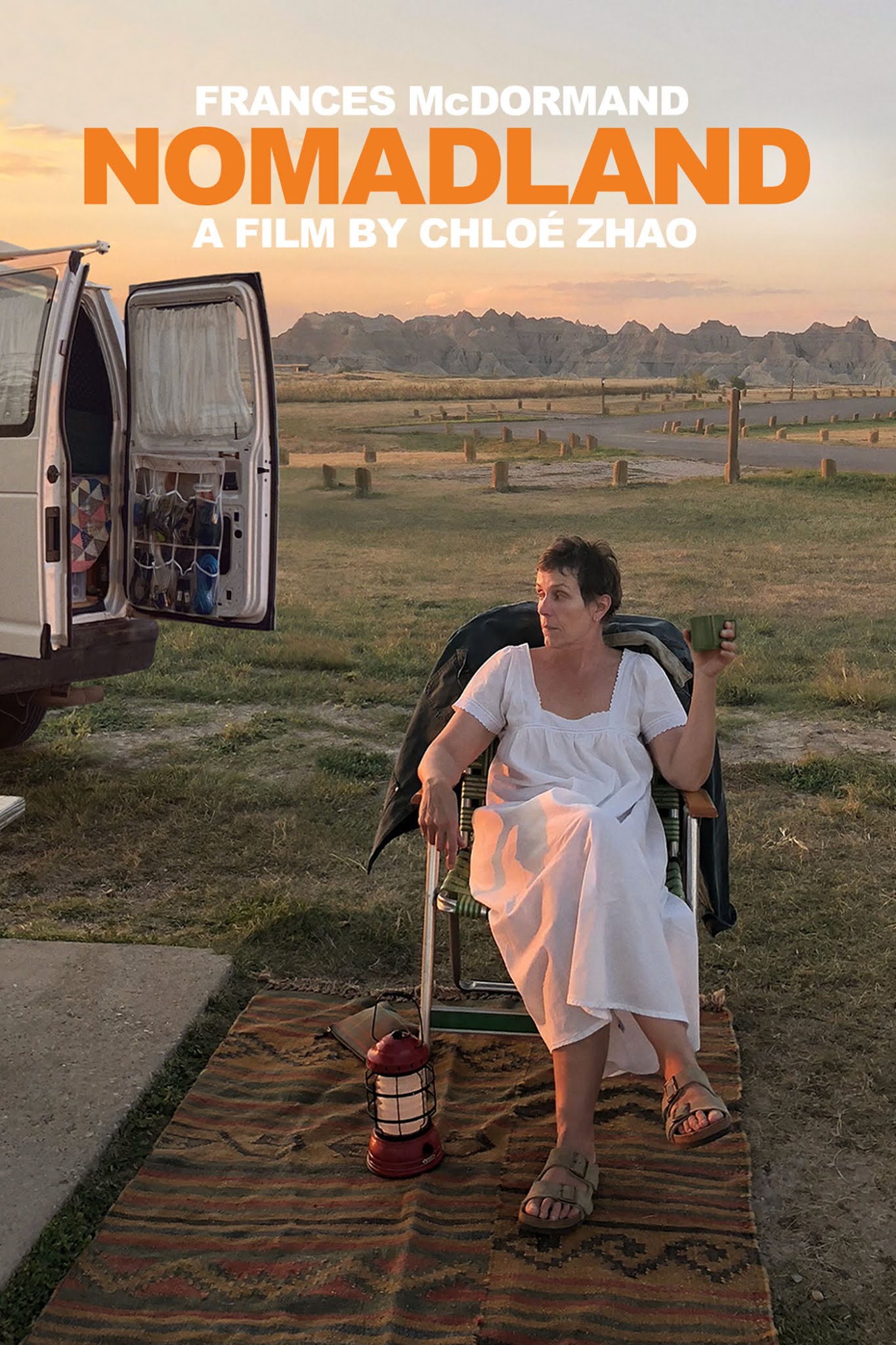
NOMADLAND (2020)


NOMADLAND (DIR: CHLOE ZHOU)  (SCR: ZHOU, BASED ON THE NONFICTION BOOK NOMADLAND: SURVIVING AMERICA IN THE TWENTY FIRST CENTURY)


To me, NOMADLAND was a surprising choice for a Best Picture winner; it's unassuming and soft spoken, its plot is loose, there are no big emotional scenes, it has many moments of stillness, and at times seems downright meditative.  Add to that a main character who is a woman over sixty and you have a film that doesn't seem like the usual Oscar glory material. It's possible that the recent movement to diversify the Oscar voters may have led to more openness to low key independent movies than splashy, big budgeted Hollywood affairs, like Aaron Sorkin's THE TRIAL OF THE CHICAGO 7 (which I thought was going to win). Or maybe the Academy just wanted to embrace a road movie during the pandemic lockdown.  Either way, I  personally don't think that NOMADLAND was the best film of the year, but I do enjoy its lovely images and independent heroine.

 It tells the story of  Fern (Frances McDormand), a sixtyish recent widow who used to work at a now closed factory in Nevada .  At the start of the movie she has decided to sell most of her belongings and live in her van, traveling from place to place to find work.  In her travels she meets other people living the same lifestyle, who teach her some of the ways of life on the road.  After her van breaks down, she doesn't have enough money for repairs, so she goes to visit her sister by bus.  Her sister offers to let her live with her family, but she refuses, borrowing money for her repairs instead.  On the road, she also meets Dave (David Strathairn) a fellow traveler who moves in with his children after becoming a grandfather.  He asks her to stay with him, but she says no and hits the road once again.  

Before it was a movie, it was a non-fiction book called  Nomadland: Surviving America in the Twenty-First Century written by Jessica Bruder and published in twenty seventeen.  The rights to the book were optioned by McDormand herself, and after seeing director Chloe Zhou's twenty seventeen film THE RIDER (another movie about an independent loner), asked her to write and direct it.  For the shooting of the film Zhou and McDormand lived in vans like the characters for four months, and often used real people playing themselves instead of actors.  Shot on a budget of around five million dollars, the film would eventually make six million in worldwide grosses (obviously the pandemic has affected its box office take).


Frances McDormand


To me the most striking thing about NOMADLAND is just how real it feels.  There is no attempt to sugarcoat Fern's life; she is poor and lives out of a small van, she has few possessions, and yes, she has to use a bucket as a toilet.  And yet there is a beauty to her way of life, (like how she proudly shows another traveler how she has found ways to utilize the limited space of her van), and there's a dignity in her willingness to do the  hard work that she needs to do to survive.  I love the way that Zhou's camera moves smoothly through the gorgeous natural landscapes that Fern travels through, and the quiet way it shows Fern appreciating those landscapes while lying naked in a river or hugging a huge tree.  The fact that Fern is alone in these scenes is telling; Zhou's script gives Fern no big speech about her desire to be independent because we can see it in the still moments like these.  Here is a woman who misses her husband but now treasures her independence and time alone.   But even more striking than the natural landscapes are the scenes towards the end of the film when Fern visits the now shuttered factory that she and her late husband used to work in.  There's a striking beauty in the ruins of a once busy, now desolate building. 

While Fern does make some friendships and connections, they are always at a distance.  When Dave tentatively makes romantic gestures towards her, she gently turns him down. McDormand and Strathairn have a real nice chemistry; I really like the way he calmly tells her that he likes her, and the quiet way that she rebuffs him. I also enjoy the way that Dave's attempt to be helpful finds him accidentally breaking some of Fern's plates, one of the few moments of humor in the film.   It's rare and refreshing to see people over sixty portrayed romantically (although they never even hold hands), but   it's also no surprise to the audience that Fern doesn't move in with Dave; her independence has already been established earlier in the film when we see her turn down the chance to adopt a sweet dog (as a dog owner myself, it does bother me that she just leaves the poor pooch leashed to a bench!).  The idea of a person who travels alone across the country, never wanting to settle down, is not new in movies, but such wanderers are usually male characters, and ending the film with a woman refusing to live with a man and taking to the road instead is a nice inversion of the usual cliche'.

McDormand, who is in every scene of the film, won her third Best Actress Oscar for this role, and again I find that a bit surprising given that the character is usually still and almost never raises her voice.  But, to me,  that's the beauty of her performance; when Fern talks about the loss of her husband, she isn't asking for pity, she's just laying out the truth of her life.  When she works at tough jobs across the country, she never complains, even though her face shows the strain of her work.  As I said, McDormand lived in a van for this role (and she also actually worked at some of the jobs shown on screen), and that gives her performance a sense of rightness, a feeling that this isn't just some Hollywood actress slumming.  Her van feels lived in.

If the film has a flaw, it's that to me it does sometimes drags.  Although I've already stated that I admire Zhou's decision to not have big emotions in the film, I do wish that there was more focus to the story.  No, I don't want chase scenes or explosions, but maybe a little more about how Fern and her fellow travelers get by would have been nice.  But my criticisms are mostly mild for what is a very successful film.

SO DID THE ACADEMY GET IT RIGHT?


While I think it's clear that I really enjoyed this film, I don't think that it was the best film of the year: I preferred Shaka King's JUDAS AND THE BLACK MESSIAH, Lee Isaac Chung's MINARI and, my personal favorite, Emerald Fennell's openly provocative PROMISING YOUNG WOMAN.  Still, NOMADLAND is certainly not a bad choice, and it's great to see Zhao breaking ground as the second woman (and first Asian one) to win Best Director.  

Monday, April 26, 2021

THE PANDEMIC OSCAR SHOW


 So, how was the first (and hopefully last) pandemic Oscar ceremony like?  Not bad, in my opinion.  Placing the show at Union Station in downtown Los Angeles and having the attending nominees sit at tables while a DJ (Quest Love, the drummer from the hip hop group The Roots) spun appropriate tracks gave the show a loose, party vibe that was fun.  And not having an official host took the pressure off one person to be constantly entertaining, which worked for me.  I enjoyed the long tracking shot that accompanied the first presenter, Regina King, as she made her way into the station.  And her joke about the recent Chauvin trial's outcome was well made without getting too preachy.

Most of the awards did not come as a surprise: Nomadland was favored to win Best Picture which it did, and its director  (ChloĂ© Zhao)  and lead actress (Francis McDormand) were also favored and also won.  The big surprise was when Anthony Hopkins won Best Actor for The Father over the late Chadwick Boseman for Ma Rainey's Black Bottom.  Personally, I preferred Boseman's performance, but in The Father, Hopkins, one of the most esteemed actors in the world, showed a willingness to play a character who is sad and pathetic, breaking down in a raw and honest way at the end of the film.  (And maybe the fact that many of the Oscar voters are older themselves had something to do with it).  In any event, I am a big fan of Hopkins so I won't say his award was completely underserved.  (At the same time I still think that Delroy Lindo was robbed by not even being nominated in this category for his great performance in Da Five Bloods).

The lack of musical numbers (the songs nominated for Best Original Song were all performed in pre broadcast special) meant that the show could indulge longer speeches from the winners, which is really a lot of what people want to see the most anyway.  And there were a lot of nice moments:  Zhao becoming the first Asian woman (and only the second overall) to win Best Director (for Nomadland) and her thoughtful acceptance speech was great.  As was Yuh-Jung Youn, who won for Best Supporting Actress for Minari, and who joked her way through her speech in a charming manner.  And Tyler Perry, getting a lifetime award, gave a moving and sincere speech; even though his movies are not my cup of tea, his graciousness was appreciated.  

Oh sure, there were a few silly moments in the broadcast as well: an Oscar music trivia contest felt too much like a bar trivia night, and some speeches did go on a bit too long.  To me the worst decision was to announce the Best Picture winner before Best Actor and Actress.  Since the Best Picture award is the one that is remembered the most, and can add enormously to a film's box office success, building up to it seems to be the logical way to do the show.    In any event, ending the show with the Best Actor award really didn't work because when Hopkins won  he didn't appear and no speech was given, causing the show to peter out somewhat pathetically. Still, considering everything going on in the world, this broadcast was a fun break from the stresses of our time.  Obviously I didn't agree with some of the winners (more on that when I post about Nomadland), but that's all part of the show.

Monday, March 15, 2021

THE 2020 NOMINEES: FIRST IMPRESSIONS


Even with all the chaos that the coronavirus has wrecked on the world, Hollywood has decided that the (Oscars) show must go on.  Even with so few films playing in theaters and delays in production and whatnot, there were still enough good movies released (or streamed) to qualify.

Many of the choices were not surprising: because Hollywood loves movies about its own history, David Fincher's MANK, about the writer of CITIZEN KANE, got multiple nominations.  And because the Academy is made up of older people, FATHER, a film about an elderly man dealing with dementia, also is up for many awards.  It's also not surprising that Shaka King's critically acclaimed drama JUDAS AND THE BLACK MESSIAH and  Aaron Sorkin's THE TRIAL OF THE CHICAGO 7, were well represented, since both were well acted period pieces about the kind of political upheaval that progressive Academy members can support.  Personally, I think it's good to see nominations for low budget independent productions like NOMADLAND and MINARI, not to mention what is probably my favorite movie of the year, PROMISING YOUNG WOMAN.  It's also noteworthy that Emerald Fennell being nominated for Best Director for PROMISING YOUNG WOMAN and Chloe Zhao being nominated in the same category for NOMADLAND  marks the first time that two women have been nominated for Best Director in the same year.  And historical precedent aside, I think they both deserved it. I imagine that both will lose to David Fincher for MANK, given that he's never won before and that it's such a good looking film.

As for disappointments, although  George C. Wolfe's MA RAINEY'S BLACK BOTTOM got several acting nominations, I think it was good enough to be up for Best Picture, and I preferred it to MANK and THE SOUND OF METAL.  I also think Regina King's ONE NIGHT IN MIAMI  was also worthy of being up for the Best Picture award.  But to me the big surprise and disappointment was the complete shut out of Spike Lee's DA 5 BLOODS.  Maybe it was uneven and too long, but I much preferred it to most of the Best Picture nominees.  I'm really surprised that Delroy Lindo, who's dynamic performance steals the film, is not even nominated.  Perhaps because it came out to early in the year to be remembered?  In any event, it's a shame.  

The awards show this year will inevitably be a subdued affair, just like the Grammys and the Emmys were, and that's not necessarily a bad thing. (I'm not a big fan of all the glitzy trappings of the show itself).  While it's hard to say what the favorite is, I think that MANK will probably win Best Picture because of the sheer number of nominations it received (ten in all).  Despite the film's occasional historical inaccuracies, the strength of its performances, meticulous production design and stunning black and white cinematography will put it over the top.  But of course, I could be wrong.

Monday, June 15, 2020

CANCEL GONE WITH THE WIND?

“Gone With the Wind,” starring Vivien Leigh as Scarlett O’Hara, left, and Hattie McDaniel as Mammy, has enduringly shaped popular understanding of the Civil War and Reconstruction perhaps more than any other cultural artifact.


Recently, in the wake of the civil rights protests going on around the nation, HBO decided to remove the 1939 film of Margaret Mitchell's novel,  GONE WITH THE WIND, from their downloading sight.  This was understandable, given, that the film unabashedly romanticizes the days of the antebellum South, complete with happy slaves who fight for the Southern cause.   A few days later, African-American film scholar Jacqueline Stewart announced that the film would return with an introduction by her that would help explain the inaccuracies of the film, and, I assume, will also explain the controversies around it.  This is also understandable.  GONE WITH THE WIND is, quite simply, a film that is too big, too popular (the most popular film ever when adjusted for inflation), and too influential to just pretend it was never made.
It should be mentioned that it was certainly not the first film to romanticize the South.  In fact, DW Griffith's THE BIRTH OF A NATION, which went even further, and which was also extremely popular, was released  way  back in  1915.   To his credit, David O Selznik, the producer of GONE WITH THE WIND consciously tried  to avoid making another BIRTH OF  A NATION, as he had all the source novel's references to the Klu Klux Klan removed.  Still, not making a film that sank to the level of one of the most racist movies ever made is still not all that impressive. And while both films are often defended as products of their time, it should be remembered that were also controversial and picketed at the time of their making.

The Birth of a Nation - Wikipedia
Yes, Gone With the Wind could have been as bad as this

I first saw Gone With the Wind at a special screening for my junior high school class when I was just twelve years old.  My reaction to it then was actually very similar to how I still feel about it; I was dazzled by the first half of the film, with its gorgeous technicolor visuals, amazing sets and costumes and romantic, often poetic dialogue, with the fiery spectacle of the burning of Atlanta really making a deep impression on me.  And then I felt that the second half of the film lapsed into romantic melodrama, with too many big emotional moments piled together towards the end.  Still, I enjoyed it overall and understood why it was considered a classic.
As for the film's racism, I must admit that as a white upper middle class child, it didn't really register with me.  Yes, I of course knew about the evils of slavery and saw that all the black characters in the film were stereotypes, but it didn't occur how historically wrong the film was.  I just accepted that its depiction of the South was accurate, and it wasn't until I read thought provoking analysis of the film years later that I changed my mind.  And that is the real danger of the film.  To this day, the film's view of Southern plantation life has bled into our national collective image of that time, making us think that its depiction was real.  And so much of it is so alluring, with colorful fancy dress balls and beautiful, castle like mansions that it's easy to forget how those balls and mansions were paid for.
And much worse than those fancy balls and beautiful buildings are the scenes that show slaves happily working in the fields or cheerfully helping out the white characters.  And, perhaps worst of all, we see a contingent of slaves joining together to fight against the Union soldiers!  And yes it's true that Hattie Mc Daniel made history by winning an Oscar for Best Supporting Actress, and her performance in the film is undeniably great, but just like the film itself it endorsed and influenced a stereotype that would last for decades.
I think HBO is making the right move here by bringing the film back with the commentary at the beginning.  This is an important and wonderfully made film that should still be viewed, but not without some context being placed on it.  Personally, I always like to hear about the context of the making of any work of art that I enjoy.  My interest in   Fred Zinnemann's 1952 film HIGH NOON, for example, is increased by the fact that the film's story was consciously fashioned to be a metaphor for the anti-Communist witch hunts that were going on in Hollywood at that time.  So people should still watch GONE WITH THE WIND, but they should also be aware about the controversy it has caused ever since it was made.

Sunday, February 23, 2020

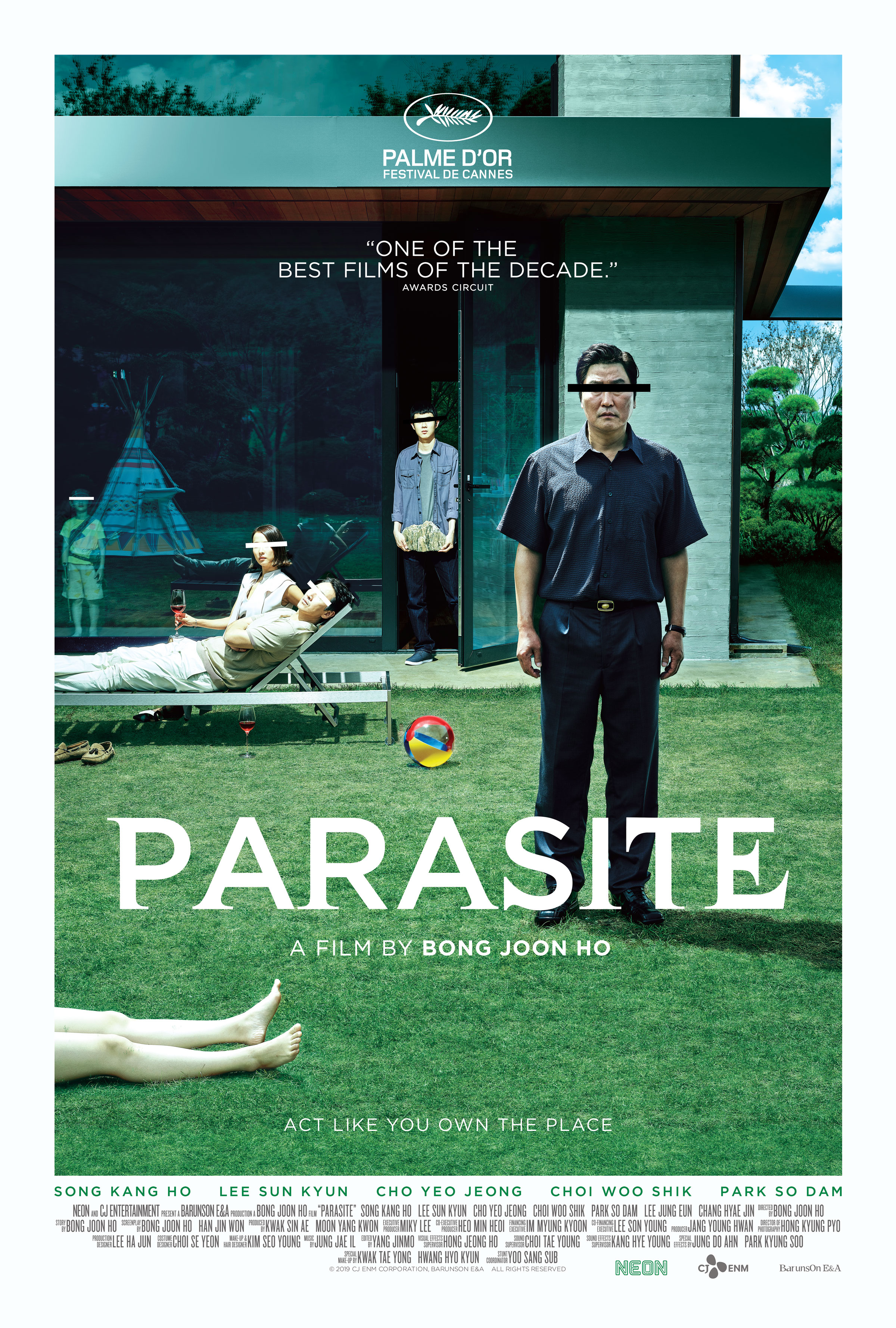
PARASITE (2019)


Image result for parasite movie poster

PARASITE (DIR: BONG JOON HO) (SCR: HO AND JIN WON HAN)

The ratings may have been low for this year's Academy Award telecast, but that didn't mean that there weren't any surprises.  I won't lie, when Bong Joon Ho's South Korean thriller PARASITE was announced as the Best Picture, I jumped to my feet in surprise.  Even though the film had already won three Oscars (for Best Original Screenplay, Best Director and Best International Film), I just couldn't believe that the Academy had, for the first time ever, awarded a foreign film the Best Picture award.  Now a cynic may point out that this could just be an example of Hollywood courting the foreign film market at a time when  international box office is getting more and more important to their bottom line, and it does raise the question of why the Academy has waited so long to award a foreign film when there have been so many great foreign films made over the years. Surely,  filmmakers like Akira Kurosawa, Ingmar Bergman and Federico Fellini have made movies that were the best of the year they were released.  Despite all of that, I think PARASITE won simply because it was indeed, the best film of last year.  It's an exciting, darkly funny and wildly violent movie with some raw social satire mixed in as well. 
Director Bong Joon Ho has actually been pretty well known in the American market since his entertaining monster movie THE HOST came out in 2006.  Since then he has also made another excellent thriller (2009's MOTHER) and two oddball science fiction films (2013's  SNOWPIERCER and 2017's OKJA).  Ho first came up with the idea for PARASITE while working on SNOWPIERCER when it was originally imagined as a play.  He based the story partly on his own experiences as a struggling young student tutoring for a rich family back in the '90's ("Every week I would go into their house, and I thought how fun it would be if I could get all my friends to infiltrate the house one by one." He told Atlantic magazine).  The script that Ho and his co screenwriter Jin Won Han completed was also influenced by Kim Ki-young's 1960 Korean film THE HOUSEMAID and the true story of Christine and LĂ©a Papin—two live-in maids who murdered their employers in 1930s France.  Because the beautiful home that the poor family infiltrates is so crucial to the film, the entire building was created in striking looking sets in different locations.   The poor family's basement dwelling was also built on sets, with production designer Lee Ha-jun visiting towns and villages in South Korea that had been abandoned and were about to be torn down to get a feel for the set design.  Shot in a hundred and twenty four days mostly in the city of Seoul on a budget of around eleven million dollars, PARASITE has become a world wide hit.  Along with grossing around forty three millions in the US (a very high amount for a foreign language film), it has made over two hundred million world wide.

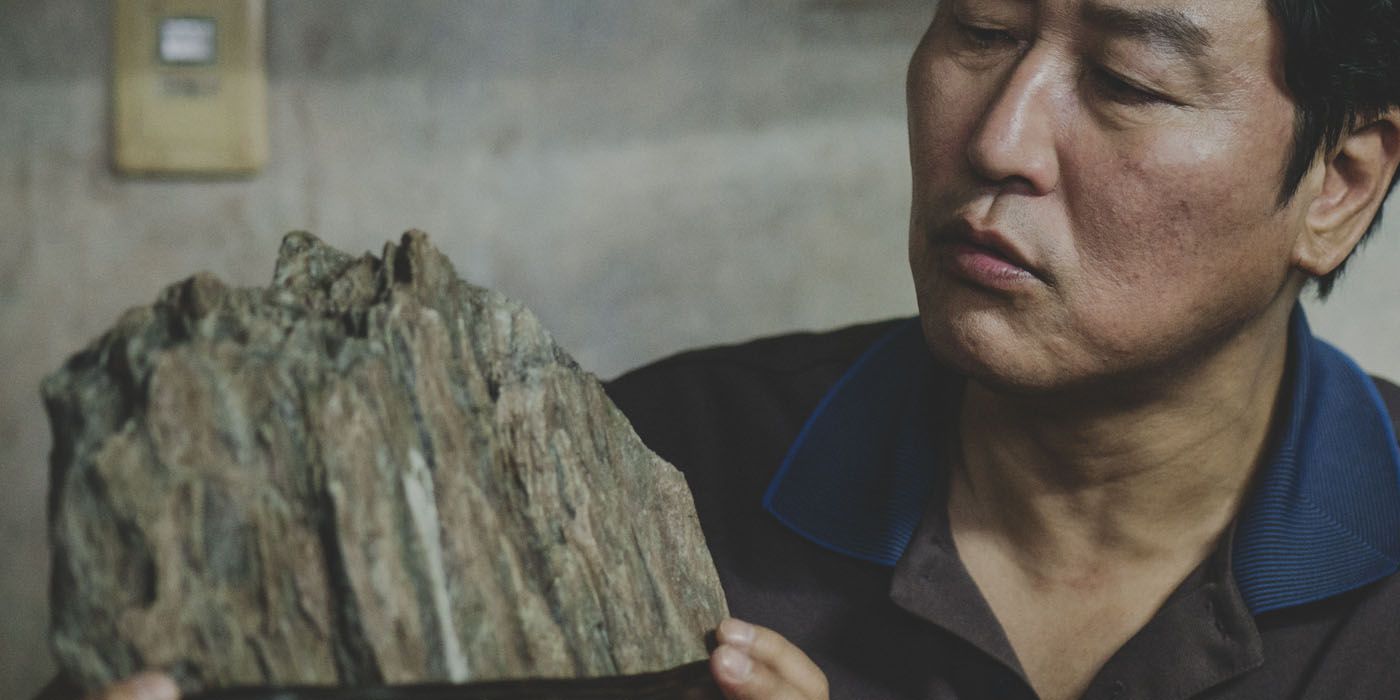
Image result for parasite movie luck stone
Kang-ho Song

It's plot concerns a family of four, father Ki-taek (Kang-ho Song), wife  Park Chung-sook(Jang Hye-jin), young adult daughter Kim Ki-jung(Park So-dam) and near college age teenage son Kim (called Kevin) Ki-woo(Choi Woo-shik) that are just barely surviving in modern day South Korea, squatting in a basement and doing odd jobs.  When a teenage friend of the son offers him a job tutoring the teen daughter of a rich family, he jumps at the chance and secures the job with documents forging a fake education.  Seeing that the family has an artistic young son, Da Song(Jung Hyeon-jun) he introduces his sister as his educated cousin and art therapist, and she too is soon hired.  Then the family manipulates the family's chauffeur (Park Keun-rok) and maid  (Lee Jung-eun), getting them fired and replacing them with the father and mother.  But one night when the wealthy family is gone and the whole family is relaxing and enjoying their new social status , the maid returns and reveals that her husband Oh Geun-sae (Park Myung-hoon) has been hiding in a secret bomb shelter in the basement of the house to avoid paying his debts.  She begs them to let him stay and give him food, but they refuse.  A physical confrontation ensues, which gets even more tense with the unexpected early return of the wealthy family.  The four of them manage to lock the maid and her husband in the cellar for the night and avoid being found by the family.  The next day there is a birthday party for  Da Song.  When Keven tries to let the maid and her husband loose, he finds her dead and the husband crazed.  After knocking  Keven unconscious, he wildly stabs Kim during the party.  In the ensuing chaos, Da Song appears to have a seizure, and his father begs Ki Taek to drive him to the hospital.  In a fit of rage, Kit Taek stabs his employer and hides in the basement.  Later, Kevin recovers from his injuries and discovers where his father is hiding.  He dreams of buying the house and releasing his father.

First of all, this is a great movie to rewatch: the first time I saw I responded mostly to the thriller elements, as I found myself wondering if the trickster family would get away with their scam.  And then, when everything seems to be going their way, the return of the family's maid set the movie going in a completely different direction.  In a world of predictable movie formulas, there's nothing I love more in a film than a story that moves in unexpected (but plausible) ways, so from the moment that the maid revealed her husband's hiding place I was hooked!  Ho has mentioned that Martin Scorsese is one of his directorial influences, but I found myself thinking of Alfred Hitchcock in the way that Ho builds suspense out of the simplest thing, like hiding under a table or walking down  a long, narrow staircase without knowing what lies below.   And the chaos of the climatic birthday scene is perfectly handled, with characters making sudden, shockingly violent choices that make sense upon reflection.  While the script sometimes can be heavy handed (the symbolism of the philosopher's stone, which brings the poor family both good and back luck, is a bit obvious, especially since Kevin refers to it as a metaphor!), and the fact that we don't know for sure if little Da Song dies at the end or not seems like a flaw (it could go either way), it's mostly perfect in both story and character.
On my subsequent viewings of the film, I was able to focus more on the more subtle elements of it:  I love the way that director Ho and cinematographer Kyung-pyo Hong keep the camera sleekly panning in the enormous house, often to reveal people hiding or spying.  Or the way that Kim's first visit to the wealthy household is shot likes he's entering paradise (for him, he is).  The house itself, with it's enormous window view and sleek modern look, is a triumph of production design.  Even the location of the basement door and the secret door beneath it is in the right place, becoming a constant reminder to the trickster family once they know what lies behind it.  I also love the clever wit in the way that Kim rehearses her fake story to herself before meeting the family, and then correctly guesses just what to say to impress the mother while "analyzing" her son's art. 
All of the performances are great: I especially enjoy Kang-ho Song (who's a big star in Korea, and has worked with director Ho several times now, stretching back to 2003's MEMORIES OF MURDER) as the father Ki-taek.  On my first viewing of the film, I found his act of violence at the end shocking, but upon repeat viewings I can see the anger and resentment simmering up under his usually taciturn demeanor.  And the moment where he almost seems mad enough to strike his wife, and then laughs it off is chilling, because we never know just how much he's joking.  As great as he is, my favorite performance in the movie is given by Jeong-eun Lee (who has also worked with director Ho before)  as the ill fated maid Moon-gwang.  At first, her character just seems like a prim and proper housekeeper, but then she becomes sad and  pathetic as she begs the family to let her husband stay.  Only moments later she becomes wrathful when she briefly  has the upper hand on them, almost transforming on screen .  She even gets some nice romantic flashback moments with her simple minded husband.  This is a wide range of complex emotions that Lee nails perfectly, and she's only a supporting character!

Image result for parasite movie Moon-gwang
Jeong-eun Lee

So, excellent suspense, dark humor, great plot twists and wonderful performances throughout are part of this film's greatness.  But it also works on another level; biting class commentary.  From the opulent home of the wealthy family to the pathetic, crowded basement that the poor family is squatting in, the contrast between the rich in the poor in not only South Korea but also the rest of the world is always present in the film.  Importantly, we at first on the side of poor family as we see the terrible conditions they live in and menial work they have to do.  But as their plan progresses it's gets harder to defend the way they set up the innocent servants to get fired, although we can enjoy their ingenuity as they manipulate the family into hiring them(squirting chili sauce on a napkin at just the right moment is a brilliant detail!).  And we can't help but be on their side when they briefly enjoy their ill gotten gains by kicking their feet up and dreaming about actually owning a such a house  while the rich family are all on vacation. The real breaking point comes when Moon-gwang reveals her husband, and they refuse to feed him and let him stay, even though it wouldn't be hard for them.  So here we have an poor family that has moved up in the world refusing to help out someone who is in the same position they once were, a bleak look at how poor people moving into the middle class often ignore their roots.  Even more interesting is the fact that the rich family are not bad people, but then they have the luxury of being able to afford kindness ("They are rich but still nice."  Ki-taek tells his wife. "They are nice because they are rich." She replies).  Class is shown as such a defining factor with these people that even the literal stench of poverty that hangs over Ki-taek can't be washed off, and it leads to a defining moment when a reminder of his scent causes him to lash out at his employer, killing him.  Yes, wealth dispartiy is a tricky issue in this film, and even the title can be seen as having a double meaning, in which both the poor and the rich leech off of each other.

SO DID THE ACADEMY GET IT RIGHT?

Ok, it's pretty obvious that I love this movie and agree with the Academy's choice.  I personally didn't think that 2019 was a particularly great year for American movies, with only Noah Baumbach's well acted drama MARRIAGE STORY reaching greatness, in my opinion.  In fact, I think the only other movies that could compare with PARASITE are all from other countries, like Pedro Almodovar's excellent PAIN & GLORY, or CĂ©line Sciamma's PORTRAIT OF A LADY ON FIRE.  And while both of those films are good, I don't think that they top PARASITE, which was not only a groundbreaking choice, but the right one.