Monday, September 24, 2012

THE LAST EMPEROR (1987)


THE LAST EMPEROR (DIR: BERNARDO BERTOLUCCI) (SCR: BERTOLUCCI & MARK PEPLOE)

In some ways, the selection of THE LAST EMPEROR for best picture seems like a typical choice for the Academy: it's an epic, good looking historical drama that chronicles the enormous changes that occur in a single man's life, pretty standard Oscar fare.  On the other hand, it is unusual in that it deals with historical changes in a non western culture, and it was the first  best picture winner to feature an almost entirely nonwhite cast.  It is also an excellent, intelligent film, with strong performances and a sweeping story that chronicles a part of world history that is rarely acknowledged in Hollywood films.

Its director, Bernardo Bertulucci, first began his directing career in his homeland of Italy in the 1960's.  He became well known in America after directing Marlon Brando to a great, raw performance in 1972's controversial LAST TANGO IN PARIS.  In the 1980's, the Marxist director became interested in Asian culture, and convinced the Chinese government to let him shoot a biographical film about Aisin-Gioro Puyi, the last Emperor of China.  It would be the first Western film made in China with the government's cooperation since 1949.   He also gained permission to shoot inside China's fabled "Forbidden City", the first Western feature film to ever do so.  The film's twenty three million dollar budget was raised independently by British producer Jeremy Thomas.   Bertolucci wrote the script with Mark Peploe, and researched Puyi's life, with his younger brother Henry Puyi serving as an advisor.  Hong Kong born John Lone, then known for playing a gangster in Alan Parker's 1985 film YEAR OF THE DRAGON, was hired to play the title role, and famous British actor Peter O'Toole was brought in to play the small role of Puyi's  English tutor. It took six months to shoot the film in China, with the Chinese military helping provide some of the thousands of extras needed for the crowd scenes. It was released in North America by Columbia pictures, and interest in it built slowly, with a big push from the  Oscars (it won nine in all) eventually pushing its box office total to around fifty million dollars in the US.
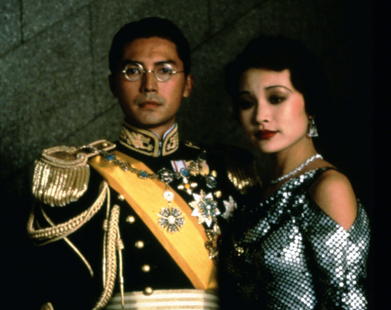

John Lone and Joan Chen


Beginning in 1950, we see the grown Puyi as a prisoner of war, held by the Red Army of the Soviet Union.  We then flashback to his childhood, when he was raised in the forbidden city after becoming emperor of China at the age of three.  After the Japanese invasion of China, he is allowed to reign over the Japanese puppet state of Manchukuo, but he is captured by the Red Army after the end of the war.  Eventually, Puyi is released after renouncing his collaboration with the Japanese, and he becomes a simple gardener.

This is a long film, but it rarely drags, really, how could it when its hero has a life that  encompasses both World War II and the rise of Communism?   In the film Puyi goes from spoiled Emperor to exiled playboy enthralled with Western culture, to puppet leader to prisoner, before ending his life as an anonymous gardener; a life truly worthy of an epic film.  And it's also a great looking one; Bertolucci and cinematographer Vittorio Storaro  wisely give each phase of the emperor's life a different look, with his later years appearing gray and  almost colorless, while his time in the forbidden city has colors that are so vivid they practically pop off the screen.  (James Acheson's excellent costumes help a lot too, and both he and Storaro won deserved Oscars for their work).   There are many visually striking moments in the film, like the newly crowned boy emperor emerging from a billowing curtain to discover an adoring crowd, or the seemingly ancient empress dowager (Lisa Lu) lying on her death bed, still adorned in all her finery.

Lisa Lu as the dying dowager


In the title role, John Lone gives a muted but fine performance; he is often quiet and placid, even as huge events occur around him, which is appropriate enough because he had so little control over those huge events; this was a man who was buffeted all his life by forces beyond his control, a fact that Berolucci shows visually at one point by having a wave of Chinese soldiers wash down the steps of the forbidden city and towards the emperor, ready to sweep him into exile.  In many ways, the real heart of the film lies in not the emperor, but in the empress: Joan Chen plays Wan Jung, the young woman who marries the emperor in an arranged marriage, and eventually comes to care for him.  But, when he agrees to become a puppet leader for the Japanese, she rightfully sees it as a betrayal of China, and her bitterness towards this turn of events sends her into a spiral of opium addiction and affairs.  In contrast to Lone's stoicism, Chen is emotional and heartbreaking in her role, and her final scene is powerful indeed.  It is to the film's credit that Peter O'Toole, the only famous actor in the film, is important to the story, but never overshadows the film.  O'Toole seems to be enjoying himself here, showing warmth and humor in the same vein as  the title character from  GOODBYE MR CHIPS, and the rest of the cast  is solid throughout.
If the film has a flaw, it is that I sometimes find it curiously uninvolving.  I think the problem may lie in having a main character who has so little control over his own life, with little initiative or drive to speak of, making Puyi not always the easiest character to warm up to, especially when he quickly agrees to sell out to the Japanese.  Still, this film is an impressive achievement.

SO DID THE ACADEMY GET IT RIGHT?

Although fine films like Norman Jewison's MOONSTRUCK, James L Brooks's BROADCAST NEWS and Steven Speilberg's EMPIRE OF THE SUN were all released that year, I think Bertolucci's film towers over them all and is a worthy best picture winner.

Sunday, September 9, 2012

PLATOON (1986)


Enjoy my ramblings?  Check out my new blog here.

PLATOON (DIR: OLIVER STONE) (SCR:STONE)

PLATOON was the second film about Viet Nam to win best picture, but unlike Micheal Cimino's 1979 film THE DEER HUNTER, which often fell into a surreal view of the war almost out of a Hieronymus Bosch painting, Oliver Stone's film had a gritty, realistic feel to it, which was no surprise seeing how Stone based the script on his own life and experiences in the war.  While the film does sometimes descend into the kind of heavy handed pretensions that would mar Stone's later work, it still holds up as a powerful, emotional and well made movie that displays the Viet Nam experience more vividly than any other; one can sense that this was an intensely personal film for Stone that  he felt that he  had to make.

Its Oscar victory  must have been particularly sweet for him, considering how long it took for the film to get made.  Stone came to filmmaking after serving in the war in the late sixties; he first wrote  the script for PLATOON in 1968, reportedly it came partly over his anger at John Wayne's pro war  film of that year, THE GREEN BERETS.    Stone's first film as a director was 1974's horror film, SEIZURE.  After that he continued to work as both a writer and director, with his greatest success coming with his Oscar winning script for Alan Parker's 1978 film, MIDNIGHT EXPRESS.  He tried to get funding for  PLATOON as early as 1976, with no luck. Finally, after almost ten years, he hooked up with Hemdale films and producer Arnold Kopelson, who green lit the film at a budget of around six million dollars.  Several actors, including Kyle MacLachlan and Keanu Reeves were considered for the lead role of Chris Taylor before Charlie Sheen was cast.  Immediately before shooting, retired marine Dale Dye trained the actors for two weeks in a tropical jungle near Manila, whipping them into military shape.  The cast and crew then suffered through sixty days of shooting in the Philippines, (which was mostly shot sequentially to heighten the realism. ) amid  rain storms  and bugs, not to mention some possibly dangerous moments with helicopters and explosions.  In the editing room, editor Claire Simpson (who would win an Oscar for the film) suggested that Stone use Samuel Barber's beautiful, haunting "Adiagio for Strings" over the more emotional footage, which wound up adding to the film's sense of tragedy beautifully.  The film became an enormous hit, earning over one hundred and thirty million dollars in the US alone, becoming the perfect antidote to the previous year's terrible Viet Nam based film, RAMBO: FIRST BLOOD PART II.

Charlie Sheen

It tells the story of Chris Taylor, who drops out of college in 1967 and volunteers to serve in Viet Nam.  His gung ho attitude is changed as he sees the horror of war, and he finds himself torn between two sergeants, Elias (Willem Dafoe) and Barnes (Tom Berenger)who come to represent his mixed feelings about the war.

Given the path that director Stone's career would later take, it's hard to believe that his first big film was praised for its realism, and yet that is what makes the film so impressive.  It really digs into the hardships of being a grunt, trudging through a dense forest with a heavy pack on your back while holding a rifle, dealing with hot weather, bugs and snakes, never really knowing when an attack can occur.  The story stays almost entirely with Chris's foot soldier point of view for the whole film, with the mostly unseen Viet Cong soldiers appearing almost like shadows, and this effectively gives the audience a "you are there" feeling.  Stone's script also gets the rough, male camaraderie of the platoon right, with the men bonding over foul mouthed insults, alcohol and drugs.  Stone also wisely has Chris narrate letters home to his grandmother that let him make more sensitive insights about the war to her than he could to his fellow soldiers.  The combat scenes in the film are mostly well done, instead of showing any kind of  glory they are chaotic and brutal, with no winners, just survivors.  The film's most powerful moments come when the platoon, angry after seeing the displayed, mutilated body of one of their men, turn their rage on a town of suspected Viet Cong sympathizers, with even Chris at one point screaming and shooting at the feet of an unarmed man, showing that even the least violent kind of person can be pushed to the edge.  The fact that the violence of the men escalates to the point of Barnes holding a gun to a little girl's head makes the scene almost unwatchable in its intensity, but it also perfectly illustrates the difficulty of any kind of order being maintained in an almost anarchic situation like the Viet Nam conflict.  Inevitably, when a group of  young men are put in a violent situation with almost no structure, and no definite sense of who is or isn't the enemy, there will be times when they go too far.  For Stone, this was the Viet Nam war in a nutshell.

Charlie Sheen has become a walking punch line now, but in this, his first lead role in a film, he's very good as the naive young Chris, he is on screen for almost every frame, and his immediate likability carries the film, and his change from supporting the war to opposing it is believable.  Even better are Willem Dafoe and Tom Berenger as Elias and Barnes.  Although Berenger has the flashier role, with the scarred Barnes making speeches about death, I think Dafoe really excels as the soft spoken Elias, who has been in Viet Nam long enough to see the war as unwinnable.  I love the scene where Elias talks to Chris about the war while gazing at the stars, or when Dafoe exhales marijuana smoke into a gun barrel for Chris to inhale, in an almost sexual way.  The rest of the cast are also very good,  populating the big, multi ethnic Platoon with immediately identifiable characters (future stars Forest Whittaker and Johnny Depp are among them).

Willem Dafoe on the left Art Greenspon's photo on the right


I find the film falters a bit towards the end; after establishing itself as a film that shows the horror of war, the final battle scene comes close to playing like a conventional action film, and while the movie thankfully never sinks to the level of the aforementioned RAMBO, it does come close to being more exciting than horrifying as Chris bravely facing down enemies while his comrades flee. It also sometimes sinks into heavy handedness: Stone makes sure we understand the battle between Elias and Barnes by having other characters compare them to larger than life figures (Barnes is compared to Captain Ahab, while Elias is compared to Jesus). This eventually  leads to the film's broadest moment: the Christ like death of Elias, complete with arms outstretched in slow motion.  To be fair, this image is not just something Stone invented, he based it on a real photograph of a Viet Nam soldier taken by war photographer Art Greenspon.  Still, with this one overdone shot, Stone hurts the film's realistic tone, although the damage is far from lasting.  On the whole, this is an excellent war movie that ranks up there with Lewis Milestone's ALL QUIET ON THE WESTERN FRONT and Stanley Kubrick's PATHS OF GLORY as one of the best of its kind ever.

SO DID THE ACADEMY GET IT RIGHT?

While I think this is a great movie that deserved the award, I am also a huge fan of Woody Allen's HANNAH AND HER SISTERS, which ranks as one of his best movies.  So, for me, it's really a toss up between those two, but, given the fact that PLATOON seemed to really help shape America's view of the Viet Nam war in the 1980's, I'll go with Stone's film by a nose.


Monday, August 27, 2012

OUT OF AFRICA (1985)


OUT OF AFRICA (DIR: SYDNEY POLLACK) (SCR: KURT LUEDTKE, BASED ON THE MEMOIR BY ISAK DINESEN)

With OUT OF AFRICA, the Academy made a safe, predictable choice for best picture of 1985; it's a great looking, classically made dramatic romance with two big stars and a period setting.  Unfortunately, it's also far too long and often uninvolving,  despite its lovely locations.  It would appear that the Academy felt that it was time to reward well admired director Sydney Pollack for his years of work (he also won an Oscar for best director) than for the film itself.  Personally, I prefer his earlier films like 1982's TOOTSIE and 1969's THEY SHOOT HORSES, DON'T THEY?, to this slow moving movie.
Long before it was a movie, it was a memoir by Karen Blixen (under the pen name Isak Dinesen), about her adventures as a plantation owner in Kenya.  There was interest in making a film of the story for years, (most intriguingly, Orson Welles wanted to make it with Greta Garbo in the lead) but it was Frank Price, the head of Universal Pictures, who finally got the funding together and hired Pollack to direct.  Pollack assigned the script to former reporter Kurt Luedtke, who had worked with the director before on 1981's ABSENCE OF MALICE.  Initially, Pollack wanted Audrey Hepburn for the lead role of Karen, but she turned it down, so it went to Meryl Streep instead.  Streep, in her usual manner, researched the role and perfected her accent by listening to actual recordings of Blixen.  Robert Redford was hired as her love interest, Denys Finch Hatten; Redford reportedly attempted an English accent, but Pollack thought audiences would find it distracting and had him stop, even going so far as to rerecord  some of his dialogue.  The film was shot almost entirely on location in Africa, and production designer Stephen Grimes spent years recreating not only the  plantation but the surrounding town as well, even using actual furniture owned by Blixen for some scenes.  Made at a budget of around thirty million dollars, and buoyed by its romance and star power,  the movie would go on to make about eighty seven million in the US.

Robert Redford shampoos Meryl Streep

Beginning in 1913, it tells the story of Karen Blixen (Streep), a Danish woman who marries the poor but titled Baron Bror (Klaus Maria Brandauer), more out of convenience than love, and moves with him to Africa to run a plantation.  Eventually, she does start to have feelings for the Baron, but he is a womanizer, and eventually she contracts syphilis from him, requiring a long period of recovery at home.  When she returns to Africa, she finds her husband still unfaithful, and she herself begins an affair with the free spirited big game hunter Denys Hatten (Redford), whom she had befriended earlier.

It's obvious that Pollack and Luedkte's script view this story as a romantic one first, while the rest just serves as an excuse to get our two big stars together in some lovely scenery, and so no time is wasted: although they may not get together romantically until later, the two lovers  first meet sometime within the first ten minutes (amusingly, Redford is first seen hauling a big, somewhat phallic ivory tusk), and the audience just knows that it is only a matter of time before they will come together.   Personally,  I don't think this was the right way to go; the emphasis on romance leaves other aspects of the story unfulfilled.  Karen has to run the plantation by herself when her no good husband leaves, but we only hear a little about her hardships.  So little that even the accidental burning down of the plantation late in the film fails to make much of an emotional mark on the audience.  The same goes for her relations with her African workers, which are not as moving as Pollack seems to think they are, and could have been fleshed out much more.  And Brandauer has such a thankless role as Karen's husband that he only shows up every once in a while to remind the audience what a loser he is.   I think a film that  shows this woman bravely working  on the plantation alone that had  some romance on the side would have made for a stronger film.  As it is, it's mostly just a pretty romance.

To be fair, the love story here is often effective; Streep and Redford make for an interesting couple: she with her chameleon like ability to disappear into a role, complete with foreign accent and dyed hair, and he giving a classic, relaxed star turn, much like the same ones he had been giving for years.  Somehow it works when it shouldn't;  Redford has such immediate charm, and Streep such intelligence that their attraction to each other seems natural, and it makes sense that the more Karen gets used to life in Africa, the more she is drawn to a man who seems built for the land.  I like the sensual shampoo he gives her on the banks of a wild river, or the shy, boyish way that he asks if he can leave his things at her place, implicating that he wants to keep seeing her.  And I can almost forgive the film's weaknesses for the beautiful scene in which he takes her flying over the mountains of Africa, surrounded by flocks of flamingoes.  If their relationship sometimes bogs down into typical emotional language (he leaves her to go on safari because it's something he has to do,  telling her "I don't want to live someone else's idea of how to live") the love story still is the heart of the film, and works better than anything else around it.

The lovely flying scene


It should also be noted  that the filmmakers and Streep want Karen to be seen as a proto feminist: along with running the plantation, she also explodes with righteous anger when she finds her husband has changed their plantation from a cattle farm to a coffee farm without telling her, and when she realizes that her husband will not cease his philandering, she guiltlessly takes a lover of her own.  And, in the film's only truly exciting moment, she calmly shoots down a charging lioness with a single rifle shot!  (I like this scene not only for the excitement, but also for Redford's look of amazement and awe afterwards, a nice example of his growing respect and attraction for her).  While I'm not sure how historically accurate this  characterization is, it works for the story and makes the character more interesting. And that leads to one nice detail: at the end of the film, she is invited to have a drink in the men's only Muthaiga Country Club.  This really happened, and Karen Blixen remains the only woman ever to be served a drink at that club to this day!

SO DID THE ACADEMY GET IT RIGHT?

It's probably pretty clear that I have a mixed reaction to this film, despite its lovely visuals; personally, I think any of the other films nominated for best picture that year (THE COLOR PURPLE, WITNESS, PRIZZI'S HONOR, KISS OF THE SPIDER WOMAN) would have been a better choice.  I also prefer  some films that weren't nominated, such as Terry Gilliam's crazed BRAZIL, and Woody Allen's delightful fantasy, THE PURPLE ROSE OF CAIRO.  Yes, OUT OF AFRICA is only a pleasant movie at best, and it remains one of the Academy's weaker choices.


Friday, August 17, 2012

AMADEUS(1984)


AMADEUS (DIR: MILOS FORMAN) (SCR: PETER SHAFFER, BASED ON THE PLAY OF THE SAME NAME, ALSO BY SHAFFER)

AMADEUS, was the second best picture winner for director Milos Forman (the first being 1975's ONE FLEW OVER THE CUCKOO'S NEST), and it's a intelligent, literate  and wildly entertaining film, sparked by great performances and gorgeous period recreations and filled with beautiful music.  Despite some moments of crude humor, it is a classy, high brow film all the way, and although it has its detractors, and its historical accuracy is certainly questionable, it seemed an obvious prestige film for the Academy to choose.  And, speaking for myself,  I think it stands as one of their best choices.

Before it was a movie, it was a play; written by English playwright Peter Shaffer, (and based loosely on an 1830 play by Alexander Pushkin called MOZART AND SALIERI) it premiered in London in 1979  and eventually made its made to Broadway in 1980.  There, it was seen by director Forman, who immediately called producer Saul Zaentz (with whom he had also worked on CUKOO'S NEST) about making a film out of it.  Zaentz agreed, and Forman went to work on the script with Shaffer, turning an often surreal play into a far more realistic film, and being sure to add, as Forman put it, "more Mozart and more music".  While many high profile actors were interested in playing the two rival composers Mozart and Salieri, Forman wanted lesser known actors.  While auditioning for a smaller role, F Murray Abraham helped test out possible Mozarts by reading Salieri's lines to them; he did such a good job that Forman wound up giving him the part.  And, after testing such performers as Mel Gibson, and Tim Curry for the part of Wolfgang Amadeus Mozart, Forman went with American actor Tom Hulce, who at that point would probably be best known for his sizable role in 1978's ANIMAL HOUSE.  Notable conductor Neville Marriner was hired to conduct the score, demanding that a not a note of the original music be changed.  The film was shot almost entirely in Czechoslovakia, mostly in the city of Prague, which still had much of the 18th. century architecture needed for the film.  (Ironically,  Forman was born in Czechoslovakia and had fled the Communist government years earlier).  Amazingly, the debut of Mozart's opera Don Giovanni was shot in the Tyl Theater, where Mozart himself had conducted its premiere two centuries earlier. Forman had his longtime cinematographer Miroslav Ondricek use only natural lighting for the entire film, including lighting the Tyl Theater with hundreds of candles.  The effect is marvelous, giving the film a look that is both beautiful and realistic.  Despite shooting in a country that was still under Communist rule (apparently some of the extras were secret police!), the making of the film went with any significant problems, and it came in at a budget around eighteen million dollars.  It would go on to make around fifty two million.

Tom Hulce


Its story begins in 1823 when elderly former court composer Antonio Salieri (Abraham) attempts suicide while begging forgiveness for killing Amadeus Mozart (Hulce)years earlier.  Later, in an asylum, Salieri tells a young priest(Richard Frank) the story of how as a boy he longed to be a composer and idolized the famed, even younger composer Mozart.  Years later Salieri has become the court composer to Emperor Joseph II (Jeffrey Jones) , and he is excited to meet Mozart for the first time; but upon meeting him, he finds Mozart to be a "giggling dirty minded creature".  And after he discovers that Mozart has seduced one of Salieri's female students, Salieri dedicates his life to destroying Mozart's career.  All the while, he loves Mozart's music and realizes that the young composer's talent was superior to his own.  Eventually, he secretly engages the financially bereft Mozart to write his own requiem.

The first impression I always have when viewing this film is just how great looking it is: each costume, every set and location, even the enticing food that Salieri loves is gorgeous to look at in its own way, and this is especially true of the wonderful recreations of the operas of the day (the costumes used were based on sketches for the actual shows).  And, it goes without saying, there is lovely music nonstop (and I'm not what you would call a big classical music fan).  But this isn't just a movie that is pretty to look at; at its core stands,  for me, one of the most fascinating characters in movie history.  Antonio Salieri is a man who thanks God for his musical talent, but then curses God for giving even more talent to Mozart.  "Why would God choose an obscene child to be his instrument?" he asks, knowing that there can be no reasonable answer.  The cruel irony for him is that only he and Mozart himself realize just how great a composer Mozart is; while others dismiss Mozart, it is Salieri who sees his undeniable talent and realizes that his own music will be forgotten while Mozart's will endure (a cruel truth he lives long enough to see happen).  So, he both works to destroy Mozart's career and adores every aspect of it, and he purposely drives Mozart to an early grave and then laments at all the wonderful music that he has stolen from the world, eventually driving himself to suicidal madness, sowing the seeds for his own destruction.  The movie also gets into other aspects of the nature of art and artist that endure to this day: Mozart often faces censorship, and has to defend his work more than once before priggish fools, something that the Communist fleeing  Forman could identify with I'm sure.  The question of art versus commerce is also raised, with Mozart's works, despite their brilliance, never finding a popular audience is his lifetime, (they are challenging and ahead of their time) and he is eventually forced to write THE MAGIC FLUTE, even though its comic opera story is beneath him.   And has there ever been a better cinematic display of artistic creation than the scene in which the ailing Mozart transcribes his own requiem to Salieri, with each piece of music played over the soundtrack as its written?  It's a marvelous bit of filmmaking.

The casting of Tom Hulce as Mozart seemed controversial at the time; after all, an American actor to portray the Salzburg born composer?  But Hulce is winning in the role, perhaps because his character is supposed to be brash and vulgar, and perhaps it takes an American in a  European country to play that so well!  Forman clearly tries to sell Mozart to modern audiences by making him out to be a rock star of his era (the pink wig he fancies in one scene looks almost like a punk rock hairdo, and his purple outfit at one point resembles that of rock star Prince), and certainly his drinking, his arrogance and his crassness fit that nicely, along with his untimely demise; but Hulce is also excellent as Mozart the passionate artist.  I love the scene in which he convinces the Emperor to allow him to make an opera of the story of Figaro despite the fact that the story has been banned.  Hulce is so determined, so driven to describe his ideas that his enthusiasm is infectious and inevitably wins the Emperor over.  Although I do think that Hulce overacts in some of the film's later scenes as he spirals into drunken madness (I'm really not a fan of the scene in which he drunkenly thumbs his nose at his father's picture), he still holds his part of the film well, and manages to be sympathetic while believably annoying the hell out of Salieri.

F Murray Abraham


F Murray Abraham was an unknown actor who seemed to come from nowhere, give a brilliant, Oscar winning  performance, and then sadly fade back into obscurity again.  But for this one film, he is great, wonderfully delivering dramatic monologues on his hated of Mozart and love of his music directly into the camera with joy and energy; even though his character is an old man in a wheelchair for much of the film, we still feel his drive and determination about events that happened decades earlier.  (I should also mention that the perfect old age makeup he wears was designed by the legendary makeup artist Dick Smith and that it adds to the performance enormously).  

Along with the two leads, the film is filled with excellent performances, and I especially love Jeffrey Jones as the tin eared Emperor Joseph II, who's word is law even though he's a fool; Jones plays every blank expression and ignorant utterance for maximum comedic effect, and he's a delight.  Also very good are Elizabeth Berridge as Mozart's long suffering wife Constanze and Roy Dotrice as Mozart's formidable father Leopold.  Yes, this is an excellent film that is both visually stunning and thought provoking.  And while some have criticized its historical accuracy, I personally have no problem with a story based on real people from centuries ago taking a few dramatic liberties.  Really, it's what story tellers like Forman and Shaffer have been doing for years.  

SO DID THE ACADEMY GET IT RIGHT?

It's clear that I love this movie, and while 1984 also gave us Roland Joffe's excellent THE KILLING FIELDS, I still think that AMADEUS stands head and shoulders above the rest.


Sunday, July 29, 2012

TERMS OF ENDEARMENT(1983)


TERMS OF ENDEARMENT (DIR: JAMES L BROOKS) (SCR: BROOKS, BASED ON THE NOVEL OF THE SAME BY LARRY MCMURTRY)

The best picture winner of 1983 was a triumph for writer, director and producer  James L Brooks (who also won Oscars for his direction and script), made even more impressive by the fact that he had never directed a film before.  It's a moving family drama, filled with warmth and humor, and even if it lapses into some maudlin territory towards the end, the terrific performances still make it a winning film.

Brooks first began his career working in television in the mid sixties, eventually going on to produce hit shows like THE MARY TYLER MOORE SHOW and TAXI.  His first foray onto the big screen was as writer and producer of 1979's well received comedy  STARTING OVER.  For his directoral  debut he decided to adapt Larry McMurtry's 1975 novel, TERMS OF ENDEARMENT.  He bought the rights from movie actress Jennifer Jones, who wanted to play the important part of Aurora Greenway, but  Brooks talked her out of it.  He spent two years on the script while looking for another Aurora; Anne Bancroft and Louise Fletcher were both considered, but finally the role went to Brooks's first choice, Shirley MacLaine.  He also added the character of retired astronaut Garret Breedlove as Aurora's love interest, with Burt Reynolds in mind, Brooks having worked with Reynolds before on STARTING OVER.  Reynolds loved the  part, but he was already committed to making STROKER ACE (talk about going from the sublime to the ridiculous!), and Jack Nicholson was picked instead.  Debra Winger, hot off the hit AN OFFICER AND A GENTLEMAN, was chosen to play Aurora's daughter Emma, and fine actors Jeff Daniels and John Lithgow were also added to the cast.  The film was shot on several different American locations, and while there was some reported tension between MacLaine and Winger, the shooting was not difficult, and the film was finished for around eight million dollars; it would go on to make over a hundred and eight million. 

The film is about the decades long relationship between the widow Aurora Breedlove (Shirley McClaine)and her daughter Emma(Debra Winger), starting with Emma's wedding day.  Over the years, they both have trouble with the men in their lives and stick by each other.  When Emma is stricken by cancer, Aurora moves to hold her family together.

Shirley McClaine & Debra Winger


When shooting this film, Brooks demanded that it be shot entirely on the various locations that the story is set in and not on Hollywood sets;  this is important to its sense of realism, like when Emma goes to visit New York City for the first time, we can understand her feeling of awe, because we've already seen the kind of places that she has lived all her life. That sense of realism pervades the entire film, which cinematographer Andrzej Bartkowiak shoots with naturalistic lighting and no fancy editing or camera set ups. This is exactly the right style for  the film's story, which is also completely believable; the characters all feel like real people, real decent, flawed people,  living their lives in an ordinary way.

Working on the MARY TYLER MOORE SHOW (which was considered groundbreaking for having a female lead that was single, both a rarity in TV at the time) seems to have given Brooks a real affinity for creating likable female characters.  And he couldn't have done better than mama Aurora and daughter Emma, with McClaine and Winger both giving marvelous performances (both were nominated for the best actress award, with McClaine winning).  While certainly neither character is  perfect, they both are likable, funny and relatable; both actresses get big dramatic moments that they deliver wonderfully, and add nice, small eccentric touches to their performances (Winger gets stoned and dances in front of a mirror wearing her bridal veil on the night before her wedding, McClaine tips over while leaning out the window to spy on her neighbor). Most importantly, they share excellent chemistry, even when they're just talking on the phone.  Their bond seems so strong that it is both moving and appropriate that the last thing Emma does before dying is look at Aurora one last time.

After a couple of brief flashbacks, the movie opens with Aurora sternly warning Emma not to marry Flap Horton (Jeff Daniels, who is very good), a college professor.  Aurora even goes so far as to boycott the wedding ceremony (although, in true form, she constantly calls Emma the next day).  And while it would appear that the marital trouble that soon occurs would prove her right, it's to the film's credit that Flap is no villain: he truly does seem to love Emma at first, and he does the right thing when she falls ill.  And while he philanders with at least one adoring student, Emma herself has an affair with likable married local banker Sam Burns(John Lithgow), who, again to the film's credit, is portrayed as a perfectly good man who strays from his wife out of sexual frustration.
As Emma's marriage deteriorates, Aurora finds herself slowly being drawn to her next door neighbor, former Astronaut Garrett Breedlove (Jack Nicholson).  Now Brooks may not have written the role for Nicholson, but, as usual, Nicholson made it his own, giving the film an energetic shot in the arm and some very funny moments whenever he's on screen (he won a best supporting actor award for the role).  And, can any other actor go from lecherous to charming in a heartbeat the way he often does here?  At first glance, he and Aurora would seem like an odd pairing; her the proper lady, him the leering boozy womanizer, and early in the film, when she seems him drunkenly flirt with two younger women, she seems repulsed.  But she can't stop thinking about him, and although she has several adoring admirers (one of whom is humorously played by Danny DeVito), they lack the animal magnetism of Garrett.  And so, she decides to accept his invitation to a lunch date, even if she's late by few years (Nicholson's reaction to this is classic!).  The date is both a disaster and the film's comic highlight, as McClaine gets wind blown while sitting in Garrett's top down sports car, has Garrett inform her that she needs to get drunk, and then has to sit in his car as he speeds down the beach, sitting on top of the car and steering it with his feet!  And yet, despite all of this, later, on her fiftieth birthday (which may actually be her fifty second) Aurora invites Garrett over to her house, and so begins a most unlikely, but eventually understandable relationship. It's great to see a loving, sexual coupling in a movie  between two people who are not young or physically perfect, and I love how giddy Aurora gets talking about it with  Emma.  Along with his humorous over the top antics, Nicholson also gets to show moments of tenderness, especially when, in the film's most romantic moment, he unexpectedly arrives to provide moral support to Aurora as she cares for the cancer ridden Emma. ("Who would have expected you to be a nice guy?", says Aurora, seeing what she always sensed in him.).

Jack Nicholson


There is some debate to the film's final third, when Emma slowly dies of cancer, with some people dismissing it as an obvious, melodramatic development that sinks the film into TV movie disease of the week territory.  Personally, I don't think the cancer is necessary to a story that already has plenty of drama, but this movie is  too well made and well acted to be dismissed so lightly, especially when the cancer is just one part of the story.  And Brooks shows enough restraint to keep the film from sinking into heavy handedness. For example, he actually allows Winger to truly look sick, instead of flooding her with heavenly lighting and making her look beautiful like director Arthur Hiller so infamously  did to Ali Mcgraw in 1970's LOVE STORY.  He also mostly avoids over the kind of sappy, over the top musical cues that so often drown stories like this in sentiment, even during the powerful scene in which the dying Emma reaches out to her eldest son Tommy(Huckleberry Fox).  And he never allows his sense of  humor to disappear, using it to temper the darker moments, as when a doctor tells Aurora "I tell people to hope for the best and expect the worst" and she responds "And they let you get away with that?".  Most importantly, Emma's illness allows Brooks to make an important point about how friends and family can come together in a crisis and forget their differences, as the actions of both Flap and Garrett show. Unfortunately, this idea is one that proved so influential that it has become a timeworn cliche in movies about families, like 1998's STEPMOM or 2004's FINDING NEVERLAND, (and who knows how many TV movies on the LIFETIME network), so, through no fault of its own, TERMS OF ENDEARMENT has become dated over the years.  Yet I still feel that it a great movie, worth watching just to see two female stars at the top of their game (a rare commodity in modern Hollywood!).

SO DID THE ACADEMY GET IT RIGHT?

Just as with 1982's GANDHI, this is another tough call for me, because while I do love TERMS OF ENDEARMENT, I think that another, better film was released that year: Philip Kaufman's outstanding THE RIGHT STUFF, one of the few patriotic movies that I really admire.  But TERMS OF ENDEARMENT is still a fine choice.

Sunday, July 22, 2012

GANDHI (1982)


GANDHI (DIR:RICHARD ATTENBOROUGH) (SCR: JOHN BRILEY)

In awarding GANDHI best picture, the Academy made an obvious choice:  here was an epic biopic with noble intentions about one of the world's most revered historical figures that was a labor of love for director Richard Attenborough, and that featured an impressive performance from a virtually unknown actor in the lead.   Its grand scale is reminiscent of 1962's Best Picture winner LAWRENCE OF ARABIA, and it rails against injustices like other Best Picture winners such as  1935's MUTINY ON THE BOUNTY and 1937's THE LIFE OF EMILE ZOLA.  (And also like those two films, the injustices that it rails against are ones that occurred decades before the film was made in other countries, making them safe and noncontroversial choices).  Overall,  I think Attenborough's reverence for his subject occasionally sinks the film into hagiographic territory, but I it's still think it's a  terrific achievement.

The film had been a passion project for director Attenborough since he read Louis Fisher's biography of Mohandas K Gandhi in 1962.  Over the next eighteen years the film bounced from one stage of production to another, with David Lean at one point slated to direct Alec Guiness in the lead role (an intriguing possibility!).  Finally, in 1980 the funding for the film came through, with a combination of both Western and Indian production companies putting up the money, along with Attenborough selling off his share of the long running British play, THE MOUSE TRAP to help raise funds.  For the lead role, little known British TV actor Ben Kingsley was cast, while better known actors like Candice Bergen and John Geilgud were given supporting roles to beef up the film's star power.  Shot almost entirely on location in India, and utilizing literally hundreds of thousands of extras, it's final budget came out to around twenty two million dollars; it would make around fifty seven in the US alone.

The film's story begins in 1948, when the elderly Gandhi (Kingsley) is assassinated.  It then flashes back to 1893, when the 24 year old Gandhi, living in South Africa, is thrown out of a first class compartment on a train because he is an Indian.  And so he begins a life long struggle to end English colonial rule of India through nonviolent protest and resistance.  

Ben Kingsley


This was such a  passion project for Attenborough, that his feeling for the material and the character of Gandhi show up in nearly every frame of the film, from its beautiful, sweeping shots of India to its tense action scenes, to the very way that Gandhi practically glows with righteousness.  I find it interesting that it took an Englishman like Attenborough to portray such a negative portrayal of British colonialism and prejudice, and he seems to take a definite pleasure in the way that he punctures the balloon of England's superior nature and sense of entitlement.  Although there is a likable English priest (played by Ian Charleston) who supports and admires Gandhi, the vast majority of Brits in the film are either brutal police and military officers, (like Edward Fox's chillingly vicious General Dyer, who's order to fire upon nonviolent protestors was one of the turning points in the British rule of India),  or they are pompous politicians like John Geilguld's  Lord Irwin, who underestimates our hero's resolve and influence.

John Geilguld

Ben Kingsley won a best actor Oscar for his portrayal of Gandhi, and even some thirty years later it is still seen as his signature role (in 2000, when he played a sadistic criminal in the film SEXY BEAST, many critics couldn't resist saying that Gandhi had gone bad).  And really, it is a great performance, one in which he is on camera almost throughout the film without ever losing the audience's interest.  Kingsley not only captured Gandhi's look (credit must also be given to the makeup department for pulling off an impressive resemblance)  and the cadences of his  speaking style, but, more importantly, both his charisma and his humility.  He rarely raises his voice, even when giving speeches, but he always holds himself with a quiet dignity that commands the attention of those around him.  And he also ages fifty years believably, never losing his sense of purpose, even as an old man. Bottom line, if we don't buy him as a great, influential leader, than the film doesn't work, and Kingsley more than accomplishes that.  That said, I wish John Briley's script gave him more humanizing moments, and didn't treat him with such reverence, which is the film's greatest flaw: early in the film, Briley has Gandhi quote Jesus, making a decidedly unsubtle comparison.  And from then on, Gandhi the man is always portrayed as a noble, brave, man who is a devout Hindu,  but completely open to other religions, and utterly committed to the cause of nonviolence.  The more controversial aspects of Gandhi's life (like his alleged sexual peccadilloes)are ignored in favor of pure fawning.  It is of course, difficult to portray the entire essence of such an influential figure in world history (a fact that the movie acknowledges in an opening credit), but I prefer my biographical films to show their subjects as real humans, warts and all. Perhaps Attenborough felt so strongly about getting this film made, and about the character of Gandhi that it prevented him from making a more honest portrayal.  It is interesting to contrast this film with another epic biographic film that was a passion project: Spike Lee's 1992 film MALCOLM X, which portrayed its hero in a far more real fashion, making it a film that I think surpasses Attenbrough's. 
Furthermore, I think that GANDHI goes on a bit too long,  with some of its impact lost in the second half of the film.  Also, the stars that are cast in supporting roles to beef up the film's box office appeal are a mixed bag; while Geilguld has fun in the mostly comic role of the dim witted Lord Irwin, Martin Sheen's reporter is not really necessary.  Worst of all is Candace Bergan as photographer Margaret Bouke White, who has so little screen time or impact on the story that she just seems like a distraction.  (Amazingly, Bergen got second billing after Kingsley!).  Still, if their casting was necessary to get funding for the film, then such are the realities of big budget filmmaking, and their presence is far from ruinous.  And it should be pointed that the non famous supporting cast are all uniformly excellent (I particularly like Alyque Padamsee as Mohammed Ali Jinah, the future founder of Pakistan).  So, the combined strengths of the film certainly outweigh its weaknesses and given that this film introduced Gandhi the man to a generation who had never heard of him before, it is certainly praiseworthy.


SO DID THE ACADEMY GET IT RIGHT?


When GANDHI is compared to other good films released in 1982,  the difficulty of rating wildly different films becomes all too clear; how, exactly, does GANDHI compare with Sydney Pollack's wonderful comedy TOOTSIE?  Or Ridley Scott's influential BLADERUNNER?  Or my personal favorite, Steven Spielberg's enormously popular ET-THE EXTRA TERRESTRIAL?  It's never easy to say, but given how long it took Attenborough to get the film made, and how fine a film it is on the whole, I won't carp about the Academy's choice.

Sunday, July 1, 2012

CHARIOTS OF FIRE (1981)


CHARIOTS OF FIRE (DIR:HUGH HUDSON SCR:COLIN WELLAND)

The win for CHARIOTS OF FIRE as  best picture of 1981 remains as one of the biggest Oscar upsets in history: somehow, this unassuming, low budget English film, with no big stars won out over Steven Speilberg's rousing RAIDERS OF THE LOST ARK, Warren Beatty's sweeping epic REDS, and Mark Rydell's sentimental hit, ON GOLDEN POND, surprising many people on Oscar night, and causing some to think that perhaps the three bigger films split the vote and pushed it over the top.  In any event, director Hugh Hudson's movie remains one of the most unlikely (and least liked) best picture winners ever.  If the film is remembered today for anything at all, it's for composer Vangelis's beautiful soundtrack, one of the most famous in movie history.  Personally, I find the film pleasant enough, hand some looking and well made, but it falls far from greatness, with many slow moments that don't justify its two hour running time.

It began when film producer David Puttman wanted to make a film about someone who follows his conscience, like 1966's best picture winner A MAN FOR ALL SEASONS. Then, while flipping through a copy of THE OFFICIAL HISTORY OF THE OLYMPICS he decided that a movie about the British athletes of the 1924 Summer Games would fit the bill.  ("Sport is such a clean simple metaphor" he would later say).   He hired writer Colin Welland (who had mostly worked in British television) to write the script; Welland researched heavily, interviewing surviving athletes and even getting copies of letters that one of the runners sent home.  (Despite Welland's research, there are, somewhat inevitably, a few historical errors in the film). Puttnam felt that it was important to have new faces in the film instead of established stars, even if that would make getting the funding more difficult.  He also made the surprising choice of Hugh Hudson as the film's director, even though Hudson had only directed short films and documentaries up to that point.  Eventually, the film was privately financed by the Allied Stars company, with distribution controlled by Hollywood film companies 20th. Century Fox and Warner Bros.  Unknown actors Ben Cross and Ian Charleson were cast in the leads, and the film was set.  When shooting was completed, Vangelis's all important score (his first) was added.  The finished film was wisely opened in London before reaching America, and good word of mouth aided it's arrival in the states, where it eventually grossed around sixty million dollars on a budget of around six.

The famous opening 

The film's story is about two British runners, the Scottish missionary Eric Liddell (Charleson) and the Jewish Englishman Harold Abrahams, who are rivals before both being picked for the 1924 Olympic games in Paris.   Although trouble comes when Liddell refuses to run on a Sunday for religious reasons,  he is allowed to switch with another runner, and both he and Abrahams go on to win gold medals.

One of the big criticisms of this film is that it feels more like a long episode of the English TV series MASTERPIECE THEATER than it does an actual film, and I think that that is a fair point; like that show, this is a film set in a highly romanticized version of England's past, in which the upper crust live on beautiful estates, attend Cambridge, engage in low key, high toned conversations with muted emotions and dress in dinner jackets  while attending Gilbert and Sulivan performances.   Unfortunately, this also means that the film, like the show, often feels pallid and bloodless when it should be emotional and up lifting.  The movie only really succeeds during the racing scenes, which are excellently photographed by David Watkin and edited by Terry Rawlings.  They contain all of the drama and excitement that the rest of the move often lacks, and, fortunately there are quite a few of them. In one striking moment, the camera shows the race track from the runner's point of view seconds before the race begins, and it seems to stretch out to infinity.   Another great moment comes when Puttnam shows Abrahams racing victory at normal speed, and then immediately flashes back to the same race in slow motion, heightening the hard fought nature of the runner's achievement.
The performances are all fine, especially considering how the actors had to train hard to believably  portray Olympic caliber athletes, but I wish there was a little less classic British stoicism in our two leads and little more sense of feeling.  This is especially true in the romance between Abrahams and singer Sybil Gordon (Alice Krige), which is distinctly lacking in passion.  My favorite performance in the film is given by Ian Holm as Abrahams trainer, Sam Mussabini, who's outspoken energy and gruff likability gives the film a needed shot in the arm whenever he's on screen, and who really should have been in the film more.

Ian Holm


I think the film really misses an opportunity in having the characters of Abrahams and Liddel share so little screen time together.  Here you have a Jewish man who's running is fueled by his anger and frustration at being Jewish in a mostly Christian country( he calls running a "weapon"), and a Christian missionary who is willing to give up Olympic glory if it means running on a Sunday.  Surely these two men would have something interesting to say to each other, especially when they go from being rivals to being on the same team.  But the film keeps them mostly apart, even when they are both traveling to the Olympics on the same ship.   I do admire the fact that the film doesn't take sides when they are competing, showing them both as honorable and dedicated men who run for good reasons.
I've already mentioned the excellent score by Vangelis, and really, it's hard to imagine the film without out it, especially in the famous opening shots of the young runners racing down the beach.  Using electronic music for the soundtrack of a film set in the 1920's was a very interesting gamble that pays off, as the music highlights the beauty and tension of the races.

SO DID THE ACADEMY GET IT RIGHT?

It's clear that, apart from the racing scenes, I'm not a big fan of this film, and I don't think that it should have won best picture.  Along with preferring both REDS and RAIDERS OF THE LOST ARK, I also liked Louis Malle's ATLANTIC CITY and Karel Reiz's THE FRENCH LIEUTENANT'S WOMAN more.


Wednesday, June 20, 2012

ORDINARY PEOPLE (1980)


ORDINARY PEOPLE (DIR: ROBERT REDFORD) (SCR: ALVIN SARGENT, BASED ON THE NOVEL OF THE SAME NAME BY JUDITH GUEST)


In 1980, for the second year in a row, the Academy awarded a serious family drama as the best film of the year.  But, unlike KRAMER VS. KRAMER, ORDINARY PEOPLE has not held up all that well; while it certainly isn't a poor film, in fact, it's quite good, it is almost maddeningly uneven, with effective moments followed by clunky ones, and it has even a few cringe worthy scenes that just don't ring true in a film that, as its very title implies, is supposed to be portraying a normal family.

Before it was a movie, it was a successful novel published by Judith Guest in 1976, which came to the interest of Robert Redford, who at the time had become frustrated at being just an actor and longed to direct a film.  He purchased the rights to the book and hired veteran screen writer Alvin Sargent  to adapt the novel.  The script took over two years to finish, with Sargent remaining faithful to the novel while turning its dialogue heavy style into something more cinematic.  For the central role of troubled teen Conrad, Redford conducted a nation wide search before choosing Timothy Hutton who had only a few roles on TV before this, and who posed as an outpatient at a private psychiatric hospital for a week to prepare for the part.  In the role of the sympathetic father, Redford cast Donald Sutherland, normally known for playing oddballs in films like MASH, against type.  Even more offbeat casting came when Mary Tyler Moore, still most famous for her perky role on her self titled TV show, was cast as Beth, the cold mother  of the family.  Another important role, that of the psychiatrist  Dr. Berger, was offered  to Gene Hackman, but he turned it down, so it  went to another TV star, Judd Hirsch from the show TAXI.  Made on a low budget of around six million dollars and shot mainly in Illinois, Redford basically got everything he wanted on the film with little studio interference. After being critically acclaimed, it would go on to make over fifty four million dollars at the box office.
It tells the story of the Jarrett family, father Calvin (Sutherland), mother Beth (Moore) and high school teen Conrad (Hutton).  The film is set about a year after a boating accident that Conrad was involved in that caused the death of his older brother Buck; shortly thereafter, Conrad tried to commit suicide and was hospitalized.  Out of the hospital for a few months, but still wracked with guilt, Conrad sees psychiatrist Dr. Berger (Hirsch) and becomes more and more alienated from his grieving mother.  Eventually, this leads to marital tension between Beth and Calvin.

Timothy Hutton and Mary Tyler Moore


The film opens with autumnal shots of suburban middle america that cinematographer John Bailey shoots with picture postcard beauty, but Marvin Hamlish's melancholy score on the soundtrack sets a mood of sadness that punctures that beauty, setting up the film's theme of the sorrow that lurks underneath a seemingly perfect American family.  It's a feeling that pervades the early scenes of the film as we see the (obviously well off ) family going about their business in a normal way, but with something off about it all, seen especially in the sunken eyes of young Conrad, so it's no surprise when we see him eventually decide to make an appointment with Dr. Berger.  While I think Redford lets some of these early scenes go on too long (do we really need to hear so much idle banter when Calvin and Beth go to a party?),  he does a good job of subtilely bringing out the tension of the family. But then, in a major misstep, the lack of connection between mother and son is illustrated by having the two of them share an awkward conversation that ends with him barking like a dog!  The moment is played completely straight, but I find it hard not to laugh at its absurdity and the way that Conrad's decision to bark seems to come from nowhere (yes, they were vaguely talking about  a dog, but still...).  Surely a less ridiculous way of showing their lack of communication could have been found by Redford and Sargent.

Unfortunately, this scene highlights what is the film's biggest flaw: how unlikable the Beth character is.  In interviews before making the film, Redford described his surprising casting of Moore by saying "I became interested in the dark side of Mary Tyler Moore", and while he sure found it,  I think he overdid it.  While there is a certain perverse pleasure in watching America's sweetheart play a villainess, the credibility of the film is hurt by it.   Moore does what she can with the role, but her perfect ice queen mother is often unbelievable: by the end of the film we learn that she never visited her son in the mental hospital, that she would rather go on vacation then spend time with him, that she has no intention of meeting with her son's psychiatrist, and that she even has trouble returning her son's hug!  Her coldness comes to a head in what is perhaps the film's low point: while on vacation with Calvin, she flies into a rage when her husband merely mentions her son's name.  Honestly, by the film's end, when Calvin tells her to leave, it's hard to believe he waited so long.  Furthermore, I find it strange that  the film never comes out  and says what the obvious motivation for her anger towards Conrad is: clearly, she loved Buck more than Conrad (we see evidence of this in a flashback), and she blames Conrad for Buck's death.  It seems odd that in a film that showcases people talking seriously about their feelings, this obvious point is never brought up and dealt with by the characters.  It's interesting to compare Moore's character with the one that Meryl Streep played a year before in KRAMER VS. KRAMER; while both of them are unsympathetic mothers, Streep's Joanna gives a speech at the end that explains her motivations, effectively humanizing her.  Moore's Beth has no such scene, and really, the only moment of sympathy we feel for her is when she  stands in her dead son's bedroom, forlornly gazing at old trophies and photos.  Other than that brief moment, she's pretty much a monster, too much so for my taste in what is an otherwise realistic film.
Judd Hirsh and Timothy Hutton

While I think Moore's character hurts the film, it still has many moving moments that make it worth watching; this is mainly due to the excellent performance by Hutton.  It is likely that Redford cast him in the film because he saw a younger version of himself in the boyishly handsome, immediately likable nineteen year old actor, who carries the film handily (save for the aforementioned "barking" scene).  He seems to have that same quality that James Dean had in REBEL WITHOUT A CAUSE of being able to play a young man who often engages in foolish or dangerous behavior, but who is still essentially a good person with good intentions.   All of his interactions with Sutherland and Hirsch are very good (unlike Moore's character, the two men seem to radiate kindness and intelligence), especially in the film's most powerful scene when Conrad emotionally recollects the death of his brother with Hirsch in order to finally put it behind him.  He's also good in the film's lighter moments,  like when he romances Elizabeth McGovern or hangs out with his friends from school.  Yes, it's an impressive debut, one for which he won a best supporting actor award, even though he clearly is the lead.  
The smart thing that Sargent's script does is to mostly avoid unnecessary subplots, and overt melodrama; the story focuses  almost entirely on Conrad's mental state and how he, his family and his psychiatrist deal with it.  It's that rare Hollywood film in which the main character's goal is an entirely emotional one. I just wish that Moore's character could have had more sympathy; this is a story that should have no villain.

SO DID THE ACADEMY GET IT RIGHT?
  
It's obvious that I find this film uneven, and despite Hutton's performance, I don't think that it was the best film of that year.  Not when Martin Scorsase's RAGING BULL was released the same year.  Unlike ORDINARY PEOPLE, RAGING BULL is a film that only improves with age.