Saturday, February 23, 2013

TITANIC(1997)


TITANIC (DIR: JAMES CAMERON) (SCR:CAMERON)

Three years after awarding box office champ FORREST GUMP, the Academy once again agreed with the American public, giving a best picture victory to James Cameron's TITANIC, which was not only the most popular film of that year, but the highest grossing film ever up to that point (unadjusted for inflation).  The win was icing on the cake for Cameron, who's incredibly expensive and risky project had paid off in a way no one (probably not even him) saw coming.  And not only did it win best picture, TITANIC also won ten other Oscars, tying it with BEN HUR for most wins ever; it was also the first winner to be produced, directed, written and edited by the same person.  But, as with
FOREST GUMP, there was an inevitable backlash against the film (the fact that many of its biggest supporters were teenage girls in thrall to its romantic storyline didn't help), with many people ridiculing its melodramatic  and simplistic story.  Looked at objectively, years after all the hype, TITANIC is a solidly entertaining period piece, that looks great, is full of drama and excitement, and that, yes, has a nice romantic storyline.  But I don't think it ranks as the best film of its year, with its main flaw lying not with the love story, but with the portrayal of one of the film's main characters.
The movie sprang from the mind of James Cameron around 1995, when, after viewing Roy Ward Baker's 1958 film about the Titanic A NIGHT TO REMEMBER, he decided to explore the remains of the actual Titanic.  This lead to him pitching the idea of a Romeo and Juliet story on the Titanic to the 20th. Century Fox studio.  The studio was understandably dubious, especially given Cameron's budget requests and the film's  projected length, but he was riding high after having made the back to back hits  TERMINATOR TWO (1991) and TRUE LIES(1994).  So the studio took a chance, and Cameron shot real footage of the wreck of the Titanic that would appear in the film, and then went to work.  It was a massive production, with over a thousand extras and enormous sets that were built to the exact specifications of the real Titanic, along with numerous costly special effect shots.  The studio wanted Matthew McConaughey to play the lead role of Jack, but Cameron demanded the then mostly unknown Leonardo DiCaprio be cast, with the also mostly unknown Kate Winslet set to play the female lead Rose.   The shoot was long and difficult, with literal tons of icy water being blasted onto the cast and crew; meanwhile the budget got so big that another film studio, Paramount, chipped in part of the cost, while Cameron himself gave up his director's fee and percentage of the gross.  All told, the budget was a stunning $200,000,000.  Upon its initial release, it looked like the film had no chance of breaking a profit; sure it opened up at number one at the box office, but at under $30,000,000, hardly the stuff of blockbuster numbers.  But then an amazing thing happened: it stayed at number one with little drop off for an astounding fifteen weeks, still the longest run for any film ever.  Stories appeared of fans (mostly women or teenage girls) seeing the film again and again, obsessing over DiCaprio and his character of Jack, vaulting him to the kind of screaming fandom usually reserved for teen pop stars (this showed the wisdom of Cameron casting DiCaprio; although he was 23 when the film was made, DiCaprio looked even younger, exciting teenage girls in a way a more mature looking actor may not have).   This adoration lead to the film making over $600,000,000 in the US alone.  Even before the Oscars, Cameron's huge gamble had paid off.

Leo DeCaprio & Kate Winslet


The film's story begins in the modern day, with treasure hunter Brock Lovett (Bill Paxton)seeking a valuable diamond necklace believed to still be on the wreck of the Titanic.  He enlists the aid of elderly Titanic survivor Rose (Gloria Stewart), who recounts the story of how, when she was a young woman,(Winslet) she rode on the Titanic with her fiancee Cal (Billy Zane), whom she was planning on marrying only for financial protection for herself and her mother Ruth (Francis Fisher).  On the ship, she meets the dashing but poor Jack (DiCaprio), and finds herself drawn to him.  The insanely jealous Cal attempts to have Jack framed for theft, but when the ship strikes an iceberg and begins to sink, Rose stays with Jack, even when that means missing her place on a lifeboat.

The film opens with modern shots of the actual rotting watery remains of the Titanic being searched by remote controlled robotic ships.  This leads to an extended set up for the main story that focuses on a search for a (fictional) valuable diamond necklace.  While I think this opening goes on too long before getting us to the real story of the film,  the shots of the sunken ship are hauntingly beautiful, and it does introduce to the character of Rose, well played by Gloria Stewart.   I also enjoy the moment when a computer geek (Lewis Abernathy) gives the audience a quick computer simulation of the ship's sinking that nicely sets up the latter part of the film.
It's when the flashback begins that the movie really takes off, and when Cameron's eye for detail and historical recreation become so important; by the end of the film, cinematographer Russel Carpenter's camera will have shown us every inch of the Titanic, from the stunning ball rooms to the steerage to the massive engine room, along with many glorious shots of the ship in all its hulking entirety.  The inevitable sinking of the ship is stunningly filmed, and I find the boat's final descent, with helpless passengers clinging on vainly, to be particularly powerful.  Cameron also gives us a wealth of minor characters, many of them based on real people, moving all around the ship, (I especially like Kathy Bates as the unsinkable Molly Brown) heightening the sense of realism.  The result is what  I like to call immersive cinema, that is, a film set completely out of the audience's own world that is so full of details and well populated with interesting characters that, for the length of the film, the audience feels like they are actually in that world.  It is a transportive experience, and I think that's one of the keys to the film's success.  That's why I'm not generally bothered by the film's simple storyline, because it provides immediate and easy to identify with characters that can be universally embraced and related to by any audience (the fact that the film was a world wide hit proves this).  This transportive feeling is one that Cameron would use again in 2009's AVATAR, which was an even bigger hit than TITANIC, and that was so immersive that there were reports that some audience members were depressed when the film ended and they had to "return" to planet earth, as it were.
I often wonder if, when scripting the film, Cameron realized how, with the character of Jack, he was creating an almost perfect dream man for young women and teenage girls.  He's a world traveler and artist, who lives by his own rules and loves dancing and drinking; while he has a bad boy streak (he wins passage on the boat in a poker game),  he's no thief, even when standing next to an open safe filled with valuables.  And he falls for Rose completely almost immediately, praises her "inner fire", and bravely acts to save her life when the ship is sinking.  While he may be too good to be true, DeCaprio gives such a sincere performance that it's hard not be won over by him.  If anything, his charming nature seems almost too easily earned, which may explain why he was not even nominated for best actor for the role.  Sincerity is also the word for Winslet's performance as Rose; if Jack is the man girls dream about, Rose is the woman they dream about being. Like Linda Hamilton in the TERMINATOR films and Sigourney Weaver in ALIENS, she is another strong woman in a Cameron film; she is smart (she figures out that there are not enough life boats right away), brave (she saves Jack's life, too) and follows her heart, even when it means giving up a life of wealth with Cal.  It's clear that Cameron had much affection for his Romeo and Juliet, and that really comes through in the almost immediate bond between them.  While I don't enjoy every scene they have together (the scene in which he teaches her how to spit comes to mind), it's hard not to be won over by them, or to deny the loveliness of the soon to be iconic moment when  Jack and Rose stand together at the mast of the ship, arms outstretched. 

Billy Zane


But, while I am won over by the romantic couple, the film's greatest flaw lies in the character of Billy Zane's Cal; now normally you would think that he would be a sympathetic person.  After all, here is a man who's fiancee openly cheats on him, even after he gives her a valuable diamond necklace.  But Cal is so vile, so pompous, classist and cruel, that he never has a single likable moment in the film.  He's even a fool, scoffing at Rose's admiration for Picasso ("he won't amount to a thing") and dismissing her fears about the number of life boats.  Personally,  I find his villainy so over the top that it hurts the film, changing Cameron's scrupulously realistic tone into almost a cartoon every time he opens his mouth and starts sneering.  Even worse, his framing of Jack for theft is an unnecessary subplot that distracts from the sinking of the ship and pads an already lengthy film. And then he follows that up by literally shooting at Jack and Rose when he sees them together, and, just when he couldn't seem to get any worse, he cowardly uses an abandoned baby to con his way onto a life boat.  At this point he might as well wear a black mustache and hat while tying Rose to the train tracks!  Billy Zane is a fine actor, but his character is written in such broad tones that there's no way to save him. I suppose that Cameron felt that humanizing Cal might have made Rose less likable, but I think it would have added to the complexity of both Cal and Rose if he was a decent man that she just falls out of love with as she finds herself drawn to Jack.  But making Rose less noble and more complicated might have made her less of an identification character for the female audience that made the film so popular, so there you have it.  Sometimes you can't argue with success.  

I've already mentioned how Cameron's viewing of Roy Ward Baker's 1958 film A NIGHT TO REMEMBER, influenced him,  and that influence goes beyond mere subject matter, with Cameron borrowing some of the details (like the string quartet that continues to play even as the ship sinks) and exact shots and dialogue from the earlier film.  Although that film didn't have Cameron's huge budget and special effects, it has a documentary tone that ultimately makes it seem more real, if less moving than TITANIC.  More importantly, it doesn't have any villains like Cal, allowing the iceberg to be villain enough, and for that alone I think it's, overall, a better film. 

SO DID THE ACADEMY GET IT RIGHT?


Despite all it's gorgeous recreations and romantic moments, TITANIC is not my favorite film of that year.  I prefer BOOGIE NIGHTS, PT Anderson's amazing, entertaining story of the rise and fall of a fictional porn star.  I also love Barry Levinson's wickedly funny WAG THE DOG, a media satire that seems to get more relevant every year.


Monday, February 11, 2013

THE ENGLISH PATIENT (1996)


THE ENGLISH PATIENT (DIR: ANTHONY MINGHELLA) (SCR: MINGHELLA, BASED ON THE NOVEL OF THE SAME NAME BY MICHAEL ONDAATJE)

Anthony Minghella's THE ENGLISH PATIENT was the perfect best picture winner in that it fairly reeks of class, with its gorgeous, exotic settings (not since LAWRENCE OF ARABIA has a film so strikingly captured the foreboding beauty of desert plains) attractive European actors, and acclaimed novel pedigree.  And it worked on more than one level, playing as both an epic war film, and a doomed romance.  Most importantly,  with its great performances and well handled time shifting story line, it holds up as an excellent film.

In 1992, author Michael Ondaatje published THE ENGLISH PATIENT, basing its central character on the real life Count Laszlo de Almasy, a Hungarian who explored the Sahara desert.  The book was critically acclaimed and, when English director Anthony Minghella read it all in one sitting, he wanted to make it into a film.  He pitched it to American producer Saul Zaentz, who had seen Minghella's previous film, TRULY MADLY DEEPLY (1990) and wanted to work with him.  Minghella scripted the film, consulting both author Ondaatje and an actual journal of Almasy's , and he also carefully storyboarded every shot.  At first 20th. Century Fox was interested in making the movie, but when Minghella refused to cast big star Demi Moore as Katherine (which I think was the right choice!), the studio pulled out.  It almost appeared that the film would fall through, but then independent film company Miramax stepped in to help, and Zaentz himself put up six million dollars of his own money.  Kirsten Scott Thomas, Juliette Binoche and Ralph Fiennes were all cast in important roles (this would mark only the second lead role for Fiennes after his breakthrough in SHINDLER'S LIST in 1993).  Shot on locations in Italy and North Africa, the film's production was, in Minghella's own words "difficult" and "strenuous", partly because he had never made a film on such an epic scale before.  But the cast and crew bonded together and came to believe in the film, and, after a lengthy five month editing process, it opened to rave reviews  and eventual box office success,  bringing in around $80, 000,000 dollars on a budget of around $44,000,000.

Set in Italy during the end of World War II, its about Hana (Juliette Binoche), an English nurse who stays in a abandoned building with a dying, badly burned patient Laszlo (Ralph Fiennes) who has a mysterious past.  In flashbacks we see him as a dashing cartographer mapping the desert of Cairo and falling in love with the married Katherine (Kirsten Scott Thomas).  Meanwhile, Hana mourns the losses of both her lover and best friend in the war, and finds herself falling for a bomb defuser from India named Kip (Naveen Andrews).
The ENGLISH PATIENT begins with a stunning image: an aerial shot soars over the curves of desert sands, looking almost like the curves of a prone human body.  Then we see the shadow of a small plane zooming above those sands.  For a brief moment we see Katherine, a pretty young woman, sitting in the passenger seat of the plane, asleep or dead.  Then the plane is shot from the sky by a German cannon.  It is with this wonderfully enigmatic image that the film both opens and closes.  This is a long film that unfolds its secrets slowly, taking its time to explain how that opening scene came to be.  Because it cuts between two different stories in separate time periods, sometimes the thrust of both stories is slightly diminished, but for the most part the movie works as two very different love stories unfold, and the way that the two stories come together at the end, with Hana reading the dying Katherine's love letter to the doomed Laszlo weaves the two stories together perfectly.  Minghella also pulls off some excellent set pieces, such as when Hana, who thinks she is cursed because both her lover and her best friend have died in the war, begs her new lover, Kip, not to go an defuse a bomb, but he calmly tells her that it's his job.  This leads to him trying to defuse a bomb under a bridge while an oncoming tank causes it to shake.  It's a marvelously suspenseful scene worthy of Hitchcock, made all the more dramatic by the immediate romantic chemistry that Kip and Hana have, and our fear that the tragic Hana may soon have more sadness in her life.

Ralph Fiennes and Kristen Scott Thomas


Ralph Fiennes, in only his second lead role (the first was the disappointing STRANGE DAYS) really gives two terrific performances here: first, he must play the horribly burned Laszlo, and he shows more emotion with his eyes and simple gestures under pounds of makeup than most actors can with their full bodies (the moment at the end when he silently begs for an overdose of morphine is moving without being maudlin).  And then in flashback we see him as a doomed romantic lead, and again he is completely convincing.  Really, this is his first movie role to display his good looks and sex appeal, and the passionate heat he and Thomas generate in their slow building romance and steamy sex scenes is almost palpable (when he tells her "I can still taste you" we can believe him!). His character is a man of few words and big actions, and it's easy to see why Katherine falls for him, even if he seems initially aloof.
In contrast to the doomed, obsessive nature of Laszlo and Katherine's romance, the attraction between Kip and Hana is sweet and charming, giving us two immediately likable and brave characters who are drawn to each other naturally.  In a truly lovely moment, Kip hoists up Hana on a pulley so that, with the aid of a flare, she can see the paintings on the walls of a dark building, echoing a similar moment seen earlier in flashback when Laszlo and Katherine find some cave drawings in the desert.  Although Kip and Hana go their separate ways at the film's end, they pledge to meet again some day soon, and it's to the film's credit that we both believe them and want them to be true to their words.

Naveen Andrews

It's interesting to note that both Thomas and Binoche were nominated for best supporting actress awards, with Binoche winning; perhaps part of the reason she won out is that her Hana character is more likable than the adulterous Katherine, but in any event, they are both impressive.  And so is Willem Dafoe as the mysterious David Caravaggio, a soldier who shows up at the house Hana and the wounded Laszlo are staying; I enjoy the way that Dafoe plays his character as outwardly friendly, but  clearly hiding some dark secret.  And the scene in which we see him tortured in flashback is a stunner.

There was some criticism of the film's final resolution, when we learn just how Laszlo and Katherine wound up in that plane from the beginning.  It turns out that Katherine's jealous husband Geoffrey (Colin Firth), having found out about the affair, flies his plane with her in it out into the desert to meet Laszlo, and then crashes it straight into the ground (he tries to hit Laszlo but misses) killing himself and badly hurting Katherine.  Laszlo drags the badly wounded Katherine to a cave and leaves her there, and with no one else around, goes to get help.  When he eventually finds the English army, they assume he is a spy and arrest him.  He then escapes and makes a deal with the German army, giving them maps in exchange for a plane, and it is here that the criticism begins.  Is it right for the romantic hero of a film to make a deal with the Nazis?  While it's clear that he only makes the deal because of  his pledge to Katherine not to leave her in the desert, it's still morally questionable.  Personally, I have no problem with this since the film clearly shows that Laszlo's fatal flaw is his single minded, lustful desire for Katherine above everything else.  Even as a war rages on around him, he shows no interest in anything other than her, spitefully rejecting her intention to return to her husband, and boldly showing his longing for her in a way that her husband can't possibly ignore.  Therefore the deal he makes with the Nazis is a deal with the devil that seals his fate; the fact that he will both find the woman he loves dead and then suffer a long painful death himself puts him in a hell truly of his own making.  His willful ignorance of the world around him and placement of love (or maybe just lust) over all things is what puts him on that plane; he is too self centered to accept the world around him, so even though he is a romantic hero, he is a flawed one, one who can sell out to anyone, even the Nazis,  just to accomplish his desires.

SO DID THE ACADEMY GET IT RIGHT?

I think it's clear that I greatly enjoy this film, and that I find it a worthy choice, although this is another one of those tough years for me in that I also greatly enjoyed Milos Foreman's wildly entertaining THE PEOPLE VS LARRY FLYNT, one of the best movies about censorship ever made.  So while I loved THE ENGLISH PATIENT and generally see it as a good choice, I'm not sure if it's my favorite.


Tuesday, January 29, 2013

BRAVEHEART (1995)


Enjoy my ramblings?  Check out my new blog here.

BRAVEHEART (DIR: MEL GIBSON) (SCR: RANDALL WALLACE)

Mel Gibson's BRAVEHEART was an obvious choice for the Academy, given as how it was a big historical epic with exciting battle scenes not unlike 1959's winner BEN HUR; along with being a throw back to the "cast of thousands" kind of filmmaking that was so rarely done in the 90's. And it was a personal triumph for Gibson as both director and star.  Like Kevin Costner's win for DANCES WITH WOLVES in 1990, Gibson's award seemed to be partly given to him just for being able to successfully complete a big budget pet project and turn it into a box office hit.  And while I personally enjoyed other films that year more, it's still a great looking and often thrilling film.

It all began when an eight year old Randall Wallace heard stories about famous thirteenth-century Scottish clansman William Wallace (no known relation to Randall) from his relatives, who mentioned statutes in Scotland that had been built in his honor.  Years later the adult Randall determined to write a film about William.  Research was not easy, but a reproduction of an old book, written by a poet named Blind Harry, provided some anecdotes about the famed clansman.  Eventually, he finished the script and got it to Gibson, who had just made his directoral debut in 1993 with THE MAN WITHOUT A FACE.  At first, Gibson wanted to only direct the film, thinking that he was too old to play William, but funding for the sure to be expensive film could only be green lit if he agreed to star as well.  Once that was settled, the film quickly came together: the rest of the cast was filled with mostly unknown British actors, and it was shot on locations in Ireland and Scotland, using thousands of extras, many of whom were Irish army reservists who's training came in handy for the battle scenes.  Although Gibson had to trim the film's violence to avoid an NC-17 rating, he was still able to keep its three hour length; the final budget for the film was over $70,000,000, and, after a somewhat slow opening weekend, it would go on to make around $75,000,000, making it a reasonable, if not spectacular, success.

Set in the thirteenth century, it tells the story of Scottish clansman William Wallace (Gibson): after his wife(Catherine McCormack)  is executed for attacking an English soldier who tried to rape her,  William leads a Scottish rebellion against the rule of King Edward I of England (Patrick McGoohan).  After a few successful battles against the English, he is eventually defeated by England's overwhelming forces and is put to death, although his memory lives on to inspire the Scottish people.

Mel Gibson

It's hard to believe that Mel Gibson was once known primarily for his charm and good looks instead of his excessive, alcohol fueled behavior, but that certainly was the case in the 1980's and 90's.  Also, as this film proves, he was a confident director (he would win an Oscar for his direction) who could handle both big battles and smaller scaled scenes with equal skill (cinematographer John Toll also won a well deserved Oscar for making the constantly overcast European locations look beautiful).  Although the film is too long and far from subtle, it mostly works as an exciting  action filled period piece that can certainly be held up favorably to the epics of past years, especially SPARTACUS, which has a slightly similar plot.
I've already mentioned the connections this film shares with Costner's DANCES WITH WOLVES, and here's another connection; just like Costner, Gibson seemed fully aware of his star persona and how best to utilize that on film.  He first rose to fame in action films like 1981's THE ROAD WARRIOR, so he seems right at home in the film's action scenes, yet he was also a sex symbol, so there are also plenty of romantic scenes too, in which his soft spoken sexuality and animal magnetism are winning.  (He seduces Sophie Marceau's princess Isabelle after only meeting her twice, and we completely understand her attraction!).  He also really nails the rousing speech he gives to his men before leading them into battle, which also gears the audience up for what is sure to be an epic fight.
And that fight, in which William leads his rag tag army to victory over the English, is the film's really outstanding moment. With skillful use of slow motion and editing, Gibson builds great tension as the two armies race towards each other like huge crashing waves, and he doesn't skimp on the bloody nature of battle, making it all the more realistic and powerful.  I also like that we completely understand how William's army can win against superior forces by using clever strategy and playing their opponents over confidence against them.   This probably ranks as one of the best epic battle scenes in movie history; if it has a flaw, it's that it comes at about the half way point in the film, and the later fight scenes just don't hold up to it.

The exciting battle scene begins


Some historians have criticized the film's inaccuracies, but, since this is a tale based on poems written years after the life of William Wallace, that doesn't bother me, especially since the film itself shows William's exploits being exaggerated as they pass from person to person; clearly this is intended to be a historical fairy tale.  So it makes perfect sense that William is an almost indestructible warrior, and that the complexities of the British political scene at that time can be boiled down to the evil English (Patrick  McGoohan makes a great slimy villain as King Edward) exploiting the noble Scotsmen. In many ways William Wallace is a lot like another near mythical character: Robin Hood, who both fight against injustice with a loyal army of rebels.  He even has a little John character in the towering Hamish (Brendan Gleeson). It is also not surprising that the film was popular in the US, given that its theme of a rebellious army standing up to English repression is similar to what the American colonies did a few centuries later.
I've already mentioned that I think the film is too long; this is especially true in the film's pleasant but pointless opening scenes in which we see William as a child.  Even worse are the torture sequences towards the film's end; Gibson indulges in heavy handed  Christ figure imagery as William is brutally tortured to death in an absurdly drawn out moment that becomes a kind of torture for the audience, although it is interesting in that it appears to be a dry run for Gibson's later and even more popular film, 2004's THE PASSION OF THE CHRIST.  Still, one really gets the sense that BRAVEHEART was a special movie for Gibson, one that he hated to see end, so the film still works, overlong as it is.

The movie's most troubling flaw comes in the portrayal of the gay prince Edward (Peter Hanley), who shows every negative stereotype about gay men possible: he's narcissistic, weak and simpering.  Even worse, when the disgusted king Edward pushes the prince's lover out a window to his death, it's played for dark humor, implying that he had it coming!  Although the character's homosexuality does play a part in the plot, (his refusal to have sex with the Queen pushes her into William's arms) it feels more like an excuse to make his villainous character a  weakling.  It also didn't help that Gibson had already made homophobic comments in the press before making this film.   Not surprisingly, gay rights groups objected to the character, but for the most part, Gibson refused to apologize.  Personally, while I do find the Prince offensive, he's a minor enough character that I can just cringe when he's onscreen and then forget about him when he's gone, and  I still find myself enjoying the film  despite this stereotypical character, just as some modern audiences can enjoy a film like 1956's THE SEARCHERS despite its essentially racist storyline.

SO DID THE ACADEMY GET IT RIGHT?

While I think BRAVEHEART is an impressive achievement, it was not my favorite film of the year; for it's powerful portrayal of the serious topic of the death penalty, I think Tim Robbins's DEAD MAN WALKING  was a truly great film, one of the best Hollywood films made in the 90's, and therefore more worthy of a best picture award.  But I can understand why the Academy was more drawn towards Gibson's uplifting epic than Robbins's more controversial film, and so I don't begrudge their choice.

Friday, January 11, 2013

FORREST GUMP(1994)


FORREST GUMP (DIR: ROBERT ZEMECKIS) (SCR: ERIC ROTH, BASED ON THE NOVEL OF THE SAME NAME BY WINSTON GROOM)

The Academy's choice for best film of 1994 marked one of the few times that the Academy agreed with the American public, giving the best picture award to Robert Zemeckis's oddball comedy drama FORREST GUMP, which was also the number one movie at the box office that year.  But the film's enormous success brought an inevitable backlash, with many criticizing its length and sappy tone.  It really seems to divide people between those for who find its story moving and those who walk out shaking their heads wondering what all the fuss was about.  Personally, I tend to fall into the latter group; I think Zemekis's movie is nice looking and mostly well acted, but its too long, its often feels pointless, and when it does have a point, it makes it through sledgehammer sentiment.  

The film began as a novel of the same name published in 1986.  Producer Wendy Finerman thought there was a movie in it, but it took many attempts by different writers before Eric Roth finally wrote a script she felt was worthy of the novel.  Director  Robert Zemeckis, a protege of Stephen Spielberg, was slated to direct; at first this may have seemed like an odd choice because he was known for special effect movies like BACK TO THE FUTURE and WHO FRAMED ROGER RABBIT, but it proved  wise in that the experience he had using effects that showed interactions between humans and cartoons in the latter film would aid him in the scenes where Tom Hanks is blended in seamlessly with real archival footage of famous people in Forrest Gump.  Actors like Bill Murray and John Travolta were considered for the lead role before it went to Tom Hanks, hot off of winning an Oscar for best actor in 1993's PHILIDELPHIA.  The film was mostly shot in South Carolina (even the Viet Nam war scenes), and came in with a budget of around $55 million; it opened relatively slowly, and then built to an enormous hit, eventually making over $300 million dollars in the US alone.
Set in Alabama, the film tells the life story, mostly in flashback, of the dim witted Forrest Gump; born in the 1940's, Forrest's amazing life story includes fighting in Viet Nam, playing ping pong in China, and meeting famous people like John Kennedy and Elvis Presley.  All the while he pines for childhood friend Jenny(Robin Wright), who seems to appear and disappear from his life, until she finally marries him before dying of AIDS, leaving him alone with their son.

Tom Hanks

This is a film that is not subtle about going for big emotions almost from the start: from the heavy handed metaphor of a floating leaf landing on Forrest at the film's beginning to the painfully corny soundtrack by Alan Silvestri  (thankfully, the score is mostly thrown out when the film switches to Viet Nam, with classic rock songs taking its place, although even those are painfully obvious choices),  to Forrest's constant quoting of  little"pearls of wisdom" that he learned from his mother,  that sound like greeting card messages, not to mention  the fact that Forrest has two separate scenes in which he stands by a loved one's grave and tearfully talks to them.  The real make or break scene for the film, the one that judges just how much you'll enjoy the film, comes early on when Forrest, while he's still a child, is chased by some bullies on bikes.  Forced to wear metal leg braces because of a spinal condition, he suddenly breaks free of the braces and runs with almost super speed.  Forrest himself calls this a miracle, and whether or not you can believe such a thing happening will determine your feelings about the film.  To me the scene is absurd and laughable, and, while I find some other elements of the film successful, (the battle scene in Viet Nam is genuinely harrowing) my inability to be emotionally involved in a story where such miracles can occur hurts my overall enjoyment of the film.   To be fair, the fact that the film was so popular, with many viewers paying to see it more than once, meant that a significant part of the audience were indeed moved by the story and its characters, even if it mostly left me cold.
Tom Hanks, like classic movie stars Jimmy Stewart and Cary Grant, is an immediately endearing screen presence, one that an audience warms to and who can carry a film with ease.   Hanks won his first Oscar nomination when he played a 12 year old boy who magically ages into an adult in Penny Marshall's charming 1988 film BIG, and really, he seems to be playing the same lovable, naive  man child here, although this one has a Southern accent.    However, in this film, Hanks's lovability is pushed to the limit, as his almost perfect character becomes an often maudlin figure.  Since the whole point of the Forrest character is that he never really changes, Hanks's performance hits the same note again and again. He seems to have only two reactions to what's going on: he gazes forward, dumbfounded, or  he does something impulsive and childlike.   Still, it's not a bad performance, in that Forrest is mostly engaging throughout, it's just that it feels that Hanks is limited by the character as he's written.  He did win a second best actor award for his performance, so obviously it has its fans. As for that Southern accent he uses, the story goes that Hanks based it on the real speaking voice of Michael Humphries, the child actor who plays the young Forrest; honestly,  I find it's odd cadences and monotone distracting and sometimes annoying, although I suppose it's authentic to the region and true to the character's limited intellect.

Gary Sinese

While I think Robin Wright as Jenny and Sally Field as Forrest's mother both give fine performances (Field doing what she could with an often dull, saintly character), my favorite performance in the film is given by Gary Sinese as the bitter handicapped war veteran LT Dan.  His cynical nature and anger help to cut through the rest of the film's treacle, and he and Hanks have  good chemistry.  In what may be the film's most effective moment, the enraged Dan tells Forrest that it was wrong for Forrest to have saved him after his legs were blown off.  The intensity of Sinese here is impressive, and he maintains it in many of his later scenes, only giving in to the film's sappiness towards the end.

One of the film's big flaws comes in its use of voice over narration; using such a technique is often a tricky one for films.  While great movies as diverse as DOUBLE INDEMNITY, A CLOCKWORK ORANGE and GOOD FELLAS all use character narration, it can be often be a way for lazy screenwriters to simply tell the audience what they're watching or underline themes in an obvious way.  FORREST GUMP falls into both of those traps, with Forrest's almost constant narration spoon feeding emotion and exposition to the audience in a patronizing way, and again, I'm not a big fan of Hanks's accent.  I also don't enjoy the portion of the film in which Forrest decides to start running "for no particular reason", eventually running for so long that he gathers followers that join him (he grows a beard like Jesus, because, like I said, this is not a subtle film).  After a couple of mildly amusing jokes about how Forrest inadvertently gave good ideas to two of his followers, the sequence just peters out without any kind of climax: Forrest just decides to stop running and that's that.  In a film that runs well over two hours, why this pointless interlude did not wind up on the cutting room floor makes no sense to me.

 One of the keys to the film's huge box office success is that is was carefully written to avoid any specific politicizing in its historical overview; Forrest Gump, both the movie and the character, is a blank slate for the audience to write their own feelings on, so both conservatives and liberals can find something to like.  For example, when Forrest goes off to fight in Viet Nam, he accepts it without ever wondering about the rightness or wrongness of the war.  And when he becomes a war hero, he does it only by saving other soldiers and never fires a single shot; in other words, he's the kind of war hero that even the biggest anti war protestor can admire.
While the film's meaning is open to interpretation, I feel that it contrasts the lives of Forrest and Jenny to make its points: Forrest is always the same, from adulthood to childhood, Jenny is always trying something new, from folk singing to disco dancing.  Forrest is always lucky, good things happen to him almost by chance, Jenny is never lucky, and leads a sad life from childhood abuse by her father to an early death from AIDS.  The moral of the story seems to be that we should all be like Forrest; that we should never change, always do what our mother's tell us, and just accept whatever hand life deals us without complaint, trusting that God (the movie is quite religious) will guide us to our ultimate destiny.  The fact  that Forrest is not only lucky, but kind, brave and charitable, rams the point home.  Personally, I find this message troubling to say the least; while I'm open to the assertion that kindness is a greater virtue than intelligence, I still believe that it's important to do more than trust fate, and that analysis of one's life and the choices made in it are essential to a "full life".  Still, I will give the film credit for raising these issues in a thought provoking way, even when those issues are wrapped in a maudlin package like this film.

SO DID THE ACADEMY GET IT RIGHT?

My mixed feelings about this movie are obvious, and, despite its huge popularity,  I don't think it was the best film of that year, not when fine films like Tim Burton's ED WOOD, Robert  Redford's QUIZ SHOW,  and Frank Darabont's SHAWSHANK REDEMPTION were all released.  Not to mention my personal favorite film of the year, Quentin Tarantino's violent, profane and wildly entertaining PULP FICTION, which I believe has proven to be a far more influential film than the overrated GUMP.

Friday, January 4, 2013

SCHINDLER'S LIST (1993)


SCHINDLER'S LIST (DIR: STEPHEN SPIELBERG) (SCR: STEVEN ZAILLIAN, BASED ON THE NOVEL SCHINDLER'S ARK BY THOMAS KENEALLY)

 Steven Spielberg's SCHINDLER'S LIST became the first (and so far only) film directly about the Holocaust during WWII to win best picture, and it's hard to imagine a more moving, powerful and uplifting film about that tragedy ever being made. Not only is it one of the Academy's best choices ever, its victory was a vindication for Spielberg (who also won for best director), and signified that the popular director had finally grown up and could make more serious films than his earlier popcorn entertainments.  Although he would often return to escapist mainstream movies after this one, he still clearly established himself as a serious artist.
Spielberg began his career in the earlier 1970's, working in television on shows like COLOMBO.  His TV work included the excellent 1971 thriller DUEL, which was considered good enough to eventually get a theatrical release.  His first theatrical film was THE SUGARLAND EXPRESS in 1974, but he didn't really arrive until 1975's JAWS became a massive thriller hit.  That was followed in 1977 by CLOSE ENCOUNTERS OF THE THIRD KIND, another hit, and he was on his way to becoming the top  director in Hollywood.   Throughout the 1980's his name on a movie poster as a director or producer became a marketing point, usually promising a film with eye popping special effects and a childlike sense of wonder, and his films were popular with critics too.  Really, not since Alfred Hitchcock had a filmmaker had such a combination of critical acclaim and box office success.  But it seemed like there was a backlash against him in the Academy, who continually denied him awards for best picture or director, despite nominating him several times.  He was, it seemed, branded a boy wonder for whom fame had come too soon and too easily; he made JAWS before he was thirty, and then reaped box office gold with what were seen as children's films like 1981's RAIDERS OF THE LOST ARK and 1982's ET.  He appeared to be actively working against this image with 1985's THE COLOR PURPLE, his first serious adult film,  based on an acclaimed novel by Alice Walker.  But the Academy gave him what seemed like a stinging rebuke: the film was nominated for eleven Oscars and won none. 
The seed of his eventual path to Oscar glory began in 1982 when  Australian author Thomas Keneally published the book SCHINDLER'S ARK, based on the true story of Oscar Schindler.  Keneally stumbled on the idea for the book by pure chance, when he met the owner of a luggage store in Beverly Hills who was a holocaust survivor that had for years tried to interest writers in the story of Schindler.  Keneally was interested, later saying that Schindler intrigued  him because "you couldn't say when opportunism ended and altruism began" for Schindler.  After heavily researching the story, Keneally published the book to great praise.  It was quickly optioned by Universal, with Spielberg set to produce.  A number of directors were considered: Martin Scorsase turned it down because he felt it should be directed by someone Jewish. Roman Polanski, a holocaust survivor himself, said no because he felt it would bring back too many memories for him (in 2002 he would finally make his holocaust film, THE PIANIST).  And Sidney Lumet also said no, feeling that he had already done a film about the holocaust with 1964's THE PAWNBROKER.  So Spielberg finally decided to direct it himself, although it almost became famed old time director Billy Wilder's last film, but Spielberg talked him out of it. (Wilder, to his credit, attended the premiere of the film and freely admitted that he could not have done better).   Screenwriter Steven Zallian was recruited to write the script while Spielberg researched the story himself, traveling to Poland and speaking to many holocaust survivors.  The then mostly unknown Irish actor Liam Neeson was cast for the title role when it was decided that a big star might be distracting to the audience. Ben Kingsley was also brought on to play the important role of Itzhak Stern, Shindler's Jewish factory manager.  And, in his Hollywood debut, Ralph Fiennes was cast to play Nazi leader  Amon Goeth.  The film was shot almost entirely in Poland, using many actual locations and thousands of extras.  It was shot almost entirely in black and white with mostly handheld cameras, both of which added to the film's realism.  Despite its depressing subject matter and "R" rating (a first for Spielberg), it got glowing reviews and made almost a hundred million dollars on a budget of around thirty five.

Liam Neeson

Beginning in 1939 with the German invasion of Poland, it tells the story of Oscar Schindler (Neeson), a cynical German businessman who plans to make a fortune during the war by manufacturing war supplies using Jewish labor in his factory.  But, after witnessing the brutal killings of Jews during the liquidation of the Krakow ghetto, he strives to save the lives of his workers by using bribes and lies to keep them out of the death camps, eventually spending almost all of his money.  He eventually saves around 1100 people.

Spielberg refused taking any salary for this film; instead he used the money to fund the Shoah Foundation, which preserves the written and spoken memories of people who have survived genocides.  He has also stated that this film and ET are the two movies he most wants to be remembered for.  That sense that this film was something special, that it was a chance to dramatize the real memories of holocaust survivors, and that it would looked at for years to come as a record of their stories, pervades every frame of the film.  The Oscar winning cinematography by Janusz Kaminski is crisp and beautifully lit, with a few splashes of color used effectively in some scenes.  The soundtrack by John Williams, featuring violin solos by Itzhak Perlman (which also won an Oscar), is lovely and moving.  And every performance, even from the most minor of  characters, feels authentic and real, as do all the sets and costumes. It really feels like history come to life.
The decision by Keneally and Spielberg to tell this story feels so right; here is an uplifting story in the middle of absolute horror, a movie full of sadness and terror, but that still has a genuinely happy ending.   And it's a tribute to the decency of a common man: Schindler was a war time profiteer who could have easily ignored what was going on and made a fortune, but he instead did the right thing and worked to save as many people as he could.
Liam Neeson is excellent as Schindler, who appears so commanding and calm when we first see him casually bribing waiters in a cafe to gain access to Nazi commanders.  With his charm and good looks, he believably plays a man who knows how to spread money around to further his interests, even if the day to day operations of his factory is of no concern to him.  And I love the relationship between him and his Jewish accountant Itzhak Stern (Kingsley); Kingsley wonderfully plays Stern as a cautious man who only slowly comes to trust Oscar, fully realizing that Oscar could end his life at any minute if Itzhak displeases him. At one point Oscar lashes out at Stern because word has gotten out that his factory has become a safe haven for jews, but he eventually becomes proud of his more kindly reputation.  (In a nicely realized scene, Itzhak finally consents to share a drink with Oscar after turning him down several times before, showing his increased trust of the factory owner.) The turning point for Oscar comes when he sees the brutality of the German guards as they liquidate the Krakow ghetto, and his sunken, defeated expression as he watches is unforgettable. (The importance of this moment to him is underlined when a little girl's dress is shown with color, driving home the horror of innocence destroyed). From then on he realizes that he must do whatever  he can to save the lives of his workers, but he also is smart enough to know how to handle the Nazis, and he gains the trust of Nazi leader Amon Goeth even while fully realizing what a monster he is.
As Goeth, English actor Ralph Fiennes gives what is my favorite performance in the film;  he plays Goeth with a dead eyed stare like a shark and a soft spoken evil purr of a voice.  He can seem calm and soft spoken at one moment, and then have someone shot on a flimsy pretense in the next; a true sociopath, he looks down on the Jewish workers from his balcony armed with a rifle, like an angel of death, ready to shoot anyone not moving fast enough. (Even more chilling is how this behavior is based on real accounts of Goeth).  In one remarkable scene, he finds himself attracted to his pretty Jewish maid Helen (Embeth Davidtz), but is conflicted by his anti semitic brain washing ("you're not a person in the strictest sense of the word" he says to her).  His desire drives him to the brink of madness, and he blames Helen for leading him on and beats her severely.  Goeth's descent from kindness to brutality as Helen remains stoic is played with incredible intensity by Fiennes.  Although he has gone on to give many other excellent performances in the years following this film, none have been as memorable as this.

Ralph Fiennes

The movie moves from one impressive scene to another; at one point we see jewish people being shipped out by train as their luggage is ripped open and stripped of everything of value. Jewelry is taken as family photos are callously dumped on each other.  This leads to a chilling climax, a jeweler is given a pile of human teeth to take gold fillings from.  The blank expression of the jeweler as he regards the teeth is heartbreaking.  The use of violence in the film is brutal, ugly and often sudden, as it should be.  This is especially true in the aforementioned liquidation of Krakow sequence, in which armed guards storm through the ghetto, killing with impunity; in a horrid juxtaposition, one of the guards begins to play a classical tune on a piano while gunshots fill the air, adding to the madness of the scene.

The film also has an excellent attention for the details of life in the ghetto, like when Itzhak scratches his head so that the guards will think he has head lice and give him a wide berth.  Or when the women know that the Nazis are taking away sickly people, so they prick their fingers and smear blood on their cheeks to give themselves a more healthy complexion.

While the film was critically acclaimed, there was some debate about one of the film's late scenes: in it, after the war has ended and the factory is closed, Oscar breaks down in tears in front of his workers, guilt ridden over the fact that he could have saved more lives if he had just sold more of his material goods.  First of all,  this never happened; by all reports the real Oscar Schindler was not the kind of man to cry in front of a group of people like that.  Secondly, it underlines the character's nobility in such an obvious and heavy handed manner that it allows an otherwise serious minded film to sink into maudlin territory, literally trying to wring tears from the audience.  Is it possible that Spielberg hadn't grown up after all, that he was still hitting obvious notes?  While I understand the intellectual arguments against this scene,  it is so well acted by Neeson and the rest of the cast, and it provides some much needed uplift after so much sadness and darkness, that I find myself tearing up every time I see it.  I can understand that I'm being manipulated, but I can't lie, the manipulation works on me.  So I don't mind that scene, especially because it is swiftly followed by a wonderful climax in which the real life surviving Schindler Jews and the actors who portrayed them in the film pay tribute at Oscar Schindler's grave, which both strengthens the film's sense of realism and gives it a final, moving ending.

SO DID THE ACADEMY GET IT RIGHT?

The power and excellence of this film is almost undeniable; while other fine films were made that year, like Robert Altman's SHORTCUTS and Wayne Wang's THE JOY LUCK CLUB, there is no denying that the Academy clearly made the right choice here, and that Spielberg's film will be remembered for years to come.  Along with Stanley Kramer's excellent 1961 film JUDGEMENT AT NUREMBERG, it remains  the most powerful non documentary movie to deal with the holocaust.  It's hard to imagine a better use of film as both an art form and a dramatic historical record.


Thursday, December 27, 2012

UNFORGIVEN (1992)


UNFORGIVEN (DIR:CLINT EASTWOOD) (SCR: DAVID PEOPLES)

In 1993 the Academy awarded the Western UNFORGIVEN as best picture of 1992.  It was a bit of an odd turn; after first awarding the Western  CIMARRON as best picture, way back in 1931, it wouldn't be until DANCES WITH WOLVES's victory in 1990 that another such film would be so awarded. So the Academy awarding another Western so soon was a bit surprising. But then again, perhaps not,  given that both films are conscious re imaginings of the classic Western style, and that they are both far more adult in their appeal than the more child oriented Western films of the past.  But the award for the film UNFORGIVEN was meant for more than just the movie itself, it was clearly also a lifetime achievement award for its iconic director and star, Clint Eastwood.
Eastwood's career began back in the 1950's when, after working as a struggling extra for years (look for him in 1955's B movies THE REVENGE OF THE CREATURE and TARANTULA) he landed the plum role of Rowdy Yates on TV's RAWHIDE in 1959.  This lead Italian director Sergio Leone in 1964  to cast him as the lead in his highly entertaining Western A FISTFUL OF DOLLARS.  While Eastwood's macho character was, in some ways in the tradition of legendary Western star John Wayne, his "man with no name" protagonist was no white hatted hero.  When we first see him, riding into town on a burro, wearing a filthy shawl and sporting razor stubble, Leone firmly showed that this was a new kind of cowboy, one more cynical and jaded than the ones of old.  A FISTUL OF DOLLARS was a success, and Eastwood reprised the character for Leone twice more, in 1965's FOR A FEW DOLLARS MORE and 1966's THE GOOD THE BAD AND THE UGLY.  Unfortunately, Eastwood then made more Westerns in Hollywood (like 1968's HANG 'EM HIGH)  that were mostly pale imitations of his work with Leone.   Then in 1971 Eastwood would find his next iconic character when he made DIRTY HARRY for director Donald Siegel.  That also marked the year that Eastwood himself became a director with the odd thriller PLAY MISTY FOR ME, which he also starred in.  For the next twenty years Eastwood would continue to act in and sometimes direct mostly action films with wildly uneven results (in 1978's silly EVERY WHICH WAY BUT LOOSE  he co-starred with an orangutang!), managing to keep his star power and manly image mostly intact as he approached the age of sixty.


David Peoples first wrote the film's script, then called THE WILLIAM MUNNY KILLINGS, in 1976, to little interest from Hollywood.  Eastwood read the script and saw potential in it for him as both something he could both direct and star in; eventually he bought the rights for it 1983 and then sat on it for years, waiting to make sure that he was the same age as the main character in the script. In 1991 he felt the time was right, and he quickly struck a deal with Warner Bros to fund the film.  He then talked Gene Hackman into playing brutal sheriff Little Bill Dagget, assuring the worried Hackman that the film would not glorify violence.  Morgan Freeman and Richard Harris were both quickly cast in important roles, and the movie was set.   It was shot mostly in Canada near Calgary (somewhat ironically for a Western!).  Over the years Eastwood had built a reputation as a director that ran a fast moving, no nonsense set, and true to form he brought the film in four days ahead of schedule.  Strong reviews and word of mouth made it a sizable hit, with a box office take of around $100,000,000 on a budget of $35,000,000. 

It tells the story of William Muny, a retired bounty hunter, who is approached by a young man called "the Schofield Kid"(Jaimz Woolvett) who wants the two of them to kill two men who brutalized a prostitute and collect the bounty put up by owner of the brothel that she worked at.  He reluctantly agrees, and,  bringing along his friend Ned (Freeman), they head for the town of Big Whiskey, where they inevitably run into the town's vicious sheriff, Little Bill Dagget (Hackman), who has already disposed of another hired  killer, English Bob(Harris).

Clint Eastwood


UNFORGIVEN was the fourth Western that Eastwood directed (and the second that he worked with cinematographer Jack Green on), and he clearly knew how to make the genre look good, with beautiful shots of men riding horses through rippling fields of grain or across sunset skies.  Not to mention the superlative way he captures the  memorable image of a shotgun wielding Eastwood arriving for the film's final shootout, showing the gruff, killer stare that he used so often over the years.

It's easy to see why Eastwood admired Peoples's script; here is a complex and intelligent view of the old west that still ends with a traditional shootout and that allows Eastwood's character (and Eastwood the Western icon) to wreak violent revenge and ride off alone one last time.  Almost right away, the screenplay  throws out the simplistic view of good guys and bad guys that so many classic Westerns have.  In the opening moments, we see Quick Mike (David Mucci) brutally slice up the face of prostitute Delilah (Anna Thomson).  Then, sheriff Bill Dagget gives Mike and his brother Davey (Rob Campbell) a mild penalty, much to the anger of another prostitute Strawberry Alice (Frances Fisher).  She quickly raises funds from her fellow prostitutes to put a price on the head of the two brothers.  While we can admire Alice's anger at Mike's cruelty, is it really right for the two brothers to be killed, given as they did not kill the prostitute?  In fact, Davey's only real crime is not stopping his brother, and he truly appears sorry about what has happened and tries to make restitution later.  Clearly, this is no evil villain, and Will, the Kid and Ned are not so easily seen as being on the side of goodness.
Equally interesting is the character of sheriff Dagget; in old Westerns the sheriff is almost always a heroic figure, and yet the sadistic Dagget is the least likable character in the film.  But even he has understandable motivations: he definitely believes that he is on the side of law and order, administering rough justice in the proper manner, and if that means doling out brutal beatings and even torture, then so be it.  (This film may have come out years before the war on terror, but it seems eerily prescient!)   Hackman has a marvelous death scene, in which, to his last breath, he proclaims that it's wrong for a man like him to killed by an outlaw like William Munny.  He is that most interesting  of characters,  a man that the audience perceives as bad (look at the joy he takes in beating English Bob and William, and the way that he lectures to them as he does so) but who thinks he is good.  Hackman would win a best supporting actor award for his performance, and it's easy to see why;  with his just his walk and manner, he perfectly embodies the self righteous sheriff.

Gene Hackman


Another nice theme in the script is the idea that the old west was already in the process of mythologizing itself; when flamboyant gun man English Bob (Harris joyfully plays the role) rides into Big Whiskey, he brings along WW Beauchamp (Saul Rubinek), an author who is in the process of writing up Bob's exploits, dubbing him "the duke of death".  After beating and imprisoning Bob, Dagget explains to Beauchamp that Bob is no great assassin, and that Bob won one famous shoot out only because his opponent shot himself in the foot!  Here, Peoples is reminding the audience that the tales of old west glory were exaggerated over the years, and that we should watch old Westerns with a cynical eye.
The use of violence in the film is very effective in that it is usually ugly and brutal; from the cutting of the prostitute, to the cries of a man slowly bleeding to death, there is no glory here (one shoot out even takes place in an outhouse).  In fact, when Ned can't bring himself to shoot a wounded man, he is not portrayed as a weakling or coward, he's just making a moral choice about killing.  And after the Shofield Kid shoots a man for the first time, the gravity of what he's done horrifies him so much that he's willing to give up his share of the bounty and ride off.  Again, he is not supposed to be a coward, he's just realized that he is not a killer like William.
Eastwood is to be admired for allowing himself not only to appear old onscreen, but also off his game as a killer and badman.  At first, his character doesn't seem like much of a famous outlaw anymore: he's trying to be a pig farmer, his aim is poor, and he keeps getting thrown from his horse.  Until the end of the film, his character never really seems all that impressive.  We hear tales of how good he was at killing people, but now he seems to have lost his touch; he shoots one man, but only after several missed attempts, and he lets himself be captured by Dagget easily.  But, in the film's final shoot out, he quickly and coldly guns down five armed men without taking a scratch, and is so impressive that he can ride out of town without anyone confronting him, even when they have a clear shot on him.  While this is an exciting scene, I also find at odds with the rest of the film: here is a violent scene where the hero out draws the bad guys in a blaze of glory, living up to the myth of the gunfighter that the rest of the film seems to be opposed to.  Perhaps Peoples is saying that while some stories of the old west were exaggerated, there were some men who lived up to the hype.  Either that, or perhaps it was decided that Eastwood's character had to live up to the audience's expectations at least once; in any event, I think this traditional ending weakens an otherwise intelligent film a bit, and I wish that it had a less traditional kind of ending, like, say, having both Dagget and Will die; after all, if you're going to make a revisionist Western, you should go all the way, in my opinion.  But I don't think that this is a fatal flaw, and I imagine that the classic Clint ending gave audiences what they wanted and added to the film's box office, so on that level I can't argue with it. 

SO DID THE ACADEMY GET IT RIGHT?

There were a number of fine films released the same year as UNFORGIVEN, like Spike Lee's excellent bio pic MALCOLM X, James Foley's excellent adaptation of David Mamet's play, GLENGARRY GLEN ROSS,  Robert Altman's hilarious THE PLAYER, and Mike Newell's highly underrated (and wonderfully romantic) ENCHANTED APRIL.  But, since UNFORGIVEN functions as a lifetime achievement award for Eastwood, and a nice send off from him to the Western genre, along with being an excellent movie in its own right, it's a hard choice to argue with.

Friday, December 21, 2012

THE SILENCE OF THE LAMBS (1991)


THE SILENCE OF THE LAMBS (DIR: JONATHAN DEMME) (SCR: TED TALLY, BASED ON THE NOVEL OF THE SAME NAME BY THOMAS HARRIS)

In 1991 the Academy broke precedent by naming THE SILENCE OF THE LAMBS as the best picture of 1990, the first horror film to ever win, giving the much maligned horror genre some long overdue credit (THE EXORCIST in 1973 and JAWS in 1975 were both nominated for best picture, but didn't win).  It's easy to see why: despite containing gore, violence and some truly terrifying moments, director Jonathan Demme skillfully kept the film from ever seeming exploitive or disgusting.  In fact it is a polished and classily made film, with beautiful cinematography and terrific acting.  Despite the subject matter, this was no grind house cheapie!  And, most significantly of all, it made an overnight star of a then 54 year old journeyman actor named Anthony Hopkins, whose striking performance as cannibalistic serial killer Hannibal Lecter would quickly become iconic.  Hopkins's excellence in the role is remembered even as numerous parodies, rip-offs and disappointing sequels and prequels (some of which Hopkins himself starred in) diminished the character a bit.  In fact, 12 years after this film's release, the character was voted the number one movie villan of all time by the American Film Institute, clearly showing the lasting impact of Hannibal Lecter.

It all began in 1981 when novelist Thoman Harris published RED DRAGON, a horror thriller novel that first introduced the character of Hannibal Lecter to the world.  In 1986 it was made into a glossy, entertaining film called MANHUNTER by Micheal Mann, with Brian Cox portraying Lecter for the first time onscreen, and he is actually very good in it.  But the film underperformed at the box office, so his role in the development of the character is mostly forgotten.  In 1988 Harris wrote a sequel to RED DRAGON, THE SILENCE OF THE LAMBS, which brought back the Lecter character, and introduced a young FBI cadet named Clarice Starling.  It's critical and commercial success led to interest in a film adaptation despite the disappointment of MANHUNTER.  Actor Gene Hackman initially bought the rights, and worked with the Orion studio on getting funding.  He wanted to direct it and star as Lecter, but the dark subject matter eventually turned him off.  Eventually, Demme was hired to direct; at first he may have seemed an odd choice, since at that time Demme was mostly known for quirky comedies like 1986's SOMETHING WILD, but he began his career writing and directing exploitation films like CHAINED HEAT for Roger Corman, so he knew how to shock an audience. Former play write Ted Tally was hired to adapt the novel.  Demme wanted Michelle Pfeiffer for the role of Clarice, but she found the film's subject matter distasteful.  Jodie Foster, who had wanted to buy the rights to the book herself, lobbied hard for the part and eventually got it.  For the role of Lecter, many names like Jeremy Irons and Patrick Stewart were thrown around before Demme, who liked Hopkins's work in 1980's THE ELEPHANT MAN, picked Hopkins for the part.  Foster researched her role by spending time with real FBI agents, while Hopkins studied real life serial killers.  The film's shoot went smoothly, and it quickly became a word of mouth hit, grossing over $130,000,000 dollars on a budget of only around 20.  And, along with winning Best Picture, it would also win Best Actor, Actress, Director and Adapted Screenplay, placing it alongside 1934's IT HAPPENED ONE NIGHT and 1975's ONE FLEW OVER THE CUCKOO'S NEST as the only films to win those top five awards.

Anthony Hopkins


Its story begins with Clarice Starling (Foster), a young FBI trainee, is assisting in the pursuit of a serial killer  nicknamed Buffalo Bill (Ted Levine), who kidnaps and skins young women.  She is sent to interview imprisoned serial killer Hannibal Lecter (Hopkins) for possible insights, and eventually discovers that Lecter knew Buffalo Bill; before he was captured, Lecter was a psychiatrist and Bill was one of his patients.  When Catherine, a senator's daughter (Brooke Smith) is kidnapped by Bill, Lecter offers a deal to help the FBI capture Bill, but only if he gets to meet the senator.   This leads to Lecter making a daring escape, while Clarice confronts Bill.
Demme made this film so skillfully that you can see why it became a word of mouth hit, with people who normally don't like horror films seeing and enjoying it.  It could have so easily gone wrong, with its grisly story dealing with innocent women being skinned, but Demme made sure that the audience is always on Clarice's side and that the gore and violence are not lingered on.  (For example, when Bill kidnaps Catherine, Demme keeps the camera out of the van when he hits her, so that we just hear the attack without seeing it.)  Tally's superlative script keeps the story moving quickly and logically, and treats the story with dead seriousness, with occasional dashes of dark humor (like some of Lecter's lines to Clarice).
 I also greatly enjoy how the movie pulls the rug out from under the audience on two separate occasions: once, when Lecter is escaping and he finds a way to hide in plain sight, and again, later, when what we think is an FBI raid on Bill's hideout turns out to be an unknowing Clarice.  Both of these switches work because they play fair, with the scripting and editing coming together to  upend audience expectation in a way that is true to the story (unlike, say, in the movie FIGHT CLUB, in which a similar trick is pulled on the audience, but it makes no sense).
As well done as the story is, it's the character of Hannibal Lecter that audiences remember most of all from the film,  and its no surprise that Hopkins won a best actor award even though he is only in the movie for around seventeen minutes. While Hopkins has given many other fine performances over the years, this is still the role he is mostly identified with.  With his silken voice, (based, according to Hopkins, on a combination of Truman Capote's and Katherine Hepburn's) that rarely rises in tone, and his piercing, hawklike gaze, Hopkins makes Lecter downright mesmerizing.  I love the way that when we first see him, he is standing upright, looking right at Clarice, expecting her and already studying her.  And he is a fascinating bundle of contradictions: here is an educated, erudite psychiatrist who enjoys classical music and drawing, and who eats innocent people.  Not only that, he still lashes out at others verbally while imprisoned since he cannot physically.  It's chilling how he brilliantly (but believably) sizes up Clarice after talking to her for just a few minutes, just by looking at her clothes and listening to her southern accent, and then he spits his knowledge right back at her in the harshest way possible.   Or when he later torments senator Martin (Diane Baker) verbally before finally telling her Bill's name. And when he eventually is in a position to commit physical harm on others, he becomes even more frightening, wearing a completely blank expression on his face as he beats a police officer to death. Yes, Lecter is a seemingly impossible mix of insanity and intelligence that makes him both terrifying and kind of admirable, (one can't help but be impressed by the way that he masterminds his escape from a building filled with police) and some audiences even cheered as he walked away at the film's end!  Credit for the character must also be given to cinematographer Tak Fujimoto, whose beautiful lighting  perfectly captures the predatory gleam in Lecter's eye.  Also production designer Kristi Zea should be mentioned because it was her idea to have Lecter's cell be behind glass instead of iron bars, which gives the interactions between Lecter and Clarice a frightening intimacy.

Jodie Foster


While it's easy to praise Hopkins's performance, equal credit must be given to Foster who carries the film excellently.  Her Clarice is smart (she figures out Hannibal's word games with ease), brave, likable  and capable, and the film hits a nice feminist tone by showing her excel in the mostly male world of the FBI. Foster strikes just the right tone in her conversations with Hannibal, answering his questions and letting him get into her head without wavering or letting him know how much he's hurt her, and her unflinching attitude towards Lecter impresses both him and the audience. (It's appropriate that she cries after first meeting Lecter but makes sure that she holds her tears until after he can see them).  And Demme gets great performances from the whole cast, with Scott Glen a real standout as Starling's FBI mentor Crawford.

The film was protested by some because the Buffalo Bill character is a gay man who thinks he is a transsexual, and that he is played by Ted Levine as an over the top freak.  In the film's defense, Clarice clearly states that Bill is not a real transsexual, and that transsexual men are usually passive, but  this distinction may be lost on the audience given the scene in which Bill puts on makeup and dances in front of the mirror.  While I can understand some people's anger at such an unflattering portrayal (unlike Lecter, we have no admiration for Bill, who seems like a dimwitted lowlife along with being a serial killer), the film is so well made, and his character's homosexuality such a small part of it, that it doesn't bother me personally.  And in the years that have followed more sympathetic portrayals of gay or trans people have appeared in many movies, so that this negative portrayal seems far less representative and offensive now then it did in 1990.  Demme himself was aware of the criticism, and that was partly why he made the film PHILADELPHIA three years later, which had Tom Hanks playing a likable gay man with AIDS.

SO DID THE ACADEMY GET IT RIGHT?

It's clear that THE SILENCE OF THE LAMBS had stood the test of time and is still an excellent horror film; if it is to go down in history as the only horror film to ever win the best picture award, the Academy could have done a lot worse.  I'm tempted to say that I wish Disney's charming animated BEAUTY AND THE BEAST would have won (that's about a million miles away from THE SILENCE OF THE LAMBS!), and I also enjoyed Oliver Stone's slightly crazed JFK, but I certainly have no problem with the Academy's choice.

Tuesday, December 11, 2012

DANCES WITH WOLVES (1990)


DANCES WITH WOLVES (DIR: KEVIN COSTNER) (SCR: MICHAEL BLAKE, BASED ON THE NOVEL OF THE SAME NAME, ALSO BY BLAKE)

In 1991, the Academy started the new decade by awarding DANCES WITH WOLVES  the best picture of 1990; it was the first western to win since CIMARRON way back in 1931.  More importantly, its victory was a major vindication for the film's director and star, Kevin Costner, who turned a difficult dream project into an enormous success.  And while it's not my personal favorite film of that year, it is good looking and entertaining, plus it  manages to hearken back stylistically to  the classic Westerns by directors like John Ford and Howard Hawks, while also looking forward to a far more progressive view of Native American culture than those old films ever portrayed.
It began in the early 1980's, when screen writer Michael Blake first wrote the film as a screenplay.  Kevin Costner read the script and liked it, but urged Blake to first publish the story as a novel, which he felt would make it an easier sell to Hollywood as an adaptation.  The book was eventually published in 1988, and Costner immediately bought the rights, hoping to make it his directoral debut.  Vigo Mortensen was considered for the lead role, but eventually Costner realized that his own star power (he was then riding high after hits like FIELD OF DREAMS  and BULL DURHAM) would aid the film's box office potential, and so he decided to play the title role.  For the sake of authenticity, the rest of the cast were mostly unknown Native American actors.  Shooting took place mostly in South Dakota, and when the film ran over budget as the cast and  crew contended with buffalo herds and drought, there were many in Hollywood who considered the film a potential disaster, with some calling it "Kevin's Gate", (a reference to Micheal Cimino's 1980 dud, HEAVEN'S GATE).  Eventually, Costner put up his own money to help fund the film and soldiered on, even as some laughed at reports that much of the dialogue was spoken in the Native American language of Lakota, which would make it a hard sell to American audiences who tend not to like subtitles.  But Costner had the last laugh, as the film eventually returned over one hundred and eighty million dollars at the box office on a budget of around twenty.  He would also win an Oscar for best director.

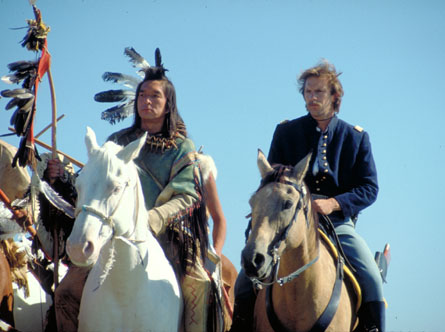
Kevin Costner


It's story is about Lt. John Dunbar(Costner), a Union Civil War Hero who is sent to a position on the Western frontier.  At first, he thinks it's deserted, but he eventually befriends an Indian tribe living nearby, and as he grows to respect them, he soon throws off his "civilized" ways and lives with them.  Eventually, he is forced to choose between his military past and his newfound culture.

Right away, one can sense in every frame that this was a film that Costner felt passionate about making. His desire to portray Native Americans in a much more honest and respectful way than they had been in most Westerns is strongly felt.  That's why his decision to have the Sioux speak their own language with subtitles is so right; for years Native Americans onscreen  have been shown speaking a ridiculous form of pigeon English (full of "Ug"s and "How"s), so by having them speak eloquently in their own language,(and by making Costner's character learn their language) that laughable stereotype is put to rest.  While it does seem awfully convenient  that the Sioux have a caucasian woman (Mary McDonnell) living with them who can serve as interpreter (and eventual love interest) for Costner, it doesn't really damage the film.
This is also a terrific looking film: Costner and cinematographer Dean Semler (who won an Oscar for his work) shoot the gorgeous scenery of South Dakota is a sweeping manner, often portraying how small a man alone can look when he's surrounded by nature.  The film's action scenes are also great looking and exciting, especially the buffalo hunt, (which was shot with nine cameras), which features a stampede of hundreds of buffalo that move like a flood through the plains.

Directing himself, Costner seemed fully aware of what had made him a star: his good looks combined with his soft spoken likability and innate sense of decency (not unlike Gary Cooper's persona) so he plays up to those in his performance.  He never over emotes, allowing the action, the story and the visuals to do all the heavy dramatic lifting.  Along with being thoughtful, kind, and brave, his John Dunbar has an intimate connection with animals (he bonds with a wolf) and is perfectly willing to throw out his prejudices about Native Americans when he finds them to be untrue.  At times his character comes across as a little too good to be true, (especially when he compares himself to Jesus in the first scene!) and, as is often the case with stars who direct themselves, a little too perfect looking, but at least he allows his character to sometimes look foolish or fall on his face, so Costner's ego was at least in check somewhat.  (Seven years later Costner directed himself again in the sci fi film THE POSTMAN, a notorious flop in which his bloated sense of self importance about his on screen character was widely mocked by critics).  He also got good performances from his mostly non professional Native American cast, especially from Graham Greene as Kicking Bird, who radiates with intelligence and plays off Costner nicely onscreen.

Graham Greene & Kevin Costner

Considering how much this film had personal meaning for Costner, it's understandable just how much he hated to see it end, unfortunately that means that at over three hours, there are more than a few slow spots: it takes almost an hour for our hero to have any contact with the Sioux, and there are some scenes    that just don't seem necessary (like an early encounter Costner has with suicidal Union Major Fambrough, [Maury Chaykin]a truly odd scene that I just don't get).  Still, the film's length also allows for some scenes of the Sioux tribe just being themselves, and engaging in what was normal behavior for them, which deepens all of the characters and adds to the film's realism,  so the long running time is sometimes a good thing.
While some historians complained about inaccuracies in the film, especially in the treatment of the Sioux tribe,  who may not have been as peace loving as they are shown here, I don't find that a serious flaw, especially when one considers the ridiculous portrayals (often by white actors in red paint!) that Native Americans have been subjected to over the years.   Another criticism aimed at the film is that it just exploits white guilt about the treatment of Native Americans by white settlers over the years, and that the white soldiers are all sadistic brutes and the Native Americans are all perfect and noble.  Now, while I  do wish that Costner didn't lay it on so thick with the white soldiers, who are all  repulsive and sadistic (his is the only truly likable white man in the film), it should be pointed out that not all of the Native Americans are shown as perfect, as they do wage war with other tribes, and they can be sadistic in battle.  Furthermore, I don't think that showing Native Americans being mistreated and killed by white soldiers and settlers is wrong because it happens to be based on historical truth; from the spread of Small pox to broken treaties, American history is littered with stories of Native Americans being abused by whites, and to deny that is to deny history.  You can call that guilty white liberal bias if you want, but as Stephen Colbert often says, "Reality has a well known liberal bias."
One final point about this film: while Costner made no bones about being influenced by classic Western  directors (this is most overtly seen in the flashback to the kidnapping of the McDonnell character when she was a little girl, which clearly harkens back to a similar scene from John Ford's 1956 film THE SEARCHERS), there is another film that predates this one and has a few similarities, Arthur Penn's excellent 1970 film, LITTLE BIG MAN.  Both films have a hero that narrates the film and spends years living with Native Americans, bonding especially with a wise older tribe member, and witnessing firsthand the horrible treatment of the tribes at the hands of white soldiers. (Even the titles of both films come from the Native American name given the main character). Now, there are also many differences between the two films, with Penn's hero leaving behind the tribe to have other old west adventures, and the tone of the films couldn't be more different, with Costner's deadpan seriousness contrasting with Penn's often comedic tone, not to mention Penn's use of history to make digs at modern issues of that day like free love and the Vietnam war, so the two films are quite different.  Still,  I think LITTLE BIG MAN is worth mentioning because DANCES WITH WOLVES is often pronounced as the first sympathetic portrayal of Native Americans in Hollywood history, when, in fact, Penn's film with many of the same themes predated it by twenty years, and is, overall, a better film in my opinion.  Also, I should mention in all fairness to old Hollywood, Delmer Daves's 1950 film BROKEN ARROW made a definite attempt to show more fairness towards Native Americans, the first of the old Westerns to really do so.  But even in that film the Native Americans were portrayed by white actors, so it would take decades before Hollywood really got it right.

SO DID THE ACADEMY GET IT RIGHT?

While I think it is understandable that the Academy would want to award Costner's risk taking in making DANCES WITH WOLVES, I don't think it was the year's best film; I prefer Martin Scorsase's hyper violent gangster comedy GOODFELLAS, which featured great performances and Scorsase's terrific, kinetic directoral style.  The awards for both best picture and best director to Costner that year probably stung Scorsase, especially because this would mark the second time that he was defeated for the director award by a first time director! (The other time was when Robert Redford triumphed over  him in 1980 for ORDINARY PEOPLE, defeating his work on RAGING BULL).  Thankfully, Scorsase's day would eventually come, although it would take another decade for him to get there.