Thursday, March 19, 2026

ONE BATTLE AFTER ANOTHER (2025)


ONE BATTLE AFTER ANOTHER (DIR: PAUL THOMAS ANDERSON) (SCR: ANDERSON, BASED ON THE NOVEL VINELAND BY THOMAS PYNCHON)

Although SINNERS got more nominations (a whopping 15, the highest in Oscar history), ONE BATTLE AFTER ANOTHER, at an also very high 13 nominations, was seen as the favorite for the Best Picture award  right after the nominations were announced.  Part of this was because OBAA's writer/director Paul Thomas Anderson had never won an Oscar before, despite him being nominated 11 times over the years. (Personally I think his classic Boogie Nights should have won Best Picture back in 1998).  So it made sense that the Academy wanted to give Anderson some well deserved Oscar glory (he also won for Best Director and Best Adapted Screenplay). And thankfully,  Ryan Coogler, the writer/director of Sinners, did not go home empty handed, as he won for Best Original Screenplay.  SINNERS also won for it's soundtrack and cinematography (that cinematography Oscar was won by Autumn Durald Arkapaw, the first woman ever to win, who's inspiring speech was the best moment of the show)

 There was an x factor at work in the victory for OBAA;  Anderson's film depicted an America in which a military force, led by a secretive group of white supremacists, use violence to round up and deport undocumented immigrants in the US, making the film almost painfully topical.  Of course, it had to have been green lit well before the second Donald Trump term came around, but it's timing couldn't be better.  So not only did this film give the Academy a chance to reward a long time nominee who'd never won before, it also gave them a chance to stick a finger in the eye of the Trump administration, something that progressive Hollywood couldn't really pass up.  (And as a fellow progressive, I get the temptation).  

Putting aside all of the Academy's motivations, I really think that OBAA is a great movie; its wildly entertaining, funny, exciting and well acted by the whole cast.  I have deeply enjoyed most of Anderson's work over the years and I was glad to see him finally win.

The genesis of the film began back in the early 2000's when Anderson first considered adapting the  1990 novel Vineland by Thomas Pynchon.  Eventually he settled on making a movie that combined  an action car chase movie with the story of a female political revolutionary.  The film began production in 2023, with big star Leonardo DiCaprio cast in the lead.  Much time was taken in picking the right person for the crucial role of his daughter Willa, with former kickboxing trainer Chase Infiniti winning the part.  The film was shot in California, with Anderson telling cinematographer Michael Bauman that he wanted it to have the same look as 70's action films like The French Connection.  The reported budget of the film was between 130 and 175 million dollars (over 20 million went to DiCaprio).  The box office in the US was only around 72 million, meaning that the film probably lost money even after overseas grosses are added.  Still, Winning Best Picture may eventually help the film eke out a profit.

It tells the story of Pat Calhoun (DiCaprio) a member of a left wing resistance group known as The French 75.  He is in love with fellow revolutionary Perfidia Beverly Hills (Teyana Taylor).  After she avoids capture and sexually humiliates military leader Steven J. Lockjaw (Sean Penn), he becomes obsessed with her and eventually tracks her down and  coerces her into having sex with him.  She becomes pregnant with Willa (Chase Infiniti), and after giving birth she leaves Willa with Pat while she continues her revolutionary activities.  Pat goes into hiding with Willa, but Lockjaw is still looking for them.


Much has been written analyzing the politics of this film: while it's clear that the government crackdown on undocumented immigrants is shown in a negative light,  does Anderson endorse the revolutionary tactics of the French 75?  It's tough to say, with a protagonist who abandons the cause of his chosen group  to protect his daughter seen as the most sympathetic character in the film, while his more militant former lover pushes things too far. I don't think the politics of the film are radical, even as it depicts a country that seems on the brink of civil war, Yes, Anderson paints a bleak, exaggerated view of modern America, as we see  cities under literal siege led by a secretive government cabal of white supremacists (the wonderfully named Christmas Adventurers Club). To me Anderson seems to be endorsing some resistance, but not full on revolution, implying that extremes on both sides are a problem.  This seems to be embodied in the wonderful characterization of the Sergio St Carlos character (Benicio del Toro)  a likable zen like karate sensei who aids the undocumented community without violence.

 Politics aside, this is just a good story well told, with plenty of action and comedy.  Like many other Anderson films, its a long movie with an epic canvas that he fills with characters who feel complicated and real even if they're only onscreen for a brief time.  The chase scene conclusion of the film is wonderfully shot and tense, while there are big laughs when Pat, after years of being out of The French 75, forgets the code words he has to say over the phone to get back in.  

And the performances are uniformly great;  DiCaprio has reached the point of his career where he can play a reluctant action hero and the concerned dad of a teenage daughter and get both right.  It's fun to see his pot smoking, laid back character have to swing into action to save his daughter.  And he and Infiniti have a very strong father daughter bond that's really the heart of the movie.  Meanwhile, Sean Penn won his third Oscar for Best Supporting Actor for playing the relentless Lockjaw, and while we never really like his character, he does bring some humanity to the role.  He makes the contradiction of a man who joins a white supremacist group while lusting after an African American woman work because we feel his deep seated sense of self loathing, making him a complex villain.  And even though I wish she had some more scenes, Taylor as Perfidia is also very good, showing the flip side of Lockjaw, the unrelenting, militant resister.  

SO DID THE ACADEMY GET IT RIGHT?

I think it's pretty clear that I love this movie and that I'm glad that the talented Anderson finally won.  While there many other good movies that came out last year, and I would have been alright with SINNERS winning, to me ONE BATTLE AFTER ANOTHER was the obvious choice.


Thursday, January 22, 2026

FIRST IMPRESSIONS OF THE 2025 NOMINEES


The Oscar nominations for 2025 show an emerging trend in Hollywood: that along with animated films, horror films have become one of  the few kind of  films that audience will actually go to a theater to see.   While other genres of films have struggled to find an audience (mainstream comedies almost always are sequels or remakes now, with original ideas few and far between),  and even superhero movies finally seeming to make less and less.horror has endured.  And since horror films tend to have relatively low budgets and can spawn franchises, they are some of the most profitable films being made these days.   Therefore it makes sense that the Academy wants to be seen as rewarding filmmakers who make successful films, so it is no surprise that Ryan Coogler's very entertaining and very popular,  period piece vampire film Sinners leads the nominations with a whopping 16, the highest ever for one film in  Oscar history.  Meanwhile, another horror film, Guillermo del Toro's recent adaptation of Frankenstein, got 9 nominations.    That said, I was disappointed that Zach Cregger's excellent horror film Weapons, a film that I actually enjoyed more than Sinners, only got one nomination, Best Supporting Actress,  for Amy Madigan's wonderfully creepy performance.  But still, considering that horror films rarely even got nominations in the past, the trend to horror shows the Academy following the tastes of the public.

Other than Sinners breaking a record for nominations, there were no big surprises in the nominees, with PT Anderson's great One Battle After Another coming in after Sinners with 13 nominations, and I think it may have a better chance at winning Best Picture than Sinners, given that its harsh look at immigration crackdowns in America means that rewarding it would be a big middle finger raised at the Trump administration from progressive Hollywood.  (Remember how giving Sean Penn the Best Actor award back in 2008, while well deserved, also  counted as a criticism of the homophobic Bush administration).  

I was also happy to see that many of the nominations were for lower budget foreign and independent films since the best thing that the Oscars can still do in a time of dwindling box office returns is to bring attention to films that many audiences have never heard of.   So I was glad to see that Chloe Zhao's Hamnet, Kleber Mendonça Filho's  The Secret Agent and Joachim Trier's  Sentimental Value all got multiple nominations.

On the other hand, the nominees for Best Picture show why the number of nominees was increased back in 2009 from 5 movies to 10; to add more mainstream films.  So, nestled in between the worthy nominees was the box office hit F1, a film that I despised.  But if calling it one of the 10 best movies of the year is a way to get more people to watch the broadcast, than so be it.  I just hope it doesn't win. 

Monday, March 10, 2025

ANORA (2024)


                            ANORA (WRITTEN AND DIRECTED BY SEAN BAKER)

Controversies, as they seem to every year,  swirled around the announcement of last year's Oscar nominations.    Jacques Audiard's   Emilia Pérez seemed like a leader for a Best Picture award, given that it lead the pack with 13 nominations.  But backlash against the film, coming from people in Mexico understandably lamenting the fact that a French film maker had made their country look like a drug war blasted hell hole, and from some trans people for the way that the title character was portrayed, sank that film's chances,  although it would still win 2 Oscars for Best Supporting Actress and Best Original Song.  (It also didn't help that the film's lead actress, Karla Sofía Gascón, had made several racist and xenophobic posts on Twitter in the past).  A stranger controversy arose when it was discovered that Brady Corbet"s The Brutalist had used artificial intelligence to help out with some scenes, all of which seemed overblown to me.  While it understandable that Hollywood is afraid of AI being used to replace people in the business (AI may be able to crank out a simple script in moments), the use of it in The Brutalist was just to tweak a few minor things.  But it still seemed to work against the film.  With two other contenders mired in these issues, that left the eventual winner, Sean Baker's Anora, to walk away not only with best picture, but also Best Director,  Best Actress (Mikey Madison), Best Supporting Actor (Yura Borisov),  Best Original Screenplay (Baker) and Best Editing (Baker, again).  Baker, who has been directing low budget independent movies for years, walked home with 4 Oscars, a record number of wins for one person from one movie.  Personally, I don't get the appeal of Anora at all.  I've seen the film twice now, before and after its victory, wondering if I had missed something after my first viewing, and if anything I disliked it more the second time.  For me, this is quite simply one of the worst films to win Best Picture ever, and I would have preferred any of the nine other films nominated to have won, plus a few others that weren't even nominated! 

I will admit that Baker came to make the film for interesting reasons: along with directing low budget films, he had spent some time editing videos for Russian weddings, and he also claims that he got the idea for the film when he heard about a Russian wedding in which the bride was kidnapped for collateral!  He also hired Andrea Werhun, a Canadian writer and actress who wrote her memoir, Modern Whore, in 2018, as a consultant.  He cast Mikey Madison for the lead role after seeing in her other films and shot the film for six million dollars in 37 days in various Brooklyn locations.  The studio, sensing that they had a sleeper hit on their hands, spent three times the film's budget on promoting it.  A wise move that made the film profitable even before winning Best Picture.  So far it's made over forty six million dollars worldwide.

It's set in modern day Brooklyn, and it tells the story of Anora (Madison), a young stripper who meets up with wealthy 21 year old Russian club visitor Ivan (Mark Eydelshteyn) after he asks for a dancer who knows Russian.  He eventually invites her over to his mansion, and then hires her for a week, asking her to be his "horny girlfriend".  After a few days of partying, he takes her on an impulsive trip to Las Vegas.  After lamenting that he will soon have to return to Russia to work at his father's company, he thinks that marrying an American will allow him to stay, so he and Anora quickly marry and then return to New York.  Inevitably, his family back home find out about the marriage and send out hired goons Toros  (Karren Karagulian),  Garnik (Vache Tovmasyan) and Igor (Yura Borisov ) to work things out.


Hollywood has always enjoyed making movies about the people (most of whom are women) that work in the sex trade.  Part of the appeal seems to be giving the audience a chance to see how people who live a very different lifestyle than most of the audience get by,  and another appeal seems to be having an  excuse to show lots of female nudity that's excused  as part of the film's plot. (And there's certainly plenty of that in Anora!).  Not that I think that all films about people in the sex industry are bad.  For example, Anora very much reminds me of the far superior 1957 Federico FelliniI classic The Nights of Cabiria, which also tells the story of a sex worker with a chance for happiness in far more moving fashion.  It was turned into a Broadway musical called Sweet Charity  by director Bob Fosse in 1966, who also turned it into a movie musical with Shirley MacLaine three years later.  I prefer that film to Anora too.

No, my problem with Anora doesn't lie in its subject matter, but in its plot, which is simplistic, predictable (I knew how this film was going to end from just seeing the preview!) and stretched to the breaking point in a film that lasts over two hours that should have ended at ninety minutes.  For example, there's a sequence in which Anora and the three hired goons hired by her husband's father all go looking for Ivan in a car that feels like being trapped on a road trip with people who hate each other.  Between endless moments of profane rudeness to each other, there are equally endless scenes of them asking about Ivan that quickly grow repetitive.  Significant cutting would have made these boring scenes play better.  I also found the films closing scenes absurdly drawn out when the main story is over.

And I also had trouble caring about any of the characters: the film's first few minutes, just showing how Anora works at her strip club, enticing clients into the private rooms, chatting during a cigarette break, are all quite good.  But once Ivan shows up, I lost interest.  The scenes where Ivan shows Anora his wealthy, party heavy lifestyle were dull to me; why should I care how a spoiled, entitled brat like him lives?  His main interests seem to only be getting wasted, sex, and video games, and he seems more interested in the games than Anora.  He also laughs loudly at his own dumb jokes, raps terribly and is rude to a hotel manager in Las Vegas.  Quite a guy! He gets even worse as the film goes on: his proposal to Anora is halfhearted at best,  and, worst of all, when confronted by his parent's hired men about his quickie marriage, he just runs away without Anora, leaving her to face them alone. 

This leads to my big problem with Anora's character: she's a complete idiot.  Time and time again in the film she maintains that her marriage to a man she's known for a week is a legitimate romance, even when he shows little interest in her beyond sex.  Even when he abandons her.  And perhaps most foolish of all, she even tries to present herself to Ivan's mother (Darya Ekamasova, who's steely eyed performance is the only one in the movie I liked) as a loving daughter in law, enthusiastic to join the family.  How could she possibly believe that Ivan's mother flew half way across the world just to meet her?  I also found the title character to be abrasive; Madison studied up on her Brooklyn accent, and I think she often hits it too hard.  And I  cringed at the way she calls Igor a "bitch ass f----t" twice and starts a brawl with another stripper.  And yes, this is yet another movie in which a character is portrayed as being passionate by having them constantly say "fuck" (The word is  used by her and others over four hundred times in this movie, to diminishing effect).  All that said, I  will give Madison this; she played the part all out, especially in the scene in which she screams and wrestles with Garnik, Ivan and Toros.  Her enthusiastic biting, clawing and kicking are probably what won her the Oscar, but for me, like much of the film, I thought the scene went on way too long, and I could have done without her screaming.

Interestingly, Madison's win for Best Actress was seen as a bit of an upset over Demi Moore's performance in body horror satire The Substance, and while I did find that film uneven, I would have given it to Moore over Madison.  (The irony of this is that Moore played a celebrity dealing with aging in The Substance, and then she then lost the award  out to a much younger star.). But then, I would have preferred the Oscar go to Nicole Kidman in Babygirl, or to Julianne Moore and  Tilda Swinton for The Room Next Door, or Zendaya in Challengers, and none of them were even nominated, so obviously the Academy and I don't see eye to eye.


SO DID THE ACADEMY GET IT RIGHT?

It's pretty obvious that I just don't care for this film.  While I'm usually glad to see a low budget independent film win, I'm not when I find it to be such an unpleasant viewing experience.  My favorite movie of the year was Mohammad Rasoulof's outstanding Iranian dramatic thriller, The Seed of the Sacred Fig.  I also loved Babygirl and The Room Next Door.  But then, as I previously stated, I would have preferred any of the Best Picture nominees over this lousy movie.  But hey, it obviously has its fans, and if after reading my opinions you still want to give it a try, I won't discourage you.

Thursday, January 23, 2025

FIRST IMPRESSIONS OF THE 2024 NOMINATIONS


 The Academy Award nominations for 2024 were just released this morning, and there really weren't any big surprises.  The Academy's love of musicals (especially really popular ones) continued with "Wicked" getting 10 nominations.  Also with 10 each are "Emilia Pérez" and "The Brutalist", both of which I found overrated. On top of that, "Emilia Perez" has suffered some blowback for its portrayal of both trans people and Mexico, but obviously that didn't stop the Academy.

While I was glad to see that my personal favorite movie of the year, "The Seed of the Sacred Fig", is up for Best International Feature, I was disappointed that "Babygirl", Halina Reijn's excellent look at sex, gender  and power, was shut out.  Interestingly, both the Academy and the Golden Globes seemed more taken by Coralie Fargeat's similar themed "The Substance."  While both films deal with the issue of an aging woman's sexuality, Rejin's film remained rooted in reality, while Fargeat's lapsed into gross out surrealism and heavy handed satire.  While I did enjoy Demi Moore's performance in "The Substance", I still think that "Babygirl" was a better overall film.

I was also glad to see that the Academy was willing to court controversy by nominating  Sebastian Stan for Best Actor and Jeremy Strong for Best Supporting Actor for their roles in the Donald Trump bio pic film "The Apprentice".  (Stan played Trump and Strong played Trump influencer Roy Cohn) I'm sure it won't take long for Trump himself to go after the Academy for honoring such a negative (but, in my opinion, honest) portrayal of him.  Hopefully the nominations will open the film up to more people who can marvel at how such a loathsome man has become president again.  But I digress...

With its themes of post war immigration and class imbalance, and its epic length and ambition, Brady Corbet's"The Brutalist" looks like it has a good chance of winning Best Picture.  While looking at the rest of the nominations, I don't see anything else that plays to the usual Best Picture tropes:  "The Substance" is too weird, "Dune Part 2" too action oriented, "Nickel Boys" too dark and unusual in style. And “Emilia Pérez” and "Conclave" too controversial. Really, the only competition I see for Corbet's film is "Wicked", even though its director, Jon M. Chu, was not nominated.  Because of that snub, I still think the smart money is on "The Brutalist", even though I myself did not care for its second half.  But I've been wrong about these kind of things before...


Tuesday, March 12, 2024

OPPENHIEMER (2023)


                            OPPENHEIMER (DIR: CHRISTOPHER NOLAN) (SCR: ADAPTED  BY NOLAN                                 FROM THE BOOK "AMERICAN PROMETHEUS" BY KAI BIRD AND                                             MARTIN SHERWIN) 


The Best Picture win for OPPENHEIMER  was almost completely predictable: it had already won multiple Golden Globe and National Review awards, and it was nominated for 13 Oscars, more than any other film from 2023.  (It won 7 in all).  It also is the kind of film that the Academy likes to give awards to: it's not just a period piece biopic, it's also about American history and deals with big, meaty issues like the morality of building nuclear weapons.  Add to that the fact that acclaimed director Christopher Nolan had never won an Oscar before, and you have all the makings of an obvious victory.  Personally, I didn't mind that at all; I consider Oppenheimer to be a great film, filled with excellent performances and terrific looking period recreations.  From Hoyte van Hoytema terrific cinematography (in both color and black and white) to Jennifer Lame's editing, (both of them won Oscars) this is one well made and great looking movie.

Like Steven Spielberg before him, for years now Christopher Nolan has been a director that has gotten both big box office receipts and critical respect for many of his movies. (I've been a fan since  is excellent 2000 thriller MOMENTO).  So much so that when he really wants to make a movie, he can get it done on the strength of his name appeal alone.  Nolan had been interested in making a movie about rocket scientist Robert Oppenheimer for years and Kai Bird and Martin Sherwin's acclaimed and well researched  2005 biography about Oppenheimer, "American Prometheus" had been kicked around as a movie for years before Nolan himself read the book in 2015.  He began production on it almost immediately after finishing his 2020 film "TENET.  Interestingly, he worked with the Universal film studio instead of his usual home, Warner Brothers, because he was mad that that studio had released TENET in both theaters and on streaming during the pandemic.  (Nolan has always been a big proponent of movies being seen on big screens in theaters).  

Due to his clout, Nolan was able to make an epic three hour  film that spanned decades of time and required numerous period designs.  He was also able to get big stars like Robert Downey Jr and Emily Blunt to take supporting roles, while he cast his frequent collaborator Cillian Murphy in the title role.  The final budget was around one hundred million dollars, and the film would, despite its length and heavy subject matter, make a hefty profit.  Its national box office was over three hundred million dollars, with foreign grosses bringing it close to a billion dollars worldwide.

The film jumps around in time, from Oppenheimer's youth as a brilliant physics student to his leading a government team of scientists to  make a nuclear bomb before the Germans did during World War II, with another timeline covering his life in the postwar years, when anti Communist fervor saw his government security clearance threatened.


Cillian Murphy and Charles Oppenheimer 


Nolan has said part of what drew him to the film was the recent Russian invasion of Ukraine, which brought serious talk of a possible use of nuclear weapons into the world's conversation for the first time in decades. And this to me is a big part of why I think this is a great film: yes, it's about events that took place a long time ago, but the ramifications of those events are still frighteningly relevant.  And the movie effectively pulls us in different directions emotionally: of course it's totally understandable that Oppenheimer and his scientific team want to beat the Nazis in developing a nuclear weapon.  But when the bomb is used on  Japan, there is both a sense of elation at the war's end and a fear of what a future with nuclear weapons will hold for the human race.  Whether Oppenheimer himself is a hero or villain is left hanging because there's no easy answer.  In perhaps my favorite scene in the film, Oppenheimer meets with President Harry Truman (Gary Oldman), who can't for a second understand the scientist's mixed feelings about the atomic bombing of Japan.  While Truman seems almost buffoonish here, his assertions are not unreasonable.  Again, there's no easy answer about Oppenheimer's discoveries.   

As Oppenheimer, Murphy is just great.  Somehow, he just seems to radiate intellect and drive as he calmly but determinedly works towards his goal.  He also seems stunned and helpless in the postwar part of the film, as the same government that he did so much for turns on him.  And Robert Downey Jr as as Rear Admiral Lewis Strauss, who's feelings about Oppenheimer are complicated,  is also very good.  One of Nolan's blind spots in his films is his lack of interesting female characters, and that problem does arise here.  Oh sure, Emily Blunt as Oppenheimer's wife and Florence Pugh as  his mistress both do what they can, but their roles don't go much beyond what you would expect from those characters.  But that doesn't really hurt the film because this was historically a story about a group of men making big decisions.

Along with jumping around chronologically, Nolan's script also deftly explains the research the characters are engaging in without confusing the audience.   And, of course, the film's inevitable build up to the first atomic bomb test is  thrilling, even though we all know the result.  To me, Nolan has made something really special:  a thought provoking, well made and acted historical epic that's also very entertaining.  


SO DID THE ACADEMY GET IT RIGHT?

It's pretty obvious that I love this movie, and while I wouldn't have minded an upset win for Cord Jefferson's wonderful racial satire AMERICAN FICTION, this was really the right choice in my opinion. (And Jefferson did win a well deserved Oscar for his script).

Tuesday, January 23, 2024

THE 2023 NOMINATIONS: FIRST IMPRESSIONS


 The Oscar nominations for 2023 were announced this morning, and to the surprise of nobody paying attention, Christopher Nolan's Oppenheimer dominated with a whopping 13 nominations in all.  Again, that's hardly a shock, given that Nolan's film is a high profile, important historical biopic about big ideas that was a big box office hit.  Add to that the fact that the highly respected Nolan has never won a Best Director award or had any of his other  films win Best Picture despite multiple nominations in both categories, and it looks like Oppenheimer will win big.  Among the other Best Picture Nominees, I was very happy to see that Cord Jefferson's excellent satire American Fiction is in there, and that Jeffrey Wright is also nominated for Best Actor for his great work on that film.  And, as always, I was happy to see Best Picture nominations for lower budgeted, non star driven films like Celine Song's Past Lives and Justine Triet's Anatomy of a Fall; to me, bringing the attention of the public to less well known films like these is what the Oscars do best.

As for surprises, perhaps the biggest one is that Greta Gerwig's Barbie movie, while nominated for Best Picture and 7 other categories, didn't get a nomination for director Gerwig or star Margot Robbie.  But before you cry sexism for Gerwig being snubbed, it should be pointed out that for the first time ever, 3 of the 10 movies nominated for Best Picture were directed by women (Anatomy of a Fall by Triet, Past Lives by Song and Barbie by Gerwig). Also, Gerwig has been nominated for Best Director in the past, for 2018's Ladybird (which I thought was better than Barbie).  That said I do think that Gerwig should have been nominated for Best Director for Barbie given that the film was such a big production that became a massive hit (the biggest box office for a movie directed by a woman ever), and I would  choose her over director Jonathan Glazer's nomination for the overrated (in my opinion) Zone of Interest.  But there's no doubt that Gerwig's entrance into the A list of directors will mean that she will be nominated in that category again sometime in the future.

Overall, there's nothing in the list of nominees that I think is unworthy or bothersome; I've seen 9 of the 10 Best Picture nominees, and I enjoyed all of them. (I plan to see Maestro, the one I haven't seen yet, sometime soon, and I'm pretty sure that I will like it).  I certainly won't complain if Oppenheimer wins Best Picture although I also wouldn't  mind if American Fiction were to were to make an upset win there.  (Picking between those two pictures is tough for me, because I loved both of them and they're so different).  Meanwhile, Barbie will almost definitely win numerous well deserved technical awards for things like production design and costumes, and Gerwig might win for Best Adapted Screenplay to make up for not getting nominated for Best Director.  So even though she won't get her Best Director award yet, she could still go home happy.

Monday, December 18, 2023

AN INTERESTING MOMENT AT THE AMERICAN BOX OFFICE


Recently, during the weekend of December 8th-10th, the number one film at the American box office was writer/director/animator Hayao Miyazaki's latest (and perhaps last) film The Boy and the Heron.  While this was in itself no surprise, with Miyazaki's films having been quite popular in the US for decades, what is interesting is that the number three spot on the box office list that week was Takashi Yamazaki's Godzilla Minus One, which had debuted at number one two weeks earlier.

This means that for the first time ever, Japan had two out of the three top box office movies for the weekend.  While this may just be a coincidence of releasing, with the two films sandwiched by the usual big budget Hollywood releases, I like to think that it also may show that international films may finally be getting their moment in the US.  (Although I suppose I should point out that both films have been shown with both subtitled and dubbed versions, with the dubbing of course making them feel less foreign).

For decades, foreign films were delegated mostly to arthouse theaters in this country, with studios assuming that American audiences just don't like subtitles and aren't interested in stories from other cultures.  Sadly, there seemed to be some truth in this, with foreign films at the Oscars almost always ghettoized by only winning a "Best Foreign Film" award and only big cities showing them on the big screen.  This happened despite the fact that many of the most influential films ever made are foreign films, such as Akira Kurosawa's The Seven Samurai (remade twice as the Magnificent Seven) and Frederico Fellini's 8 1/2, which has also been remade several times, while also being turned into a Broadway musical.  

But the fact that Japan did not just see animated films as just children's films lead to Japanese adult oriented animated movies and TV shows (like 1988's Akira) building cult followings in the US, aided by the rise of videotape rental stores.  Another big change was the surprising win for Best Picture by the Korean film Parasite in 2019, followed by the enormous success of the Korean TV series Squid Game in 2021 would seem to confirm this trend.  It would seem that the continuing rate of diversification in the country has lead to an opening for films from different cultures.

But then perhaps I'm being overly optimistic, and that the box office success of The Boy and the Heron and Godzilla Minus One is not so surprising considering that both Miyazaki and Godzilla are both far from obscure in the US. (Considering the recent series of Godzilla films made in Hollywood, that character  has pretty much become as much an  American commodity these days as a Japanese one.)   But as someone who grew up in San Francisco and has sought out and often loved foreign language films almost all my life, I hope that in the future Americans will get over their aversion to sub titles.  At the very least, I hope sometime soon that there is a cable channel available in the US that only shows foreign language films. (When you consider how many versions of ESPN there are, you'd think there'd be a chance!).  

Sunday, March 19, 2023

EVERYTHING EVERYWHERE ALL AT ONCE (2022)


EVERYTHING EVERYWHERE AT ONCE (DIR AND SCR: DANIEL KWAN AND DANIEL SCHEINERT)

 Co writers and directors Daniel Kwan and Daniel Scheinert (known as the Daniels) first started wanting to make a movie about the possibilities of a multiverse in 2010.  In the next few years movies like 2018's SPIDER-MAN: INTO THE SPIDER-VERSE came out, beating them to the punch premise wise.   Fortunately, they kept at it, directing their first film together (2016's SWISS ARMY MAN) before finally getting the chance to make EVERYTHING EVERYWHERE ALL AT ONCE in late 2020.  And I'm sure glad they did, because they wound up making a multiverse movie that blows away every other attempt at the concept; it's a near perfect blend of martial arts, family drama, comedy and trippy surrealism.  I can't think of any other film quite like it, and I love almost every minute of it.  Obviously I wasn't alone, because the film won a whopping 7 Oscars, with star Michelle Yeoh becoming the first Asian woman to win a Best Actress award.  

Considering the film's length and  how many special effects shot were there, the fact that the film was shot in only around a month and had a budget of  27 million dollars is impressive.  Its release last March saw it winning almost universal acclaim, and it was also a box office hit, making well over a hundred million dollars worldwide.

 Yeoh stars as Evelyn, a middle aged Chinese mother who runs a laundromat with her good natured husband Waymond (Ke Huy Quan).  At the film's start, she's in trouble: the laundromat is being audited by the intimidating IRS agent Deirdre (Jamie Lee Curtis), her teenage daughter Joy (Stephanie Hsu) is often at odds with her, and she's worried about telling her overbearing father Gong (James Hong) about Joy's lesbianism.  On the way to the IRS office, Waymond suddenly starts acting differently, and he explains to her that he is now actually a different version of Waymond from an alternate universe.  And he needs her help in stopping the multiverse hopping  Tobu Tapaki (who looks like Joy) from causing permanent destruction to the multiverse.

My plot description of this film doesn't even begin to scratch the surface of what's going on here, and how multiple viewings of this film are really necessary to catch everything. (I must admit, I was bit overwhelmed by first viewing of the film, and my reaction was muted, but with each subsequent viewing I've grown more and more fond of it).  The important thing is that, even when the audience is off balance, the Daniels never are; the movie slyly and swiftly moves from action to drama to comedy without ever losing a beat.  I love all the different looks for the different universes (one looks like a classic martial arts film, another is like the dreamy, gorgeous style of  director Wong Kar Wai), and how, despite all the craziness, the story always sticks with Evelyn and her problems, from the mundane (getting her taxes in order) to the action oriented (fighting off a roomful of baddies with a policeman's shield) to the surreal (living in a universe where all humans have hotdogs for fingers, or another  in which she's merely a rock).  Also, the action scenes are wonderfully choreographed and feature some amusing weaponry (Waymond wields a mean fanny pack!). 


At its core, I personally think this is a film about a woman realizing that she's losing her daughter to depression and possible suicide, and that she has to start caring about her more and criticizing her less. (Joy needs more joy). Along with that is her dawning realization that her toughness towards her daughter stems from her own father's harshness towards her (her family were never happy with her marrying Waymond).  So she must push herself to, as her husband puts it, "just be kind" to her daughter while convincing her father to do the same.  The movie wonderfully expresses this in both a special effect moment (Evelyn, Waymond and Gong all pull together to stop Joy as Tobu Tapak,i from jumping into the void) and a straightforward dramatic moment (Evelyn finally admits to Gong that Joy is a lesbian).  Although the movie thankfully never spells this out, it's entirely possible that almost all of it is just playing out in Evelyn's head as she daydreams at the IRS office.  Really, all the multiverses could just be thoughts that Evelyn is having about the choices she's made in her life and how things could have played out differently (making this the only martial arts movie I've ever seen that could be influenced by Ingmar Bergman's 1957 film WILD STRAWBERRIES!).  

Originally, Jackie Chan was intended to play the part of Waymond, but I'm glad that he bowed out; having a well known star like Chan would have made this more of a star vehicle for him, when this story really is Evelyn's.  Along with Yeoh winning, Quan and Curtis also won Oscars for their supporting roles, which is no surprise since their is a real joy to all of these performances, as each actor gets to play wildly different versions of their characters.  I love the way that Waymond's change from mild mannered husband to alternate universe warrior is shown by his taking off his glasses, like Clark Kent turning into Superman, or how Curtis at one point gets to play a crazed psycho smashing down a door, not unlike the killers she's run from in her many horror roles.   But even with all the quick character changes, the performances are also grounded; before the multiverse madness kicks in the family chemistry and dynamics between Evelyn, Waymond and Joy feel real and relatable, giving the audience something to hang on to when all the multiverse hopping starts.  Really, if I have any objection to this film winning three awards for acting, it's that I would have given the Best Supporting Actress award to Hsu instead of Curtis.  Oh sure, Curtis is great in the movie, but I think Hsu is even better, showing a wider range of emotions in her character.  But that's no big deal.

SO DID THE ACADEMY GET IT RIGHT?

This is one time that I completely agree with the Academy's choice, really, I can't think of any other movie this year that even comes close.  It's probably the best film in years.

Sunday, February 12, 2023

IS "80 FOR BRADY" PROPAGANDA?


 The recent release of the comedy film "80 for Brady" marks an interesting breaking of precedent: while there have been many movies about football going back decades, this film marks the first time that one was made that is aimed squarely at the female viewing audience.  As anyone who has seen the preview for the film knows, it stars four venerable female actors (Jane Fonda, Lily Tomlin, Sally Field and Rita Moreno) and is more about the characters whacky antics as they try to get into the Super Bowl LI than football itself.  Much has been made about how the film is loosely based on a real life group of elderly female football fans, and one of the film's producers is Tom Brady himself, who I'm sure is just fine with a movie being made about fans cheering for his greatness as quarterback.  

The film appears to already be a moderate hit, opening at number two at the box office, but I think the NFL had a little more on their mind than box office returns when they went ahead with this film.  Even someone who isn't a fan of football like me can't help but notice that the sport seems to be reaching out to female fans more and more in the past few years.  In 2015, for the first time ever, a woman was hired as an assistant NFL coach, with more on the way.   Women are also being hired as football TV announcers and referees.  Even the fact that the planes that soar over the stadium this year will all be piloted by women for the first time ever has been widely reported on.  Part of this is just due to more women breaking ground in general in the world, which is obviously a good thing.

But I think there's something else going on here: football in America is in an odd position.  While the game is obviously very popular, its future maybe in doubt.  While scandals like steroid use and players getting away with terrible behavior rocked the league in the past without really hurting the game, the discovery in 2004 that  multiple concussions from on the field play could lead  to severe mental problems, (known as Chronic Traumatic Encephalopathy) for the players, hurt the game like no other scandal before it.  The  fallout from that discovery, lead to a congressional investigation in 2009 in which the NFL was openly accused of knowing the potential damage of CTE on its players and covering it up.  Eventually the league paid out a settlement of almost a  billion dollars to retired players suffering from CTE.  And while some attempts have been made to tamp down the brutal nature of the game, pile ons and tackles are such a big part of it that it seems really impossible to make it safe for players.

Recent polls show that the league has something to worry about: a 2018 Gallup poll found that while football remained the country's favorite sport, its numbers were slipping (from 43% saying it was their favorite in 2006 and 2007  to 37% in 2017).  Furthermore,   according to the website FiveThirtyEight,  between 2016 and 2017 there was a decline of 12% in children playing in youth football leagues, and an NBC poll showed an increase in parents trying to discourage their sons from playing football between 2014 and 2018.  And the important number in that poll is that women are more likely to discourage their sons than men are.  

Putting it simply, the NFL's future resides on convincing the mothers of America that football is a safe game for their sons to play.  So the league has been doing damage control by reaching out to female fans (and trying to create more), with  moves like  hiring female referees and coaches, and  green lighting a movie for women about the joys of football fandom like "80 For Brady".  Whether this strategy will work in the long term remains to be seen,  (the NFL certainly has deep pockets to spend on improving its image).  Personally, I'm with author Malcolm Gladwell when he asserts that football is a "moral abomination", but every Super Bowl Sunday, with all the media buildup it gets,  people like me feel like we're, well, whispering in a wind tunnel.

Tuesday, December 6, 2022

WHAT DID I JUST SEE?!


The British Film Institute poll a group of 1,639 cineastes every decade to build a list of the 100 best films of all time.  Ten years ago, it was a big deal when Alfred Hitchcock's Vertigo knocked perennial favorite Citizen Kane off the top spot on the list.  But that's nothing compared to what happened to the top spot on this year's poll.    Oh boy, is there a big change: shooting up from #35 last decade, the number one film now is the Belgium film Jeanne Dielman, 23 Quai du Commerce, 1080 Bruxelles.  This marks the first time that the number one film was one that was  directed by a woman.

As a person who curates a blog like this and who passionately loves to watch films from all eras, I felt a little humbled to realize that I had never even heard of writer director Chantal Akerman's film.  And then I found it available on HBO Max.  I set aside three and a half hours of time and watched it alone with intense interest.  And my reaction?  Well, let me first say that I like to think that I'm open to experimental films, and movies that play with conventional filmmaking styles.  I generally like directors like Jean Luc Goddard and Luis Bunuel. In other words, I expected something unusual and tried to open myself to the experience.

But this movie to me was almost completely unwatchable.  First, let's talk about the style, or really, its almost complete lack of any.  All of the shots in this film are at medium length without camera movement.  The takes are mostly very long with simple editing.  There's no soundtrack, and not much dialogue to speak of, and the sets are just normal, uninteresting looking locations.  Even the color of the film looks drab and lifeless, and there are some technical flaws, like a when a boom mike momentarily dips into a shot.  All of this might be alright if the story and acting were redeemable, but they aren't.  In fact, there hardly is a story.

Oh sure, one does slowly emerge, in dribs and drabs. Delphine Seyrig plays the titular character, a middle aged widow who lives with her son in a small apartment.  She sometimes turns tricks to get by.  Honestly, that description probably sounds a lot more interesting than what's on screen.  Most of this film consists of Jeanne working around her house in real time.  So we have an entire scene of a woman doing the dishes in a single take with her back to the camera.  Realize, there is no other sound on the soundtrack, no dialogue, no music, just the sound of her doing the dishes.  This goes on for five minutes.  In another scene we see her shine a pair of shoes in much the same way.  Again, this goes on for some very long minutes.  And what could be even more boring than that?  Later in the film she does both things again in the exact same way!  We also see her prepare two different meals, also in real time.

Things get even crazier in a later scene in the film in which Jeanne just sits completely still and silent in a chair.  Save for some traffic noises in the background, there is nothing in this scene to let us know that we're actually watching a film instead of staring at a photo.  Director Ackerman really seems to be daring the audience to keep watching, giving them nothing to hang on to.  It's the cinematic equivalent of wallpaper.  It beats Andy Warhol's Empire for movement, but only slightly.  The next scene seems to push Ackerman's dare to the audience even further when Jeanne picks up a neighbor's baby, which cries incessantly for a long period of time, again challenging the audience to remain seated and keep watching.

So what was Ackerman up to here?  Was she trying to make a point about the mundane nature of the average woman's life at that time?  By showcasing the small housekeeping tasks that Jeanne must engage in, is it glorifying her work, or shoving its difficulties in our faces so that we appreciate women like her more?  This has been called a feminist film, and I suppose it is (it even had an all female crew), but points about the hardships of "women's work" can be made without boring the audience. (I suppose the film's defenders would say that the boredom is the point, allowing the audience to experience the same challenges that Jeanne does).  And even if the point of the film is the difficult and repetitive nature of Jeanne's life, how does that explain the scene I mentioned before in which she sits motionless in a chair for a long period of time.  That she's finally resting, and the audience is supposed to rest with her?  I suppose, but that point could be made in far less time.

I should mention that there is some dialogue, and that the relationship between Jeanne and her son Sylvain (Jan Decorte) has some interesting moments, although even that is hurt by the fact that Sylvain talks and acts like a teenage boy but is played by the then 25 year old Decorte.  I haven't even mentioned much about Jeanne's life as a prostitute, but that's because, through out most of the film, it's incidental.  Most of the time we see her greet her client (with just a few words) walk him to her bedroom, and then cut to her later showing him out.  We never know how she feels about her clients, or how she wound up as a a prostitute in the first place.  (Does her son know?).  The film's ending (spoiler) finally shows her engaging in lifeless sex with one of her clients.  Afterwards she silently picks up a pair of scissors and stabs him in the throat.  The shock of the violence is jolting in a film that has been so lifeless up to this moment.  But there's no build up to her action, we see no real anger or rage in what she does.  Why does she stab this client?  Because she's so sick of her life that she wants to take it out on someone?  Or did he do something particularly horrible that we didn't see? Afterwards she sits in a chair, her hand covered in blood, unmoving for what seems like an eternity.  Her face is a blank mask, although she eventually drops her head, but even that gesture seems mild given what she's done.  Is she remorseful?  Excited?  Happy that she has forced a change into her life in the most dramatic way possible? We never really know.

Now that I have spent several paragraphs breaking down this film, I suppose that means that it is worthy of discussion, and I would encourage people to see it for themselves (although I imagine very few people will actually finish it!).  But I must strongly say that I think that the emperor has no clothes and that the BFI's choice of this as the best film ever seems like an absurd joke on the viewing public.  Oh sure, I understand that there is a big difference between critical tastes and popular ones, but I can't see how anyone could find this static film superior to Citizen Kane or Vertigo.  Or nearly every other film on the list for that matter.

Monday, April 4, 2022

CODA (2021)


CODA (DIR: SIAN HEDER) (SCR: HEDER, BASED ON LA FAMILLE BELIER, WRITTEN BY VICTORIA BEDOS, STANILAS CARRE DE MALBERG AND ERIC LARTIGAU)

While the most recent Oscar broadcast will go down in history as "that time when Will Smith slapped Chris Rock", there were a number of other interesting things that happened.  Ariana Debose became the first openly gay woman of color to win an award (Best Supporting Actress for WESTSIDE STORY), Troy Kotsur became the first deaf man to win an award (Best Supporting Actor for CODA), and, perhaps most interestingly for the future not only of the Oscars but for movies in general, CODA became the first Best Picture winner ever to  play on a streaming site (Apple+) before opening in only a few theaters.  Will streaming services soon be the only way to view certain Oscar winning films?  Obviously the theater owners of America aren't too thrilled about that prospect, but with moviegoers heading back into theaters more and more as the pandemic seems to wind down,  it has been  mostly the big blockbusters that have drawn a crowd.  It's clear that a low budget film like CODA is going to  be seen on small screens by most people, as foreign and independent films go the streaming route.  Personally, I think that that is a shame, given that I prefer those kinds of movies and enjoy seeing them on the big screen. Really, the pandemic just seemed to accelerate a growing trend of audiences only going to see big spectacle movies in the theaters and staying home for everything else.

In any event, CODA was a bit a of surprise winner, given that it was nominated for only 3 awards (Best Picture, Supporting Actor and Adapted Screenplay), while Jane Campion's Western THE POWER OF THE DOG was up for a whopping 12.  Add to that the fact that CODA is the rare Best Picture winner to not even get a Best Director nomination, and its victory seemed unlikely. But then Campion's more complicated film is a tougher sell than CODA, which tells a simple, moving story with likable characters.  So maybe a sweet film like CODA winning in a world coming out of a pandemic and looking for something uplifting isn't all that surprising after all.  In any event, CODA is such a good natured film, so openly trying to coax tears from its audience, that I found it hard to resist, even if I also think it was far from perfect. 

It tales the story of teenager Ruby (Emilia Jones) who lives with her father Frank (Kotsur), mother Jackie (Marlee Matlin) and older brother Leo (Daniel Durant).  Ruby is the only member of her family that isn't deaf.  They make a living fishing, with each family member helping out.  When Ruby joins the choir at school, her teacher, Bernardo (Eugenio Derbez) thinks she has potential and personally trains her while encouraging her to try out for a scholarship to a musical academy.  But her parents want her to stay with them and continue to help out with their struggling business.


Emilia Jones


CODA began as a French film (LA FAMILLE BELIER) released in 2014.  While the film was a hit in France, it sparked some controversy because deaf characters were sometimes portrayed by actors who weren't actually deaf.  When Sian Heder was brought it to adapt and direct an American version of the film, she made sure not to make the same mistake.  It didn't hurt that the first person she cast for the film was Marlee Matlin, the deaf actress who herself had won an Oscar back in 1986, and who is probably the  most famous deaf actor in Hollywood.  And for the crucial lead role of Ruby, Heder cast English born actress Jones, who spent months learning both sign language and how to fish.  The film was shot  on location in Gloucester, Massachusetts.  After it was debuted at the Sundance Film Festival in Utah, it was purchased by Apple for a festival record 25 million dollars.

In a way it's not surprising to me that Heder was not nominated for Best Director, given that, apart from some lovely shots of fishing boats, the direction here is far from striking.  Really, one get the impression that she knew that this film was fated to be seen mostly on smaller screens, so visuals are not a high priority here.  Still, the film does have a nice sense of place, with what seems to be a realistic depiction of the highs and lows of living life as a fishing boat worker.  Heder's script (for which she won a Best Adapted Screenplay award) tells the story well, but is often predictable; yes, there's a scene in which Ruby's brother is called a "freak" for being deaf, yes, the family eventually supports her singing dreams, and yes, it even ends with a group family hug.  All quite formulaic.    It also never explains just how the family overcomes their financial difficulties. 

So, to the extent that the film works, it works on the strength of its performances: Jones is very good here, capably carrying the film and playing a teen girl who's likable without being perfect (she does yell "I hate you!" at her parents at one point).  Plus she has a nice chemistry with Ferdia Walsh-Peelo as her boyfriend Miles.  And most of the rest of the cast is also very good, with Kotsur's earthy but soulful  performance as Ruby's dad being a standout (he pretty much won his Best Supporting Actor award for his enthusiastic signing about birth control in one scene.)  The one performance I didn't care for is Derbez as Ruby's music instructor; perhaps because the inspiring teacher character is such a cliche, Derbez's performance and the script seem to play up his more eccentric behavior, making him too over the top for my taste. 

SO DID THE ACADEMY GET IT RIGHT?

I think that it's clear that I admire this film but don't actually love it.  I think Stephen Spielberg's lovely new version of WEST SIDE STORY is a better film.  I also preferred NIGHTMARE ALLEY, LICORICE PIZZA and the underrated TICK, TICK, BOOM...Still, CODA isn't a bad choice.  

Tuesday, February 8, 2022

THE 2021 OSCAR NOMINATIONS: FIRST IMPRESSIONS


 Given that the state of movies playing in theaters seems to be precarious these days (although the latest Spiderman movie is packing them in), the announcement of the Oscar nominations this morning was a less lighthearted affair than it usually is.  Still, even during a pandemic, the Oscar nominations are always big news to film fans like me.  Right away, it was interesting to see the Academy have ten nominations for Best Picture (last year there were only 8).  Perhaps the Academy is trying to drum up interest in theater going by spreading the love?  Hard to say.

In any event, there were some surprises: to me the biggest was the complete shut out of Wes Anderson's terrific THE FRENCH DISPATCH (poor Anderson has been nominated 7 times without winning!).  I was also disappointed that Lynn Manuel Miranda's first rate musical TICK,TICK...BOOM was not given a Best Picture nomination (although Andrew Garfield's performance in the film is up for Best Actor ).  Speaking of Best Picture, I was really surprised to see Adam McKay's DON'T LOOK UP up for that award, considering that the film's critical reception was mostly lukewarm (it got three other nominations too).  Still, it was very popular on Netflix, and it's certainly a timely satire (and the all star cast doesn't hurt either).

With twelve nominations, the most of any film, Jane Campion's western THE POWER OF THE DOG seems to be the front runner for Best Picture.  While I personally didn't love the film, its Oscar success makes for a nice comeback for Campion, who, after her 1993 film THE PIANO was a surprise hit that won 3 Oscars, hasn't had much of an impact in this country since.  Another favorite contender for the top award is Kenneth Branagh's bittersweet, autobiographical film BELFAST, which tells the kind of simple, uplifting story about tolerance that the Academy often embraces.  And then there's Steven Spielberg's new version of WEST SIDE STORY, which may have an outside chance because the Academy often favors musicals.  It also wouldn't hurt to help the well reviewed film out, considering that it's box office has been underwhelming.  Perhaps the Academy will want to help give a boost to the popular Spielberg.  And it would be the first time that a remake of a film that won Best Picture also wins Best Picture, which would be an interesting turn of events.  (And I for one thought that it was a great movie).

This year will see the return of a large crowd for the show at the Dolby Theater in Hollywood, a nice change after last year's subdued, scaled down  show.  Whether or not this return to normalcy will result in better ratings for the show (which have been slumping for years) remains to be seen.  Either way, I'll be watching, partly just to get the sense that the world is finally returning to normal. 

Friday, June 4, 2021

A QUIET PLACE PART II, AND THE PROBLEM WITH ALIEN INVASIONS

Deus ex machina:

Latin,  English: "god out of the machine".  A plot device whereby a seemingly unsolvable problem in a story is suddenly and abruptly resolved by an unexpected and unlikely occurrence.

 (There are spoilers for A Quiet Place II and other movies in this post).


It's hard to know exactly when stories about alien invaders attacking earth began; clearly there are ancient carvings and painting showing humans being attacked from above by some sort of creatures, but whether they count as aliens or just mythical beings muddies the waters a bit.  The first real proper alien invasion story is generally considered to be HG Wells's classic eighteen ninety eight novel, THE WAR OF THE WORLDS.  All of the usual elements are there: ghastly martians in spaceships, laser beams, terrified humans and so on.  The impact of the novel over the years has been huge, with two movie versions (one in nineteen fifty three, the other in two thousand and five) and innumerable rip offs, homages and parodies (not to mention one very famous radio broadcast from a young Orson Welles).

While Well's novel may have been written before the twentieth century, it really wasn't until the nineteen fifties that Hollywood starting turning out alien invasion movies.  Oh sure, Flash Gordon serials that featured the titular hero battling the alien Ming the Merciless started out in nineteen thirty six, but it really took a cold war to get America to start fearing an invasion.  Yes, just as Godzilla was symbolizing the dangers of nuclear radiation in Japan, alien invaders were standing in for the Russians in the US.  Starting with the nineteen fifty one classic Howard Hawks film THE THING FROM ANOTHER WORLD, each year saw Hollywood churning out films that played on our fears of Russian invasion, with titles like EARTH VS. THE FLYING SAUCERS and INVASION OF THE SAUCER-MEN.  Others, like INVASION OF THE BODY SNATCHERS and I MARRIED A CREATURE FROM OUTER SPACE showed a fear of not only Russian infiltration, but also the turning of good Americans into godless commies. And even with the cold war cooling, Hollywood kept making alien invasion movies, from Steven Spielberg's version of THE WAR OF THE WORLDS to the just released A QUIET PLACE PART II.


The titular creatures from 1957's INVASION OF THE SAUCER-MEN


While I have enjoyed a number of these movies over the years, there is a central flaw in almost all of them that bugs me: the part where the aliens lose.  Most of the movies follow the same formula: a nice, peaceful day is shattered when aliens arrive and start blasting (or in some cases, munching) people.  The human casualties are terrible, but, just when things look their blackest, one of the humans (usually a scientist) discovers the alien's Achilles heel.  Their weakness exposed, the aliens are defeated and the surviving humans all cheer.  I get that most of these movies play out this way because ending the movie with the aliens winning would be a big bummer, but that doesn't make it any less ridiculous*.  Time and time again in these movies we are supposed to believe that an alien race that is far more advanced than ours could lose to the humans by not foreseeing an obvious flaw in their plan.  Wells himself fell prey to this absurd notion by ending his novel with the almost triumphant aliens all dying from exposure to human germs.  And since then aliens have been brought down by things like flashing headlights (INVASION OF THE SAUCER-MEN), a computer virus (INDEPENDENCE DAY) and, in one example of a movie embracing its absurdity, a Slim Whitman song (MARS ATTACKS!).  

Now I understand that I'm not getting into the spirit of these movies, and again, I have enjoyed some of them, but it's still a stumbling block for me; I can only suspend my disbelief so far.  Which brings us to John Krasinski's twenty eighteen film THE QUIET PLACE (which he also wrote and starred in).  Which brought together elements from Ridley Scott's ALIEN (gooey monsters), Corman McCarthy's novel THE ROAD (post apocalyptic scrounging) and the English alien invasion movie,  ATTACK THE BLOCK (toothy flesh eating aliens float down to earth),  Krasinski's film added the clever premise of aliens that hunt entirely by sound, making even the simplest dropped item or misplaced foot a source of fear.  THE QUIET PLACE worked effectively for its first two thirds, with Krasinski and Emily Blunt  making a likable couple  that try vainly to keep their family safe in a very dangerous world.  But once again, I think the movie fails when Krasinski's teenage daughter, Regan (Millicent Simmonds) discovers that the normally indestructible  aliens are made vulnerable by high frequency sounds.  It seems more than a bit absurd that all the great scientists and researchers in the world were unable to find out what one kid armed with a walkman and a hearing aid does!  This gets even more ludicrous the  more you think about it: creatures with super good hearing might be weakened by loud sounds?  You don't say.  At one point we see newspaper headlines that write about the creatures, which means that the invasion didn't happen all at once; so there was enough time for people to report on the aliens, but not enough to discover what would seem to be their most obvious weak spot.

Still, despite my cynicism, I did enjoy THE QUIET PLACE overall, and I actually think that the recently released sequel is even better.  To me the film works well because there is no time wasted on exposition or  character introduction, meaning that it can get right down to the suspenseful scenes of people trying to avoid the aliens.  And I think Krasinski has improved as a director, as in one sequence he effectively cross cuts between different characters in dangerous situations (due credit must also be given to editor Michael P. Shawver) to build to a very exciting climax.  And as for the alien's weakness, well, even if it still bothers me, it doesn't kill my enjoyment of the film.  This time I could suspend my disbelief.


*Of course, not all alien invasion movies end this way, as fans of Philip Kaufman's very good nineteen seventy eight remake of INVASION OF THE BODY SNATCHERS can attest to. 

Sunday, May 2, 2021

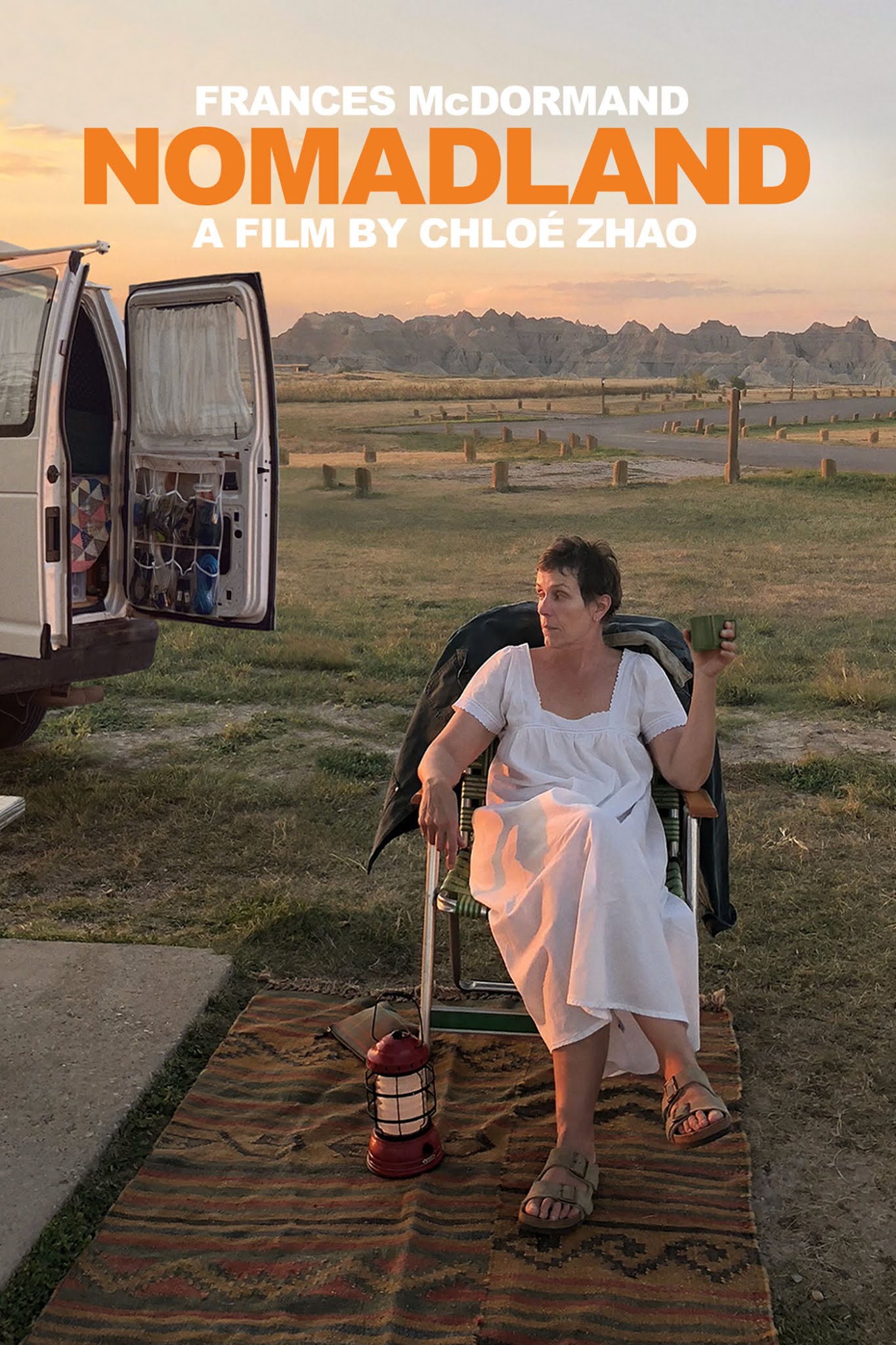
NOMADLAND (2020)


NOMADLAND (DIR: CHLOE ZHOU)  (SCR: ZHOU, BASED ON THE NONFICTION BOOK NOMADLAND: SURVIVING AMERICA IN THE TWENTY FIRST CENTURY)


To me, NOMADLAND was a surprising choice for a Best Picture winner; it's unassuming and soft spoken, its plot is loose, there are no big emotional scenes, it has many moments of stillness, and at times seems downright meditative.  Add to that a main character who is a woman over sixty and you have a film that doesn't seem like the usual Oscar glory material. It's possible that the recent movement to diversify the Oscar voters may have led to more openness to low key independent movies than splashy, big budgeted Hollywood affairs, like Aaron Sorkin's THE TRIAL OF THE CHICAGO 7 (which I thought was going to win). Or maybe the Academy just wanted to embrace a road movie during the pandemic lockdown.  Either way, I  personally don't think that NOMADLAND was the best film of the year, but I do enjoy its lovely images and independent heroine.

 It tells the story of  Fern (Frances McDormand), a sixtyish recent widow who used to work at a now closed factory in Nevada .  At the start of the movie she has decided to sell most of her belongings and live in her van, traveling from place to place to find work.  In her travels she meets other people living the same lifestyle, who teach her some of the ways of life on the road.  After her van breaks down, she doesn't have enough money for repairs, so she goes to visit her sister by bus.  Her sister offers to let her live with her family, but she refuses, borrowing money for her repairs instead.  On the road, she also meets Dave (David Strathairn) a fellow traveler who moves in with his children after becoming a grandfather.  He asks her to stay with him, but she says no and hits the road once again.  

Before it was a movie, it was a non-fiction book called  Nomadland: Surviving America in the Twenty-First Century written by Jessica Bruder and published in twenty seventeen.  The rights to the book were optioned by McDormand herself, and after seeing director Chloe Zhou's twenty seventeen film THE RIDER (another movie about an independent loner), asked her to write and direct it.  For the shooting of the film Zhou and McDormand lived in vans like the characters for four months, and often used real people playing themselves instead of actors.  Shot on a budget of around five million dollars, the film would eventually make six million in worldwide grosses (obviously the pandemic has affected its box office take).


Frances McDormand


To me the most striking thing about NOMADLAND is just how real it feels.  There is no attempt to sugarcoat Fern's life; she is poor and lives out of a small van, she has few possessions, and yes, she has to use a bucket as a toilet.  And yet there is a beauty to her way of life, (like how she proudly shows another traveler how she has found ways to utilize the limited space of her van), and there's a dignity in her willingness to do the  hard work that she needs to do to survive.  I love the way that Zhou's camera moves smoothly through the gorgeous natural landscapes that Fern travels through, and the quiet way it shows Fern appreciating those landscapes while lying naked in a river or hugging a huge tree.  The fact that Fern is alone in these scenes is telling; Zhou's script gives Fern no big speech about her desire to be independent because we can see it in the still moments like these.  Here is a woman who misses her husband but now treasures her independence and time alone.   But even more striking than the natural landscapes are the scenes towards the end of the film when Fern visits the now shuttered factory that she and her late husband used to work in.  There's a striking beauty in the ruins of a once busy, now desolate building. 

While Fern does make some friendships and connections, they are always at a distance.  When Dave tentatively makes romantic gestures towards her, she gently turns him down. McDormand and Strathairn have a real nice chemistry; I really like the way he calmly tells her that he likes her, and the quiet way that she rebuffs him. I also enjoy the way that Dave's attempt to be helpful finds him accidentally breaking some of Fern's plates, one of the few moments of humor in the film.   It's rare and refreshing to see people over sixty portrayed romantically (although they never even hold hands), but   it's also no surprise to the audience that Fern doesn't move in with Dave; her independence has already been established earlier in the film when we see her turn down the chance to adopt a sweet dog (as a dog owner myself, it does bother me that she just leaves the poor pooch leashed to a bench!).  The idea of a person who travels alone across the country, never wanting to settle down, is not new in movies, but such wanderers are usually male characters, and ending the film with a woman refusing to live with a man and taking to the road instead is a nice inversion of the usual cliche'.

McDormand, who is in every scene of the film, won her third Best Actress Oscar for this role, and again I find that a bit surprising given that the character is usually still and almost never raises her voice.  But, to me,  that's the beauty of her performance; when Fern talks about the loss of her husband, she isn't asking for pity, she's just laying out the truth of her life.  When she works at tough jobs across the country, she never complains, even though her face shows the strain of her work.  As I said, McDormand lived in a van for this role (and she also actually worked at some of the jobs shown on screen), and that gives her performance a sense of rightness, a feeling that this isn't just some Hollywood actress slumming.  Her van feels lived in.

If the film has a flaw, it's that to me it does sometimes drags.  Although I've already stated that I admire Zhou's decision to not have big emotions in the film, I do wish that there was more focus to the story.  No, I don't want chase scenes or explosions, but maybe a little more about how Fern and her fellow travelers get by would have been nice.  But my criticisms are mostly mild for what is a very successful film.

SO DID THE ACADEMY GET IT RIGHT?


While I think it's clear that I really enjoyed this film, I don't think that it was the best film of the year: I preferred Shaka King's JUDAS AND THE BLACK MESSIAH, Lee Isaac Chung's MINARI and, my personal favorite, Emerald Fennell's openly provocative PROMISING YOUNG WOMAN.  Still, NOMADLAND is certainly not a bad choice, and it's great to see Zhao breaking ground as the second woman (and first Asian one) to win Best Director.  

Monday, April 26, 2021

THE PANDEMIC OSCAR SHOW


 So, how was the first (and hopefully last) pandemic Oscar ceremony like?  Not bad, in my opinion.  Placing the show at Union Station in downtown Los Angeles and having the attending nominees sit at tables while a DJ (Quest Love, the drummer from the hip hop group The Roots) spun appropriate tracks gave the show a loose, party vibe that was fun.  And not having an official host took the pressure off one person to be constantly entertaining, which worked for me.  I enjoyed the long tracking shot that accompanied the first presenter, Regina King, as she made her way into the station.  And her joke about the recent Chauvin trial's outcome was well made without getting too preachy.

Most of the awards did not come as a surprise: Nomadland was favored to win Best Picture which it did, and its director  (Chloé Zhao)  and lead actress (Francis McDormand) were also favored and also won.  The big surprise was when Anthony Hopkins won Best Actor for The Father over the late Chadwick Boseman for Ma Rainey's Black Bottom.  Personally, I preferred Boseman's performance, but in The Father, Hopkins, one of the most esteemed actors in the world, showed a willingness to play a character who is sad and pathetic, breaking down in a raw and honest way at the end of the film.  (And maybe the fact that many of the Oscar voters are older themselves had something to do with it).  In any event, I am a big fan of Hopkins so I won't say his award was completely underserved.  (At the same time I still think that Delroy Lindo was robbed by not even being nominated in this category for his great performance in Da Five Bloods).

The lack of musical numbers (the songs nominated for Best Original Song were all performed in pre broadcast special) meant that the show could indulge longer speeches from the winners, which is really a lot of what people want to see the most anyway.  And there were a lot of nice moments:  Zhao becoming the first Asian woman (and only the second overall) to win Best Director (for Nomadland) and her thoughtful acceptance speech was great.  As was Yuh-Jung Youn, who won for Best Supporting Actress for Minari, and who joked her way through her speech in a charming manner.  And Tyler Perry, getting a lifetime award, gave a moving and sincere speech; even though his movies are not my cup of tea, his graciousness was appreciated.  

Oh sure, there were a few silly moments in the broadcast as well: an Oscar music trivia contest felt too much like a bar trivia night, and some speeches did go on a bit too long.  To me the worst decision was to announce the Best Picture winner before Best Actor and Actress.  Since the Best Picture award is the one that is remembered the most, and can add enormously to a film's box office success, building up to it seems to be the logical way to do the show.    In any event, ending the show with the Best Actor award really didn't work because when Hopkins won  he didn't appear and no speech was given, causing the show to peter out somewhat pathetically. Still, considering everything going on in the world, this broadcast was a fun break from the stresses of our time.  Obviously I didn't agree with some of the winners (more on that when I post about Nomadland), but that's all part of the show.